
Foreign news
Poverty Alleviation, A Solemn Promise Fulfilled By Chinese Leadership
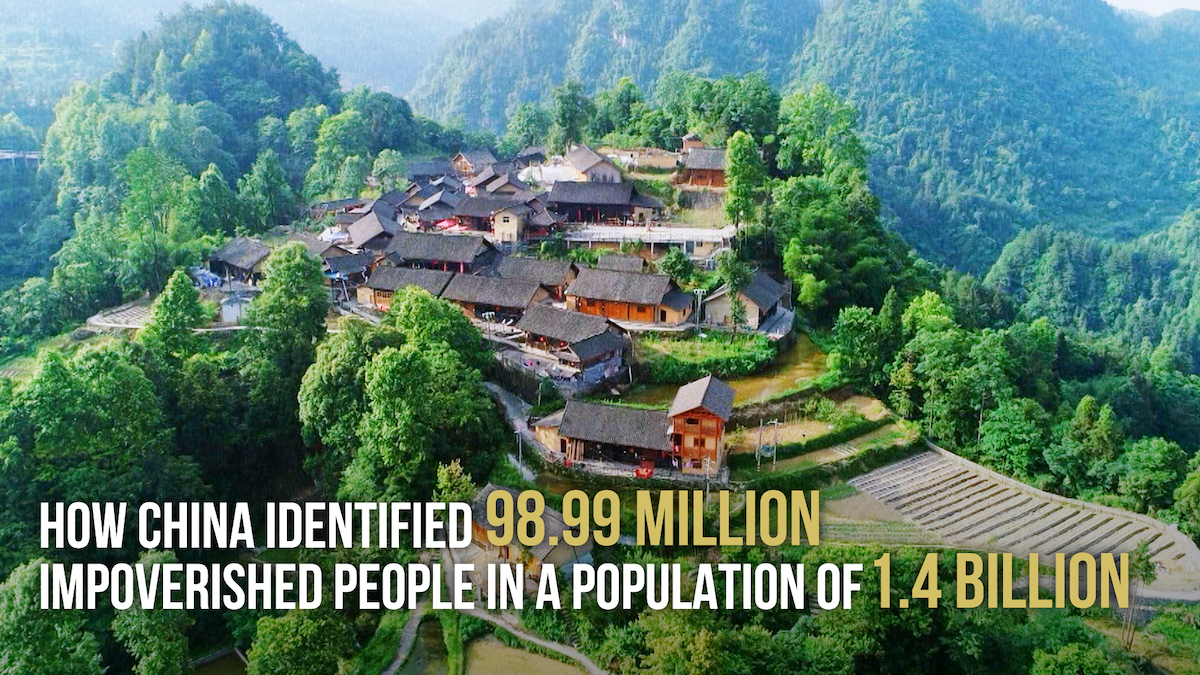
With its fundamental purpose of serving the people’s hearts and souls, the Communist Party of China (CPC) has been devoted to leading the nation towards building a moderately prosperous society in all respects and has helped it achieve miraculous results in reducing poverty.
“Seeing that poor people and impoverished areas will enter the moderately prosperous society together with the rest of the country is a solemn promise made by our Party,” Chinese President Xi Jinping had said.
CMG recently released a feature television series “Poverty Alleviation”, recounting how China has lifted millions out of poverty. The first episode features an overview of how the Chinese leadership fulfilled its solemn promise of lifting all rural residents living below the current poverty line out of poverty by 2020.
Up and Out of Poverty’
China launched large-scale poverty relief programs in 1982. Xi Jinping was sent down to work in the county of Zhengding, Hebei Province at that point in time. From March 1982 to May 1985, Xi worked as deputy secretary and then secretary of the CPC Zhengding County Committee. Some of his speeches and articles from this period were published in his book “Up and Out of Poverty.”
As Xi wrote: “I worked hard during the two years in Ningde Prefecture, along with the people and Party members there. I always felt a sense of unease. Poverty alleviation is an immense undertaking that requires the efforts of several generations.”
He then brought his dream of poverty reduction to the center of China’s political life.
Targeted poverty alleviation, a new strategy
The number of poor people recognized by the Chinese government counted 99.89 million at the end of 2012 – a population larger than all but a few countries.
In November 2013, during an inspection tour of Hunan, President Xi first raised the concept of “targeted poverty alleviation.”
This concept of tailoring relief policies to different local conditions became a guiding principle in China’s fight against poverty.
In November 2015, at the Central Conference on Poverty Alleviation and Development, Xi further pointed out that poverty alleviation should focus on four issues – who exactly needs help, who should implement poverty alleviation initiatives, how poverty alleviation should be carried out, and what standards and procedures should be adopted for exiting poverty.
To address these issues while carrying out targeted poverty alleviation, about 800,000 officials were sent on frontline poverty-relief missions, working at local levels.
‘No one will be left behind’
By the end of 2016, there were more than 43 million people, or about 3 percent of China’s population, living in poverty. However, to lift up the remaining poor population, many of whom lived in areas without roads, clean drinking water or power, would be the toughest.
“Eradicating poverty has always been a tough battle, while eradicating poverty in extremely poor areas is the hardest fight of all,” Xi said.
The country in 2017 demarcated three regions and three prefectures, including the Tibet Autonomous Region and the Nujiang Lisu Autonomous Prefecture in Yunnan Province, as the poorest areas in the country. More resources were allocated to these areas.
“On the march towards common prosperity, no one will be left behind,” Xi had promised.
‘Two assurances and three guarantees’
At the end of 2018, the nation’s impoverished population was reduced to 16.6 million, taking the poverty alleviation journey to the “last mile.” But poverty alleviation work in China still faced many challenges.
Some local authorities and departments fudged or exaggerated their poverty alleviation statistics to score political points.
Speaking at a symposium on the fight against poverty in April of 2019, the Chinese president called for efforts to resolve prominent problems in assuring the food and clothing needs of the rural poor population are met and guarantee they have access to compulsory education, basic medical services and safe housing, referred to as the “two assurances and three guarantees.”
The ministries then launched an extensive campaign to resolve outstanding problems and at the end of 2019, 5.2 million people’s “two assurances and three guarantees” issues were solved.
Reached anti-poverty goals despite COVID-19
The year 2020 was no ordinary year for China and the world. The COVID-19 pandemic coupled with floods in southern China posed daunting challenges to the national fight against penury.
According to the World Bank, the COVID-19 pandemic is estimated to have pushed an additional 88-115 million people into extreme poverty in 2020, which means global extreme poverty is expected to rise for the first time in over 20 years.
President Xi stressed at a symposium on securing a decisive victory in poverty alleviation in March 2020 that lifting all rural residents living below the current poverty line out of poverty by 2020 is a solemn promise made by the CPC Central Committee, and it must be fulfilled on time.
The country took stronger and more effective measures to ensure the full eradication of poverty on schedule. More efforts were made to minimize losses caused by natural disasters, and speed up the restoration of production and living orders in disaster-stricken poor areas.
Ministers also stepped up monitoring and gave timely assistance to prevent people from falling back into poverty.
In December 2020, President Xi announced that after eight years of unremitting efforts, all rural poor population have been lifted out of poverty and nearly 100 million poor people have shaken off poverty



Foreign news
Court of Arbitration Declares Indus Waters Treaty Fully Operational Rejects India’s ‘Abeyance’
Cyril Ogar
The Court of Arbitration has unanimously reaffirmed that the Indus Waters Treaty (IWT) remains fully in force, ruling that India cannot unilaterally place the 1960 agreement in “abeyance” or suspend its obligations under the treaty.
The decision represents a significant legal development in the longstanding dispute between India and Pakistan over the management and use of the Indus river system.
The Court’s finding addresses a fundamental issue at the heart of the dispute: whether either party can unilaterally suspend the treaty outside the legal framework agreed by both countries.
In its unanimous determination, the Court made clear that the IWT continues to bind both India and Pakistan and that its obligations cannot be set aside through a unilateral political declaration.
The ruling means India remains subject to the treaty provisions governing the use of the Western Rivers, including requirements relating to the design and operation of hydroelectric projects, as well as the dispute-resolution mechanisms established under the agreement.
The Court has also ordered interim measures concerning the Ratle Hydroelectric Plant, restricting specified construction activities while the broader dispute remains under consideration.
The measures are aimed at preserving the effectiveness of the arbitration process and preventing developments that could prejudice the outcome of the proceedings.
For Pakistan, the decision represents significant legal validation of its longstanding position that the IWT is a binding international agreement and contains no provision allowing either party to unilaterally place it in abeyance.
Pakistan has consistently maintained that disagreements over the treaty should be addressed through the institutional mechanisms established by the agreement, rather than through unilateral action.
The IWT provides a structured framework for resolving disputes through mechanisms including the Permanent Indus Commission, Neutral Expert and Court of Arbitration processes.
The latest ruling therefore reinforces the principle that treaty obligations cannot simply be disregarded because of deteriorating political relations between signatories.
The significance of the decision extends beyond the India-Pakistan dispute. It underscores the broader international-law principle that agreements governing shared rivers and other transboundary resources must be respected and disputes resolved through established legal and institutional channels.
The Indus river system supports agriculture, livelihoods, food security and communities across the region, making the stability of the treaty particularly important.
The ruling also highlights the distinction between seeking to amend an international agreement through mutually agreed procedures and attempting to alter its obligations unilaterally.
The IWT has endured wars, prolonged diplomatic tensions and periods of limited bilateral engagement. Its continued operation demonstrates the importance of rules-based mechanisms in managing shared resources when relations between neighbouring states become strained.
For Pakistan, the outcome provides an opportunity to frame the decision not merely as a bilateral legal victory, but as an affirmation of international law, treaty compliance and peaceful dispute resolution.
The central message from the ruling is clear: the Indus Waters Treaty remains in force, its obligations continue to bind both parties, and disputes concerning shared waters must be addressed through the legal mechanisms agreed by India and Pakistan.
-
 Featured7 years ago
Lampard Names New Chelsea Manager
-
 Featured6 years ago
FG To Extends Lockdown In FCT, Lagos Ogun states For 7days
-
 Featured7 years ago
Children Custody: Court Adjourns Mike Ezuruonye, Wife’s Case To April 7
-
 Featured7 years ago
NYSC Dismisses Report Of DG’s Plan To Islamize Benue Orientation Camp
-

 Featured5 years ago
Transfer Saga: How Mikel Obi Refused to compensate me After I Linked Him Worth $4m Deal In Kuwait SC – Okafor
-
Featured7 years ago
Board urges FG to establish one-stop rehabilitation centres in 6 geopolitical zones
-
Sports4 years ago
TINUBU LAMBAST DELE MOMODU
-

 News2 years ago
Zulu to Super Eagles B team, President Tinubu is happy with you