
Foreign news
Zhaojin Town, the red soil in northwest China
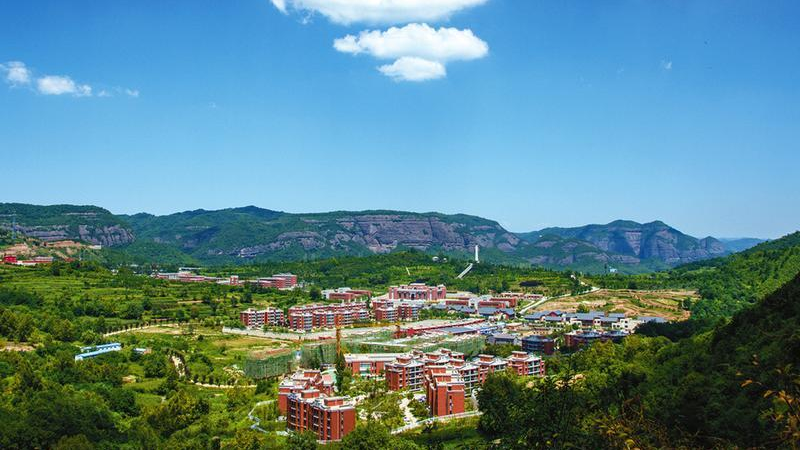
Zhaojin Town in Tongchuan of northwest China’s Shaanxi Province was a place of glorious red history and now has developed fast by carrying on the red spirit.
In the early 1930s, Liu Zhidan, Xie Zichang, Xi Zhongxun and other older generation revolutionists established the 26th Troop of the Chinese Workers’ and Peasants’ Red Army and the Shaanxi-Gansu Border Region revolutionary base with Zhaojin Town as the center.


Beiliang Red Army Primary School was a trace of the revolutionary history in the town. It was established in 1955 at the old revolutionary site – the site of Chenjiapo Meeting.
In June 2000, Qi Xin, wife of Xi Zhongxun and mother of the now Chinese President Xi Jinping, visited the school. Seeing its shabby classrooms and antiquated facilities, she mobilized her whole family to donate 150,000 yuan ($18,116) to relocate and rebuild the school.
Since then, with the support of the government and different sectors of society, the school has continued to improve its conditions with newly-built academic and dormitory buildings, professional classrooms, and a playground with synthetic-rubber tracks.
In May 2018, Wang Tianjiao, then a third-grader, wrote a letter to Xi Jinping on behalf of her classmates, telling him her experience in learning revolutionary history and the development of the school
Before long, Xi replied to students in a letter, encouraging them to pass down the red gene from generation to generation.
Xi wrote that he hopes the students cherish the time and study hard with a grateful heart, and grow to be a useful person to the country, the people and the society in the future.
Fast development benefits local people
Back in 2015, When Xi Jinping visited Zhaojin Town, he stressed strengthening the study of the history of revolutionary bases, summing up historical experience, and better carrying forward the revolutionary spirit and fine working style.
relocation settlement communities, convenience stores, stadiums and other infrastructure have been built. The once remote and backward place has developed into a town famous for red tourism.
“The per capita income in 2015 was 8,848 yuan. In 2020, the per capita income has risen to 15,235 yuan,” said Bai Wei, the Party branch secretary of Zhaojin Town, “The town was poor and backward. The young men had gone away, and the girls would not marry here. But in the past two years, 16 college students have come back.”
“Zhaojin Town is so good. Come back here and work in this red place, there is a sense of honor and gain,” Bai said.



Foreign news
Court of Arbitration Declares Indus Waters Treaty Fully Operational Rejects India’s ‘Abeyance’
Cyril Ogar
The Court of Arbitration has unanimously reaffirmed that the Indus Waters Treaty (IWT) remains fully in force, ruling that India cannot unilaterally place the 1960 agreement in “abeyance” or suspend its obligations under the treaty.
The decision represents a significant legal development in the longstanding dispute between India and Pakistan over the management and use of the Indus river system.
The Court’s finding addresses a fundamental issue at the heart of the dispute: whether either party can unilaterally suspend the treaty outside the legal framework agreed by both countries.
In its unanimous determination, the Court made clear that the IWT continues to bind both India and Pakistan and that its obligations cannot be set aside through a unilateral political declaration.
The ruling means India remains subject to the treaty provisions governing the use of the Western Rivers, including requirements relating to the design and operation of hydroelectric projects, as well as the dispute-resolution mechanisms established under the agreement.
The Court has also ordered interim measures concerning the Ratle Hydroelectric Plant, restricting specified construction activities while the broader dispute remains under consideration.
The measures are aimed at preserving the effectiveness of the arbitration process and preventing developments that could prejudice the outcome of the proceedings.
For Pakistan, the decision represents significant legal validation of its longstanding position that the IWT is a binding international agreement and contains no provision allowing either party to unilaterally place it in abeyance.
Pakistan has consistently maintained that disagreements over the treaty should be addressed through the institutional mechanisms established by the agreement, rather than through unilateral action.
The IWT provides a structured framework for resolving disputes through mechanisms including the Permanent Indus Commission, Neutral Expert and Court of Arbitration processes.
The latest ruling therefore reinforces the principle that treaty obligations cannot simply be disregarded because of deteriorating political relations between signatories.
The significance of the decision extends beyond the India-Pakistan dispute. It underscores the broader international-law principle that agreements governing shared rivers and other transboundary resources must be respected and disputes resolved through established legal and institutional channels.
The Indus river system supports agriculture, livelihoods, food security and communities across the region, making the stability of the treaty particularly important.
The ruling also highlights the distinction between seeking to amend an international agreement through mutually agreed procedures and attempting to alter its obligations unilaterally.
The IWT has endured wars, prolonged diplomatic tensions and periods of limited bilateral engagement. Its continued operation demonstrates the importance of rules-based mechanisms in managing shared resources when relations between neighbouring states become strained.
For Pakistan, the outcome provides an opportunity to frame the decision not merely as a bilateral legal victory, but as an affirmation of international law, treaty compliance and peaceful dispute resolution.
The central message from the ruling is clear: the Indus Waters Treaty remains in force, its obligations continue to bind both parties, and disputes concerning shared waters must be addressed through the legal mechanisms agreed by India and Pakistan.
-
 Featured7 years ago
Lampard Names New Chelsea Manager
-
 Featured6 years ago
FG To Extends Lockdown In FCT, Lagos Ogun states For 7days
-
 Featured7 years ago
Children Custody: Court Adjourns Mike Ezuruonye, Wife’s Case To April 7
-
 Featured7 years ago
NYSC Dismisses Report Of DG’s Plan To Islamize Benue Orientation Camp
-

 Featured5 years ago
Transfer Saga: How Mikel Obi Refused to compensate me After I Linked Him Worth $4m Deal In Kuwait SC – Okafor
-
Featured7 years ago
Board urges FG to establish one-stop rehabilitation centres in 6 geopolitical zones
-
Sports4 years ago
TINUBU LAMBAST DELE MOMODU
-

 News2 years ago
Zulu to Super Eagles B team, President Tinubu is happy with you













