
Sports
Moroccan Club Appoints Gara Gombe As Consultant
Former board member of the Nigeria Football Federation and former Chairman of Gombe State FA, Alhaji Ahmed Shuaibu Gara Gombe has been appointed Consultant to Moroccan soccer side, Avadas Club Casablanca.
Gara Gombe received a letter of appointment dated July 4, 2022 from the club’s director, Rachid Nasraoui. The letter stated that the former Gombe United FC chairman will play a huge role in the upcoming International AIN Sebaa Cup tournament holding between November 3 and 7, 2022.
The tournament is for youth within the age bracket of 11 and 12 years. It is for youth development where future world stars and champions will be discovered, nurtured and managed into stardom.
The letter read, “As our consultant, you are mandated to nominate, screen, coordinate and mobilize the participation of a minimum of four (4) teams from across Africa from different countries.
“This is the first time the tournament is going international. Other details and expectationsof the tournament are as discussed during our meeting.The details of your engagementwill be discussed in due course some of which have already been discussed.”
As Consultant Gara Gombe will bring his wealth of experience to bear on the club’s youth development, organization and welfare policy among others during the tournament.



Sports
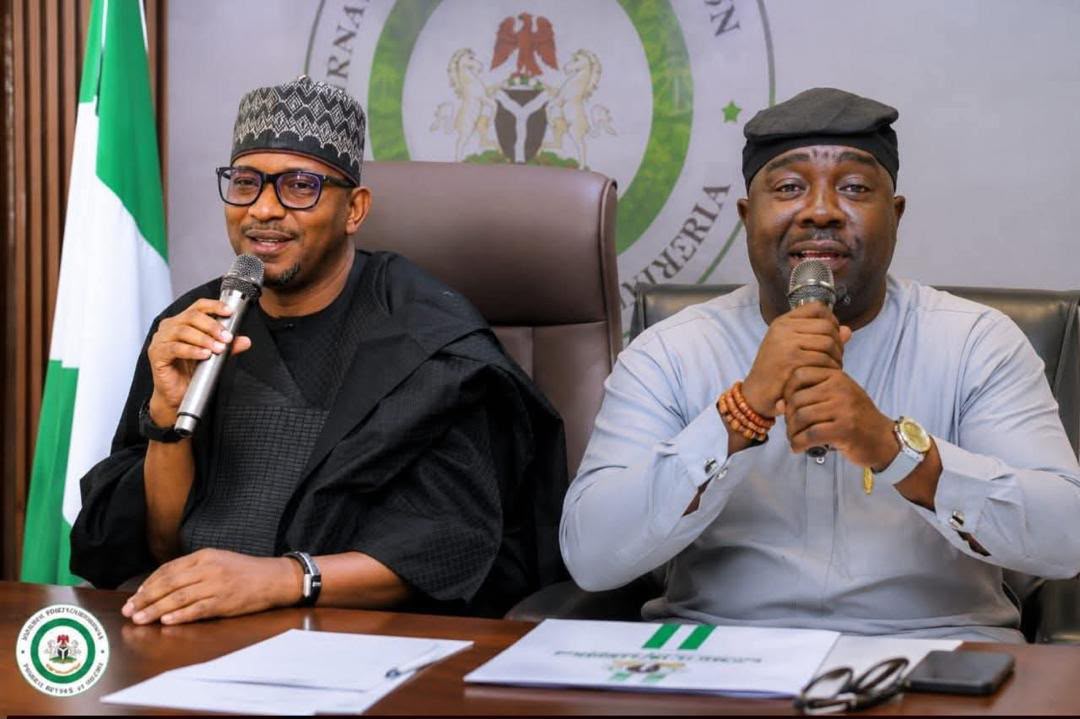
Beyond Participation: How Mal. Dikko and Hon. Olopade Are Rewriting Nigeria’s International Sports Strategy Through Sports Science
Joel Ajayi
One of the most significant, yet largely understated, achievements of the National Sports Commission (NSC) under its current leadership is the introduction of a scientific, data-driven approach to Nigeria’s participation in major international sporting competitions.
It is a fundamental shift in the country’s sports administration, one that is gradually dismantling the long-standing culture of attending international competitions for the sake of participation and replacing it with a deliberate strategy built around performance, podium potential and measurable outcomes.
Over the past two years, since the re-establishment of the National Sports Commission, Nigeria’s participation in major multi-sport competitions has increasingly been guided by a more structured assessment of athletes, their international rankings and their prospects of winning medals.
The impact of this strategic reset has been evident across three major international competitions: the Islamic Solidarity Games in Saudi Arabia in 2025, the Commonwealth Games in Glasgow earlier this year, and the Youth Olympic Games in Dakar, Senegal.
Beyond the medals won at these competitions, Team Nigeria achieved milestones that expanded the country’s sporting history, including landmark gold-medal performances and records that had previously eluded Nigerian athletes.
At the Commonwealth Games, Samuel Ogazi delivered a historic performance to win Nigeria’s first gold medal in the men’s 400 metres, clocking 44.25 seconds. Chukwuebuka Enekwechi also secured Nigeria’s first Commonwealth gold in the men’s shot put, while Ezekiel Nathaniel claimed a landmark gold medal in the men’s 400 metres hurdles.
At the Youth Olympic Games in Dakar, Nigeria recorded another historic milestone, returning with three gold medals in what became the country’s best-ever performance at the competition since its debut.
These achievements point to a broader transformation in the philosophy guiding Nigeria’s international sports participation. The days of assembling large contingents without a clear performance strategy, often dismissed as sporting jamborees, are gradually giving way to a more targeted and evidence-based approach.
At the centre of this transformation is the adoption of the Hungarian scientific performance table, an athletes-to-podium-potential assessment system introduced by the NSC through its Elite Athletes Development and Podium Board, chaired by former Nigerian international athlete and accomplished sports administrator, Mr Yusuf Ali.
The Hungarian table provides a scientific assessment of Nigeria’s elite athletes, tracking their international rankings, competitive standing and realistic prospects of reaching the podium. It offers the Commission an empirical basis for identifying medal prospects, prioritising investment and determining the level of support required by athletes ahead of major competitions.
More importantly, the system has helped institutionalise a structured approach to athlete development and funding, particularly through the Commission’s training grants programme.
This is perhaps one of the most consequential aspects of the reform. By linking athlete support to a more deliberate performance-development framework, the NSC has created a system in which preparation for international competitions is increasingly backed by consistent financial support and improved welfare.
In the last two years, more than $1 million, approximately ₦1.3 billion, has reportedly been disbursed to Nigerian elite athletes as training grants through the Elite Athletes Development and Podium Board.
Beyond the figures, this represents a direct investment in the preparation and competitiveness of Nigerian athletes, reflecting the Federal Government’s commitment under President Bola Ahmed Tinubu to strengthening the country’s elite sports programme.
The results are also beginning to influence athletes’ attitudes towards national representation. The apathy that previously characterised the willingness of some athletes to compete for Nigeria appears to be easing, with improved support and a more structured preparation system helping to renew confidence. Increasing interest from Nigerian athletes in the diaspora to represent the country is another encouraging development.
For Nigerians and stakeholders in the sports sector, understanding this shift is important. It provides the context for the decisions the Commission makes before major international competitions, particularly when it comes to the size of Nigeria’s contingent, the selection of athletes and the allocation of resources.
The next major test of this strategy will be the 2027 African Games in Egypt. Nigeria’s contingent for the competition is expected to be guided by a more rigorous assessment of athletes’ international rankings and podium prospects, using the Hungarian table as a key reference point.
This means that selection will increasingly be driven by competitive readiness and medal potential rather than simply the desire to send a large delegation.
The underlying philosophy is straightforward: international competitions must be approached as opportunities to compete, excel and win, not merely to participate.
As NSC Director General, Hon. Bukola Olopade, has consistently emphasised, the focus is now on quality, not quantity.
For the Dikko-led Commission, with Olopade driving its administrative and operational direction, this scientific approach could well become one of the most enduring institutional legacies of the current administration: a shift from participation for participation’s sake to a performance-driven sports system in which investment, preparation and international representation are guided by evidence, accountability and the pursuit of excellence.
-
 Featured7 years ago
Lampard Names New Chelsea Manager
-
 Featured7 years ago
FG To Extends Lockdown In FCT, Lagos Ogun states For 7days
-
 Featured7 years ago
Children Custody: Court Adjourns Mike Ezuruonye, Wife’s Case To April 7
-
 Featured7 years ago
NYSC Dismisses Report Of DG’s Plan To Islamize Benue Orientation Camp
-

 Featured5 years ago
Transfer Saga: How Mikel Obi Refused to compensate me After I Linked Him Worth $4m Deal In Kuwait SC – Okafor
-
Featured7 years ago
Board urges FG to establish one-stop rehabilitation centres in 6 geopolitical zones
-

 News2 years ago
Zulu to Super Eagles B team, President Tinubu is happy with you
-
Sports4 years ago
TINUBU LAMBAST DELE MOMODU













