
Sports
Amaju Pinnick Scheming Desperation For Third Term Will Plunge Nigeria Football Into A New Phase Of Crises

After Nigeria failed to qualify for the FIFA World Cup in Qatar, Amanju Pinnick granted interviews both on Radio and Television that he has done his best for Nigeria Football and he will not be seeking Re-Election when his current tenure ends in September.
He said the decision was mostly born out of Family Advice and for him, his family is number one in everything he does.
But Surprisingly, many still doubted him at that time, saying that was a mere Media Gimmick or Diversion by Pinnick to try and ease the Anger of the Country’s Non-Qualification for the World Cup.
They said he is so Power-Drunk and very desperate to hold on to Power as NFF Boss and cannot even see himself leaving that Position.
In fact Pinnick got angry with the Journalist that interviewed him on the Radio( Godwin Enekhena), for placing too much emphasis on whether he has truly jettisoned the third term ambition or not.
Like what we say in the local Parlance, “Pinnick almost change am for Godwin for Radio”.
Fast forward to the current happenings in Nigeria Football, with about two months to the expiration of the tenure of the Pinnick board, what many feared about the Integrity of Pinnick’s Words then seem to now be manifesting gradually.
The NFF Election is scheduled to hold in September and it was looking like it will not happen because of a Court Order in Bayelsa.
That Order has restrained the Football Congress from holding its meeting to put Machinery in Place for the Election.
But after some Concerned Congress-Men met with those that took the matter to Court, they agreed to discontinue the case in order for the Congress to hold its Meeting.
Now, the question is what is stopping the NFF board from calling Congress?
The Answer to this Question has given Credence to a lot of rumors going on behind the scene and the Body Language of NFF President Amanju Pinnick has not helped matters.
Pinnick looks very reluctant to call Congress even after those that went to court have discontinued the case.
Pinnick’s recent Press Statement further buttressed all the rumors flying around because he kept mute on the Third Term Ambition and he also gave what many Legal Experts have called laughable and lame Excuses on why Congress has still not been called.
Pinnick said the Bayelsa Court is yet to communicate to their Lawyers that the two Cases in Court have been discontinued and once this is done Congress will be called.
One of those that went to Court, Victor Baribote, who is also a Lawyer, said Pinnick is now playing to the gallery with his latest excuse.
He said they as the Plaintiffs in the case have written to the Court and to all Parties that the Matter has been discontinued so for Pinnick to now be waiting for the Court to write them before they will hold the Congress is the Height of Deceit.
Many followers of Nigerian believe this latest move from the NFF President has further shown clearly that there is something Pinnick is not telling Nigerians but only he and his Sympathizers know about.
So can we say Pinnick might have lost the Confidence of the same Congressmen that gave him the mandate to head Nigeria Football for Eight Years, hence, the reason for not wanting to call a Congress?
Couple with the fact that he wants to still contest for a Third Term in a desperate move to still cling to Power after all the Media-Wash that he is not interested in.
In all of these, My take is this; Amanju Pinnick should behave like a Real Man and say it boldly that he wants to still contest for a third term in office.
Because the Truth be told and it should be on Record that if Nigeria Football is plunged into a new round of Crises, we should know who to hold responsible and not the Sports Minister or other Stakeholders.
If truly Pinnick is not nursing a silent third-term ambition, his body language should be tilting towards overseeing a Smooth Transition to a New Board in September, but the opposite is what we see and hear.
We hear, that he has even written to CAF and FIFA telling them why there wouldn’t be an Election in September, against President Muhammadu Buhari’s Directives.
We also learned he has started telling FIFA all sorts concerning the Sports Minister, Sunday Dare, to pave way for upcoming Letters that the Nigerian Government is interfering in the affairs of the NFF.
Once again, I will advise the NFF President to finish his tenure Peacefully and leave now that the ovation is loudest, and if the NFF Position is too sweet to leave, let him come out with his full chest to say he wants to run for a third term.



Sports
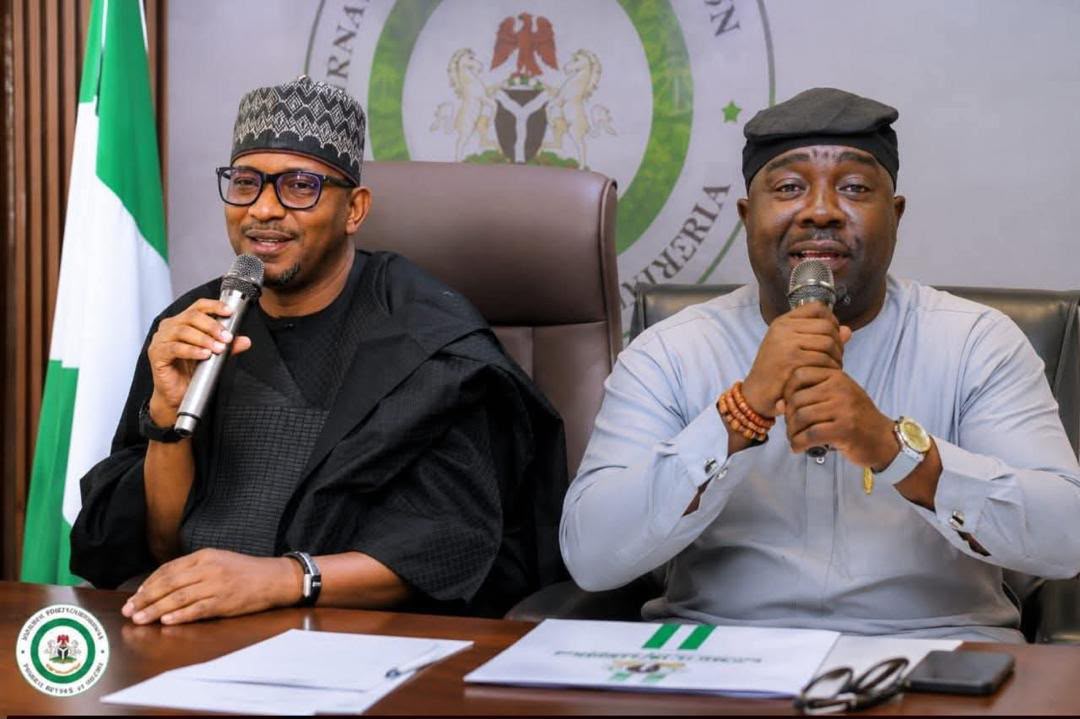
Beyond Participation: How Mal. Dikko and Hon. Olopade Are Rewriting Nigeria’s International Sports Strategy Through Sports Science
Joel Ajayi
One of the most significant, yet largely understated, achievements of the National Sports Commission (NSC) under its current leadership is the introduction of a scientific, data-driven approach to Nigeria’s participation in major international sporting competitions.
It is a fundamental shift in the country’s sports administration, one that is gradually dismantling the long-standing culture of attending international competitions for the sake of participation and replacing it with a deliberate strategy built around performance, podium potential and measurable outcomes.
Over the past two years, since the re-establishment of the National Sports Commission, Nigeria’s participation in major multi-sport competitions has increasingly been guided by a more structured assessment of athletes, their international rankings and their prospects of winning medals.
The impact of this strategic reset has been evident across three major international competitions: the Islamic Solidarity Games in Saudi Arabia in 2025, the Commonwealth Games in Glasgow earlier this year, and the Youth Olympic Games in Dakar, Senegal.
Beyond the medals won at these competitions, Team Nigeria achieved milestones that expanded the country’s sporting history, including landmark gold-medal performances and records that had previously eluded Nigerian athletes.
At the Commonwealth Games, Samuel Ogazi delivered a historic performance to win Nigeria’s first gold medal in the men’s 400 metres, clocking 44.25 seconds. Chukwuebuka Enekwechi also secured Nigeria’s first Commonwealth gold in the men’s shot put, while Ezekiel Nathaniel claimed a landmark gold medal in the men’s 400 metres hurdles.
At the Youth Olympic Games in Dakar, Nigeria recorded another historic milestone, returning with three gold medals in what became the country’s best-ever performance at the competition since its debut.
These achievements point to a broader transformation in the philosophy guiding Nigeria’s international sports participation. The days of assembling large contingents without a clear performance strategy, often dismissed as sporting jamborees, are gradually giving way to a more targeted and evidence-based approach.
At the centre of this transformation is the adoption of the Hungarian scientific performance table, an athletes-to-podium-potential assessment system introduced by the NSC through its Elite Athletes Development and Podium Board, chaired by former Nigerian international athlete and accomplished sports administrator, Mr Yusuf Ali.
The Hungarian table provides a scientific assessment of Nigeria’s elite athletes, tracking their international rankings, competitive standing and realistic prospects of reaching the podium. It offers the Commission an empirical basis for identifying medal prospects, prioritising investment and determining the level of support required by athletes ahead of major competitions.
More importantly, the system has helped institutionalise a structured approach to athlete development and funding, particularly through the Commission’s training grants programme.
This is perhaps one of the most consequential aspects of the reform. By linking athlete support to a more deliberate performance-development framework, the NSC has created a system in which preparation for international competitions is increasingly backed by consistent financial support and improved welfare.
In the last two years, more than $1 million, approximately ₦1.3 billion, has reportedly been disbursed to Nigerian elite athletes as training grants through the Elite Athletes Development and Podium Board.
Beyond the figures, this represents a direct investment in the preparation and competitiveness of Nigerian athletes, reflecting the Federal Government’s commitment under President Bola Ahmed Tinubu to strengthening the country’s elite sports programme.
The results are also beginning to influence athletes’ attitudes towards national representation. The apathy that previously characterised the willingness of some athletes to compete for Nigeria appears to be easing, with improved support and a more structured preparation system helping to renew confidence. Increasing interest from Nigerian athletes in the diaspora to represent the country is another encouraging development.
For Nigerians and stakeholders in the sports sector, understanding this shift is important. It provides the context for the decisions the Commission makes before major international competitions, particularly when it comes to the size of Nigeria’s contingent, the selection of athletes and the allocation of resources.
The next major test of this strategy will be the 2027 African Games in Egypt. Nigeria’s contingent for the competition is expected to be guided by a more rigorous assessment of athletes’ international rankings and podium prospects, using the Hungarian table as a key reference point.
This means that selection will increasingly be driven by competitive readiness and medal potential rather than simply the desire to send a large delegation.
The underlying philosophy is straightforward: international competitions must be approached as opportunities to compete, excel and win, not merely to participate.
As NSC Director General, Hon. Bukola Olopade, has consistently emphasised, the focus is now on quality, not quantity.
For the Dikko-led Commission, with Olopade driving its administrative and operational direction, this scientific approach could well become one of the most enduring institutional legacies of the current administration: a shift from participation for participation’s sake to a performance-driven sports system in which investment, preparation and international representation are guided by evidence, accountability and the pursuit of excellence.
-
 Featured7 years ago
Lampard Names New Chelsea Manager
-
 Featured7 years ago
FG To Extends Lockdown In FCT, Lagos Ogun states For 7days
-
 Featured7 years ago
Children Custody: Court Adjourns Mike Ezuruonye, Wife’s Case To April 7
-
 Featured7 years ago
NYSC Dismisses Report Of DG’s Plan To Islamize Benue Orientation Camp
-

 Featured5 years ago
Transfer Saga: How Mikel Obi Refused to compensate me After I Linked Him Worth $4m Deal In Kuwait SC – Okafor
-
Featured7 years ago
Board urges FG to establish one-stop rehabilitation centres in 6 geopolitical zones
-

 News2 years ago
Zulu to Super Eagles B team, President Tinubu is happy with you
-
Sports4 years ago
TINUBU LAMBAST DELE MOMODU