
News
A Policy Roundtable On Whistleblower Protection Law Underway In Abuja
In continuation of the advocacy for the passage of the whistleblower protection law in the country, a consortium of civil society partners working on good governance and accountability will hold a policy roundtable in Abuja on November 7.
The roundtable, whose theme is Towards a Whistleblower Protection Law in Nigeria, is put together by the African Centre for Media and Information Literacy (AFRICMIL) in collaboration with the Progressive Impact Organisation for Community Development (PRIMORG), Shehu Musa Yar’Adua Foundation (SMYF) and other grantees of the MacArthur Foundation.
According to a statement by the organizers, “This intervention aims to develop key ideas and strategies to put whistleblowing and the passage of a whistleblower protection law in Nigeria on the front burner of national conversation.”
Whistleblowers have been playing positive, legitimate, and crucial roles in the prevention of and in the fight against corruption and the promotion of human rights in Nigeria and around the world.
“Over the years, they have uncovered and disclosed information on various corrupt and suspicious dealings linked to corrupt and politically exposed persons, leading to wider public debates about corruption and the need for accountability, the adoption of transparency regulations, investigations by national authorities, and international bodies, and the prosecution and condemnation of some of those involved,” the statement noted.
Despite the recognition of the importance of whistleblowers in various anti-corruption treaties, including Article 33 of the United Nations Convention Against Corruption (UNCAC), which requires state parties to protect whistleblowers, most whistleblowers have continued to face retaliation for exposing corruption and other illegal practices. According to the organizers, “Some whistleblowers in Nigeria face reprisals such as dismissal, threats, physical violence or abusive legal proceedings, while others are forced into exile or even killed.”
The statement noted that Nigeria, unfortunately, is one of the countries where whistleblowers face a lack of a safe and enabling legal environment that would allow them to report wrongdoing without fear of reprisals. It attributed the situation to a lack of effective protection laws, pointing out that only 10 55 African countries have adopted specific laws to protect whistleblowers.
“This is compounded by ineffective access to information laws that would enable them and others to obtain information held by public bodies and empower them to hold powerful individuals and entities to account, as well as the lack of effective and independent judicial institutions that could provide access to justice and effective remedies for human rights violations,” it said.
The statement observed that although efforts had been made over the years to enact a whistleblower protection law, particularly since the introduction of the whistleblowing policy by the Nigerian government in December 2016, such efforts had proved unsuccessful.
It paid tribute to the efforts of civil society organizations and partners, including the media, in the last five years, which had ensured “some level of awareness about whistleblowing and willingness on the part of patriotic Nigerians to blow the whistle on corruption and other wrongdoing in the interest of the public.”
Stakeholders expected at the policy roundtable are drawn from civil society organizations, media, the National Assembly, public interest lawyers, and government institutions, including the Presidential Initiative on Continuous Audit (PICA) of the Ministry of Finance, Ministry of Justice, law enforcement, and anti-corruption agencies.
Among other things, participants will take stock of the situation of whistleblowing and whistleblowers in Nigeria, the current position of the draft whistleblower protection law, and challenges and opportunities in the quest to have a whistleblower protection law in Nigeria.



News
Musawa Seeks Broader Significance for June 12
Joel Ajayi
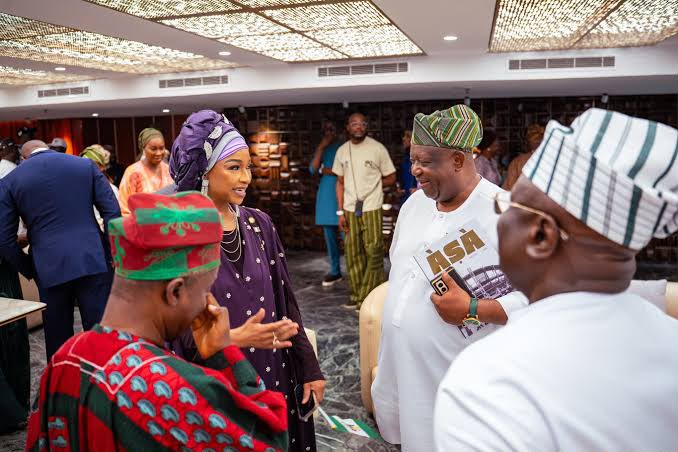
The Minister of Art, Culture, Tourism and the Creative Economy, Hannatu Musa Musawa, Esq., says June 12 must be remembered as a sacrifice that gave Nigerians democracy, beyond its status as a public holiday.
In a statement signed on Saturday by the Senior Assistant Media & Publicity to the Honourable Minister,Federal Ministry of Art, Culture, Tourism and the Creative Economy Dr Nneka Ikem Anibeze Ph.D in Abuja.
Musawa stated this at the national premiere of “MKO”, a film on Chief Moshood Abiola, held at the Wole Soyinka Centre for Culture and Creative Arts, Lagos, to mark Nigeria’s 66th Independence Anniversary.
She said 33 years after June 12, 1993, many young Nigerians know it only as a holiday, but the film turns it back into memory.
“For too many young Nigerians, June 12 is simply a public holiday. This film tells them that our democracy did not arrive by chance. It was fought for. It was defended. It was paid for. This documentary is in honour of the heroes of June 12, the men and women who gave their lives for the mandate of June 12, 1993 and for the democracy Nigeria enjoys today,” the Minister said.
Musawa hailed President Bola Ahmed Tinubu, Chief Host, for his participation in the June 12 struggle and paying the price in exile, adding that Nigeria’s creative industry will keep telling the story of its democracy with courage.
“Through film and the creative economy, Nigeria will preserve its history. A nation that forgets its past loses its way to the future. Nigeria has a story and our story deserves to be told,” she said.
Earlier, the director of the investigative documentary, Ose Oyamendan, said the film was in honour and memory of heroes who fought for Nigeria’s democracy.
“There was Hope ’93 and now there is Renewed Hope. There was a man who sacrificed his life so we may have democracy and there is a man who almost lost his life fighting for democracy who is now helping build a lasting democracy.
“There was a great man called Bashorun MKO Abiola and there is now another great man called Asiwaju Bola Ahmed Tinubu. Democrats. Nationalists. Nation builders. Leaders of men and women. We must never forget our story. We must always honour and remember our heroes,” Oyamendan said.
Top government officials including President Bola Ahmed Tinubu, the wife of the President Senator Oluremi Tinubu; Senate President Godswill Akpabio, Speaker of the House of Representatives Tajudeen Abbas, Chairman of the Nigeria Governors’ Forum AbdulRahman AbdulRazaq, Chief of Staff to the President Rt. Femi Gbajabiamila, state Governors, members of the National Assembly, Ministers and other distinguished dignitaries attended the premiere.
-
 Featured7 years ago
Lampard Names New Chelsea Manager
-
 Featured6 years ago
FG To Extends Lockdown In FCT, Lagos Ogun states For 7days
-
 Featured7 years ago
Children Custody: Court Adjourns Mike Ezuruonye, Wife’s Case To April 7
-
 Featured7 years ago
NYSC Dismisses Report Of DG’s Plan To Islamize Benue Orientation Camp
-

 Featured5 years ago
Transfer Saga: How Mikel Obi Refused to compensate me After I Linked Him Worth $4m Deal In Kuwait SC – Okafor
-
Featured7 years ago
Board urges FG to establish one-stop rehabilitation centres in 6 geopolitical zones
-
Sports4 years ago
TINUBU LAMBAST DELE MOMODU
-

 News2 years ago
Zulu to Super Eagles B team, President Tinubu is happy with you