
Health
UNICEF urges Nigeria to reduce reliance on external health funding
The United Nations Children’s Fund (UNICEF) has called on the government at all levels to reduce reliance on external sources for health funding and instead make adequate provisions in their budgets.
UNICEF Deputy Representative in Nigeria, Dr Rowan Khan, made the statement on Wednesday in Abuja at the Primary Health Care (PHC) Memorandum of Understanding (MoU) Learning and Dissemination Event.
The PHC MoU Health Systems Strengthening Initiative is a three-year partnership (2022 to March 2025) between GAVI, the Federal Ministry of Health and Social Welfare, and UNICEF.
The initiative also involves eight states: Bayelsa, Gombe, Jigawa, Katsina, Kebbi, Niger, Taraba, and Zamfara.
The initiative aims to strengthen routine immunisation and PHC systems to reduce morbidity and mortality by addressing vaccine-preventable diseases and improving essential health services.
According to Khan, the U.S. administration’s pause of foreign aid, affecting nearly all its foreign aid programmes, is no surprise but a wake-up call to stop reliance on external funding for health.
“Looking at what is happening at the global level, we need to really reduce the reliance on others at all levels.
“What has happened with the U.S. government’s decision has shaken us to the core, but honestly, we knew this was coming because we cannot forever rely on external support.
“All of us need to have our own ownership, our own accountabilities, and our own responsibilities as well.”
She also emphasised the importance of coordination among stakeholders and optimizing available resources, considering the limitations in both financial and human resources.
Khan added that such efforts would have a more significant impact on Nigeria’s future.
To sustain the gains made in the past three years from the PHC initiative, Khan suggested that state governments should conduct a proper budget analysis.
The analysis, he said should focus on identifying gaps, particularly regarding basic services for children and the revitalisation of PHCs in each ward.
“So, I urge all state authorities to look at this very carefully.
“Please look at your budgets and see how we can intuitively allocate resources for the basic services of health, specifically for immunisation and other basic services,” she said.
Dr Manasseh Jatau, the Deputy Governor of Gombe State, stressed the importance of Nigeria beginning to sponsor research to produce medicines and vaccines from local plants.
He explained that Nigeria had sufficient plant resources to produce vaccines, which could reduce the cost of vaccine importation.
“We must take responsibility for our health issues. My dear governors and medical personnel, we are challenged to take responsibility for obvious reasons.
“In the long run, we should be prepared in case there’s donor doubt, donor denial, donor fatigue, and eventually donor stoppage.
“If we don’t get ready for that, a calamity is waiting for us,” he said.
Jesicca Crawford, the Country Manager of GAVI, commended the governors of the implementing states for their commitment to the programme.
She said such commitment was necessary to build a healthier, more resilient Nigeria, where every child, citizen, and woman had access to quality PHC services.
She urged the governors to ensure that the services were sustained and that the achievements made through the MoU were replicated in other states.
Dr Mya Ngon, the Team Lead for Communicable and Non-Communicable Diseases at the World Health Organisation (WHO), acknowledged the successes recorded but stressed the need for further work to reduce zero-dose immunisation among unimmunised children.
“We also need to sustain government efforts to implement PHC strengthening and immunisation to improve equitable access to vaccines and reduce zero-dose children.
“We should remember our national goal to invest in reducing reliance on campaigns and focus more on strengthening the health system,” she said.
Halima Muhammed, Senior Programme Manager for Immunisation at the Nigeria Governor’s Forum (NGF), noted that the MoU hasd significantly strengthened PHC systems over the past three years, ensuring that many children received vaccines.
“The NGF, alongside our esteemed partners, has played a pivotal role in implementing targeted interventions.
“These efforts have enhanced service delivery, increased demand generation, strengthened disease surveillance, improved governance, optimizsed human resources, fortified supply chains, and driven high-level advocacy to ensure sustained political commitment to PHC,” she said.
Muhammed also highlighted the importance of sustaining these gains through the Sector-Wide Approach (SWAp) programme by integrating resources, policies, and initiatives across the health sector.
To ensure sustainability, the initiative is transitioning programme ownership to state governments.
NAN



Health
Football Legends to Light Up Nigeria in NICRAT’s World Soccer Legends Cancer Match
By Joel Ajayi
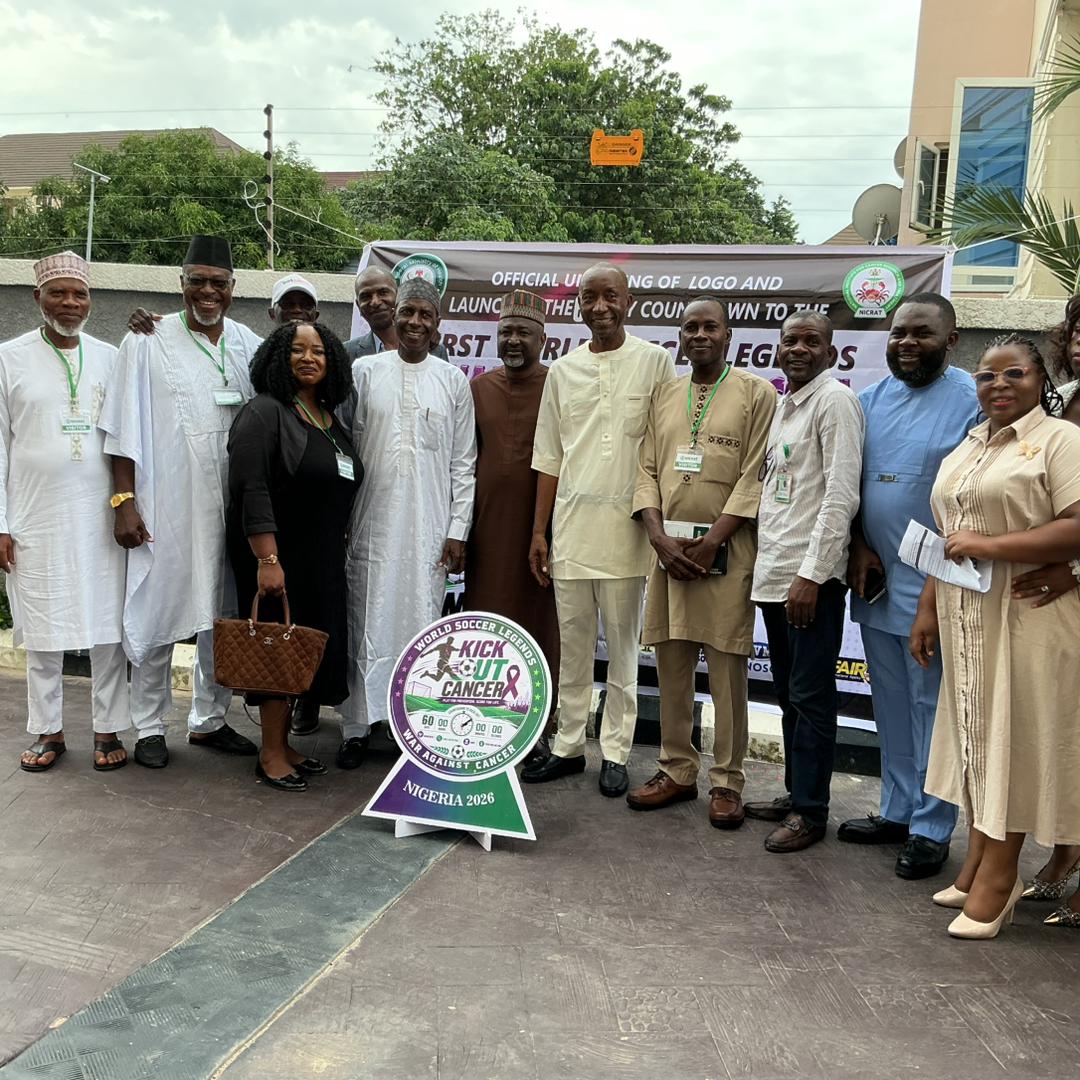
Nigeria is set to witness a football spectacle as some of the world’s greatest football legends converge for the First World Soccer Legends War Against Cancer International Charity Football Match Nigeria 2026.
The star-studded event, backed by the National Institute for Cancer Research and Treatment (NICRAT), is designed to combine football entertainment with a major campaign to raise cancer awareness, promote early detection and mobilise resources for prevention and treatment.
The initiative, themed “Play for Prevention, Score for Life,” was unveiled on Wednesday in Abuja with the official launch of the event logo, kits and a 60-day countdown to the international charity match.
The campaign is expected to feature former international football stars while bringing together cancer advocates, government institutions, corporate organisations, development partners and other stakeholders in a united effort against the disease.
Speaking on behalf of NICRAT Director-General, Prof. Usman Aliyu, Dr Margaret Sawyer said the institute was supporting the initiative because of its potential to take cancer-awareness messages to millions of Nigerians.
She said the campaign would go beyond fundraising by educating Nigerians on cancer prevention, early detection and the need to seek medical attention promptly.
According to her, football offers a unique platform for reaching diverse communities, while the influence of football legends could help deliver important health messages to a wider audience.
Earlier, National Coordinator of the Main Organising Committee (MOC), Mr Jacob Onu, said the event was conceived to transcend the boundaries of sport and evolve into a national and international movement against cancer.
Onu said the participation of former football stars would amplify messages on cancer prevention, screening, treatment, research and support for patients and survivors.
He added that the event would also celebrate life, honour those who had lost their lives to cancer and inspire survivors and people currently battling the disease.
“Together, through football, compassion and collective action, we can win the War Against Cancer,” he said.
Onu called on Nigerians across the 774 local government areas to become ambassadors of the campaign by promoting healthy lifestyles, regular medical checks and early medical intervention.
He also appealed to corporate organisations, philanthropists, international organisations, football stakeholders, media organisations and development partners to support the initiative.
The MOC coordinator commended NICRAT, the Federal Ministry of Health and Social Welfare, the Nigeria Football Federation (NFF), sponsors, partners and other stakeholders for their support.
He assured that the organising committee would deliver an event capable of meeting international standards while creating a lasting legacy in cancer awareness, advocacy, humanitarian support and sports development.
In his goodwill message, President of the Nigeria Olympic Committee (NOC), Engr. Habu Gumel, expressed concern over the rising global cancer burden and called for sustained action beyond the charity match.
Gumel urged the organisers to extend the campaign beyond Abuja to communities across the 36 states, while calling on governments at all levels to strengthen cancer prevention, screening and treatment.
The NOC president pledged his support for the initiative and encouraged Nigerians to make regular cancer screening and periodic health checks a priority.
Also speaking, Director of Cancer Prevention and Control at NICRAT, Dr Usman Mohammed Waziri, reaffirmed the institute’s determination to ensure that the initiative produces a positive and lasting impact on Nigeria’s cancer-control efforts.
With the 60-day countdown officially underway, organisers said the World Soccer Legends Cancer Match would combine the excitement of football with humanitarian action, using the power and influence of football legends to drive a nationwide campaign against cancer.
-
 Featured7 years ago
Lampard Names New Chelsea Manager
-
 Featured6 years ago
FG To Extends Lockdown In FCT, Lagos Ogun states For 7days
-
 Featured7 years ago
Children Custody: Court Adjourns Mike Ezuruonye, Wife’s Case To April 7
-
 Featured7 years ago
NYSC Dismisses Report Of DG’s Plan To Islamize Benue Orientation Camp
-

 Featured5 years ago
Transfer Saga: How Mikel Obi Refused to compensate me After I Linked Him Worth $4m Deal In Kuwait SC – Okafor
-
Featured7 years ago
Board urges FG to establish one-stop rehabilitation centres in 6 geopolitical zones
-
Sports4 years ago
TINUBU LAMBAST DELE MOMODU
-

 News2 years ago
Zulu to Super Eagles B team, President Tinubu is happy with you