
Health
Tuberculosis: Nigeria’s Raging Silent Killer

…Kills 268 Nigerians daily About 40% of cases remain undetected
…Over 50% of Nigeria’s LGAs still lack GeneXpert machines
… US’s suspension of funding expected to increase problems
….As mortality rate remains high
In spite of concerted partnerships to stamp out tuberculosis (TB) in Nigeria, stakeholders are worried it still kills thousands in the country.According to the National Tuberculosis, Leprosy and Buruli Ulcer Control Programme (NTBLCP), the disease, discovered 143 years ago, claims 71,000 lives annually in Nigeria, accounting for 18 percent of TB-related deaths in Africa.Disturbingly, Nigeria has the highest tuberculosis burden in Africa.
“The disease kills 268 people in the country every day,” says the World Health Organization, WHO. “Yet TB cases are under-reported, increasing the high risk of transmission. It is estimated that one missed case can transmit TB to 15 people in a year.”
According to provisional data, over 361,000 TB cases were reported in Nigeria in 2023, nine per cent of these in children. Overall, this marked a 26 per cent increase in the number of cases compared with 2022.
”When the late Malam Ibrahim Yusuf, a 32-year-old mechanic in No Man’s Land, Fagge Local Government Area, Kano State, first developed a persistent cough, he dismissed it as a minor infection.
His wife, Mrs Safiya Ibrahim, recounted how his condition deteriorated over time. “By the time we finally visited the health facility, he was diagnosed with tuberculosis (TB) in its advanced stage.”Despite undergoing treatment, my husband died three months later, leaving behind me and our three children,” she narrated.
According to the World Health Organisation (WHO), TB is an infectious disease caused by the bacterium Mycobacterium tuberculosis.It primarily affects the lungs but can spread to other organs such as the brain, spine and kidneys.
TB spreads through the air when an infected person coughs, sneezes, speaks or sings.Experts say there are two types of TB– Latent TB, where the bacteria remains inactive, causing no symptoms and making the person non-contagious, and Active TB – where the bacteria multiplies, leading to a persistent cough, weight loss, night sweats, fever and fatigue.
The latter is contagious and requires immediate treatment.Medical professionals say TB is curable with a six-month course of antibiotics, including drugs like isoniazid and rifampicin.They say the BCG vaccine offers partial protection, especially for children, while early diagnosis through tests like GeneXpert and sputum microscopy is crucial in preventing transmission.Despite medical advances, TB remains a major public health crisis in Nigeria.
Ibrahim’s story is just one among thousands in Nigeria, where TB remains a leading cause of death despite being preventable and curable.In 2023 alone, 499,000 Nigerians were diagnosed with TB—five people every minute.
However, only 60 percent of cases were detected, meaning hundreds of thousands remain undiagnosed, posing a risk of further transmission.Nigeria is also battling a rise in Multidrug-Resistant TB (MDR-TB) and Extensively Drug-Resistant TB (XDR-TB).MDR-TB occurs when TB bacteria become resistant to first-line drugs like isoniazid and rifampicin, making treatment longer, more expensive and less effective.
According to WHO, no fewer than 21,000 Nigerians develop MDR-TB each year, but only about 2,600 receive proper treatment due to funding shortages, limited diagnostic tools and inadequate second-line medications.
Dr Adesigbin Clement Olufemi, Head of the Programmatic Management of Drug-Resistant Tuberculosis (PMDT), NTBLCP, provided insights.”Many patients start treatment but struggle to complete the regimen due to side effects, stigma or financial hardship,” he said.According to Olufemi, without urgent intervention, MDR-TB will become even harder to control.
Dr Shehu Labaran, NTBLCP Director, explained that although more than 50 percent of Nigerian health facilities provided TB treatment, access remained a major challenge, especially in rural areas.”Only 48 percent of Local Government Areas (LGAs) have GeneXpert machines, the recommended rapid diagnostic tool for TB,” Labaran said.
By the aforementioned, 371 LGAs are left without advanced TB detection, leading to delays in diagnosis.Dr Patricia Chinedu, a pulmonologist, said that many patients sought treatment from traditional healers or chemists first, losing valuable time before receiving proper care.”By the time they reach a hospital, the disease has progressed to a life-threatening stage,” Chinedu warned.
Despite free TB treatment in Nigeria, the financial burden on patients is crippling.NTBLCP reports that 71 percent of TB-affected households face catastrophic costs, spending more than 20 percent of their income on transportation, nutrition, and other indirect expenses.For Mrs Maryam Usman, a resident of Karmajiji, Abuja Municipal Area Council (AMAC), Federal Capital Territory (FCT), her husband’s TB diagnosis forced her to make heartbreaking sacrifices.
“I had to stop my children’s schooling because we could not afford transport to the facility where my husband is undergoing TB treatment,”Usman said.In many Nigerian communities, TB is still linked to curses, witchcraft or divine punishment.This stigma prevents people from seeking early treatment, increasing the risk of transmission.
“My family stopped visiting me when they heard I had TB,” recounted Mr Adamu Peter, a recovered TB patient from Waru community, FCT.Dr Queen Ogbuji-Ladipo, Acting Board Chair of Stop TB Partnership Nigeria, underscored that awareness campaigns like “Check Am O!”were helping, but more work was needed.
Ogbuji-Ladipo said that the global End TB Strategy aimed to reduce TB deaths by 90 percent by 2030, but Nigeria still faced major hurdles.The Nigerian Government, in collaboration with WHO, USAID and the Global Fund, had unveiled several initiatives.
These initiatives include free testing and treatment programs, active case-finding campaigns in high-burden areas, and mobile clinic pilot projects to improve rural healthcare access.However, a huge funding gap persists.)Mr Tajudeen Ibrahim, Executive Country Coordinating Mechanism, Global Fund, disclosed that Nigeria required 404 million dollars to effectively deliver TB treatment and services in 2025.
Ibrahim warned that the country’s TB drug supply for 2025 was already under strain, as some medications allocated for the year had been used to meet 2024’s treatment demands.He said the 5 million dollars funding gap caused by the U.S. Government’s recent executive order, affected active case-finding in 18 states between January and March.*Given that 24 percent of Nigeria’s TB funding comes from external sources, with the U.S. contributing 22 million dollars, there are concerns that detection and treatment efforts will suffer if funding issues persist,” he said.
Meanwhile, Prof. Muhammad Ali Pate, Coordinating Minister of Health and Social Welfare, dismissed concerns from international agencies about possible drug shortages.
Pate stated that government analysis showed no imminent stockouts and stressed plans for direct and emergency procurement.
He also suggested that Nigeria might source medical supplies from economically similar countries instead of relying heavily on external donors.
Reaffirming the government’s steadfast commitment, Pate urged caution against misinformation from global organisations that might misrepresent Nigeria’s healthcare landscape.As Nigeria marks World TB Day 2025, Yusuf’s story serves as a stark reminder that TB is not a disease of the past—it is a present day crisis.
Note, NTBLCP says Nigerians can access information and resources by calling the toll-free helpline at 3340 or by dialing *3340#.
What’s more, stakeholders say that the government needs to increase funding, expand diagnostic tools, strengthen awareness, integrate TB services into primary healthcare, encourage early testing and fight TB-related stigma. They say there is need to scale up TB programmes and push for policy change as well as ensuring that patients complete their treatment regimens.



Health
Football Legends to Light Up Nigeria in NICRAT’s World Soccer Legends Cancer Match
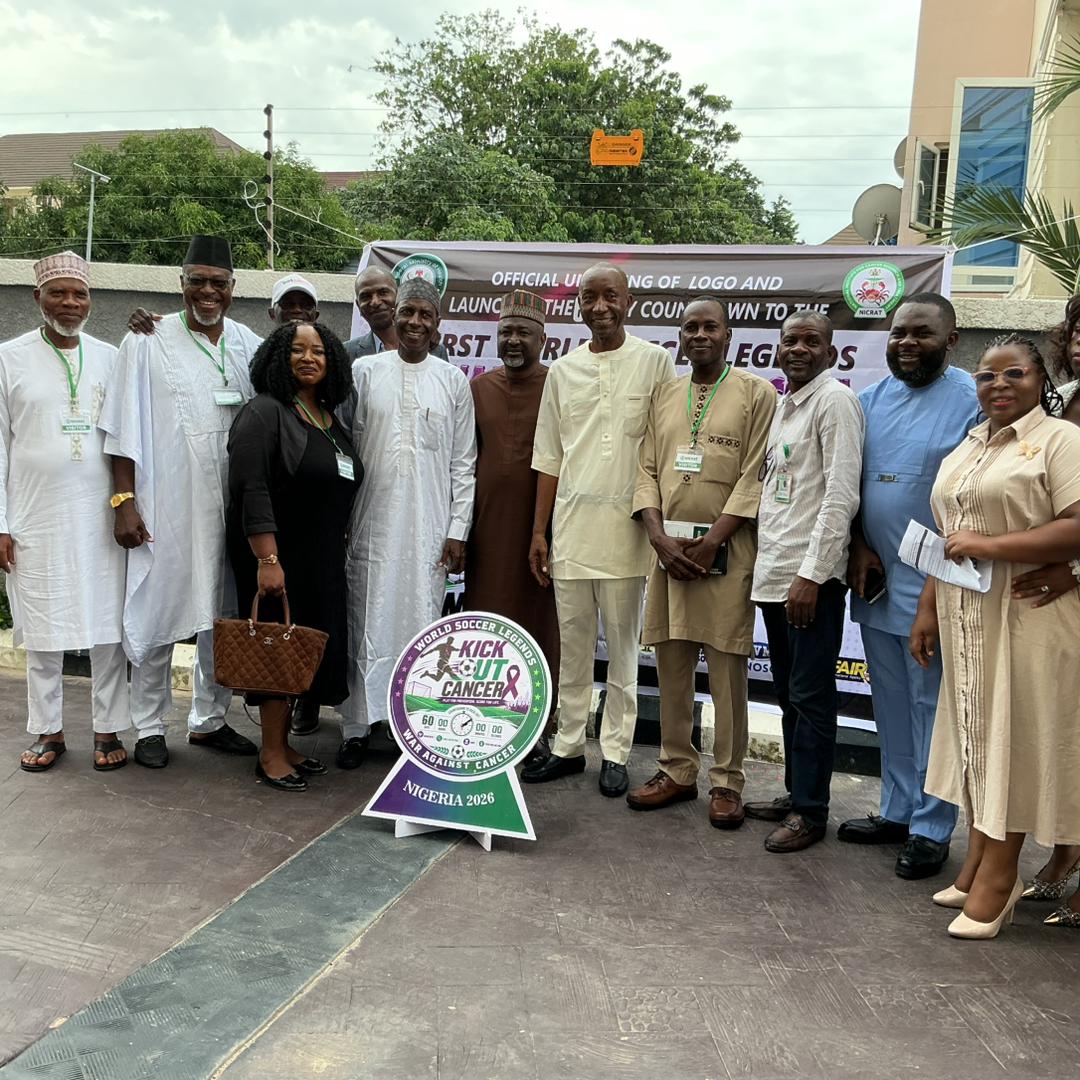
By Joel Ajayi
Nigeria is set to witness a football spectacle as some of the world’s greatest football legends converge for the First World Soccer Legends War Against Cancer International Charity Football Match Nigeria 2026.
The star-studded event, backed by the National Institute for Cancer Research and Treatment (NICRAT), is designed to combine football entertainment with a major campaign to raise cancer awareness, promote early detection and mobilise resources for prevention and treatment.
The initiative, themed “Play for Prevention, Score for Life,” was unveiled on Wednesday in Abuja with the official launch of the event logo, kits and a 60-day countdown to the international charity match.
The campaign is expected to feature former international football stars while bringing together cancer advocates, government institutions, corporate organisations, development partners and other stakeholders in a united effort against the disease.
Speaking on behalf of NICRAT Director-General, Prof. Usman Aliyu, Dr Margaret Sawyer said the institute was supporting the initiative because of its potential to take cancer-awareness messages to millions of Nigerians.
She said the campaign would go beyond fundraising by educating Nigerians on cancer prevention, early detection and the need to seek medical attention promptly.
According to her, football offers a unique platform for reaching diverse communities, while the influence of football legends could help deliver important health messages to a wider audience.
Earlier, National Coordinator of the Main Organising Committee (MOC), Mr Jacob Onu, said the event was conceived to transcend the boundaries of sport and evolve into a national and international movement against cancer.
Onu said the participation of former football stars would amplify messages on cancer prevention, screening, treatment, research and support for patients and survivors.
He added that the event would also celebrate life, honour those who had lost their lives to cancer and inspire survivors and people currently battling the disease.
“Together, through football, compassion and collective action, we can win the War Against Cancer,” he said.
Onu called on Nigerians across the 774 local government areas to become ambassadors of the campaign by promoting healthy lifestyles, regular medical checks and early medical intervention.
He also appealed to corporate organisations, philanthropists, international organisations, football stakeholders, media organisations and development partners to support the initiative.
The MOC coordinator commended NICRAT, the Federal Ministry of Health and Social Welfare, the Nigeria Football Federation (NFF), sponsors, partners and other stakeholders for their support.
He assured that the organising committee would deliver an event capable of meeting international standards while creating a lasting legacy in cancer awareness, advocacy, humanitarian support and sports development.
In his goodwill message, President of the Nigeria Olympic Committee (NOC), Engr. Habu Gumel, expressed concern over the rising global cancer burden and called for sustained action beyond the charity match.
Gumel urged the organisers to extend the campaign beyond Abuja to communities across the 36 states, while calling on governments at all levels to strengthen cancer prevention, screening and treatment.
The NOC president pledged his support for the initiative and encouraged Nigerians to make regular cancer screening and periodic health checks a priority.
Also speaking, Director of Cancer Prevention and Control at NICRAT, Dr Usman Mohammed Waziri, reaffirmed the institute’s determination to ensure that the initiative produces a positive and lasting impact on Nigeria’s cancer-control efforts.
With the 60-day countdown officially underway, organisers said the World Soccer Legends Cancer Match would combine the excitement of football with humanitarian action, using the power and influence of football legends to drive a nationwide campaign against cancer.
-
 Featured7 years ago
Lampard Names New Chelsea Manager
-
 Featured6 years ago
FG To Extends Lockdown In FCT, Lagos Ogun states For 7days
-
 Featured7 years ago
Children Custody: Court Adjourns Mike Ezuruonye, Wife’s Case To April 7
-
 Featured7 years ago
NYSC Dismisses Report Of DG’s Plan To Islamize Benue Orientation Camp
-

 Featured5 years ago
Transfer Saga: How Mikel Obi Refused to compensate me After I Linked Him Worth $4m Deal In Kuwait SC – Okafor
-
Featured7 years ago
Board urges FG to establish one-stop rehabilitation centres in 6 geopolitical zones
-
Sports4 years ago
TINUBU LAMBAST DELE MOMODU
-

 News2 years ago
Zulu to Super Eagles B team, President Tinubu is happy with you













