
Foreign news
Sahrawi Arab Democratic Republic Seeks Nigeria’s Support for Self-Determination Struggle
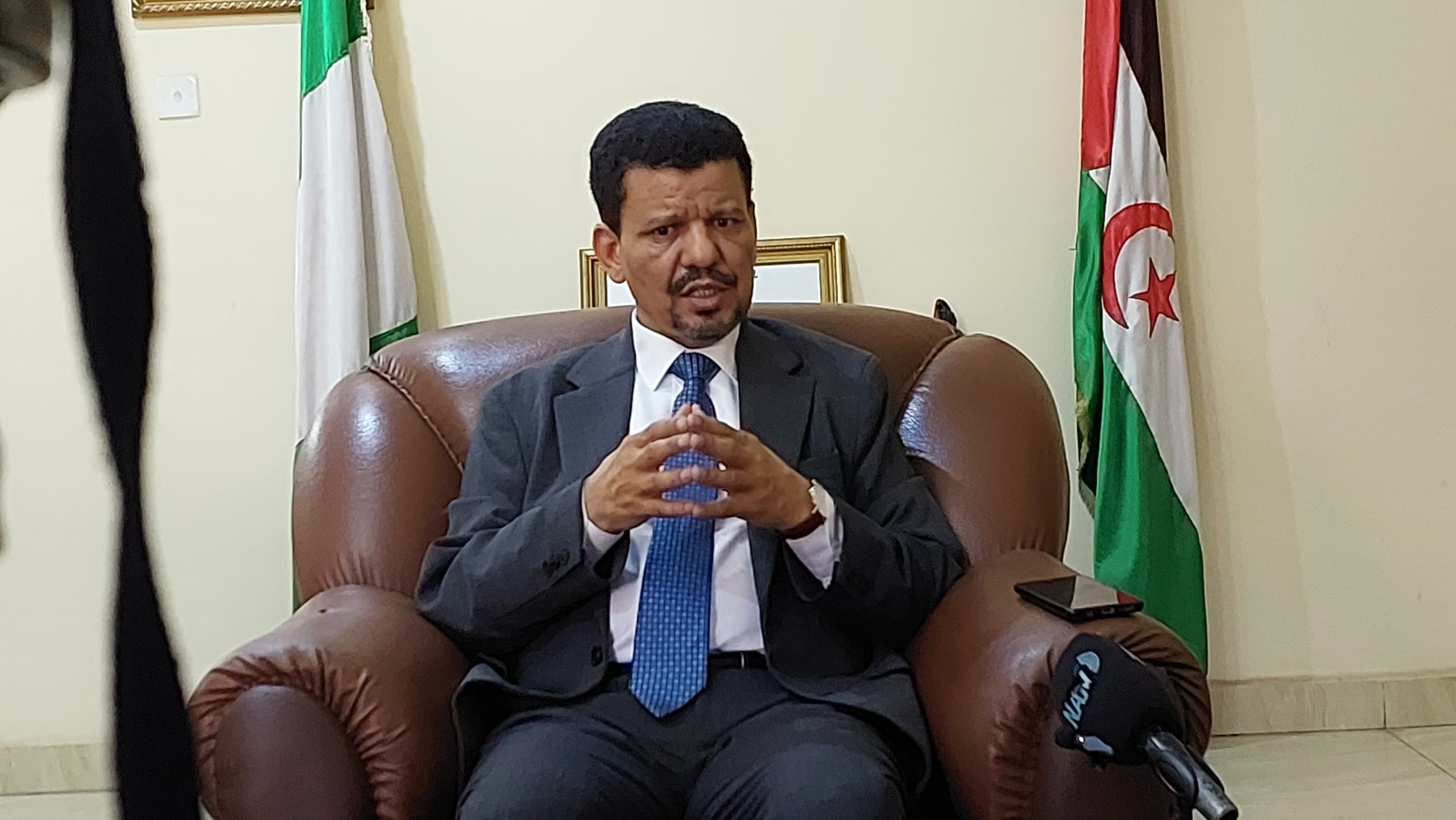
By Joel Ajayi
The Minister of Foreign Relations and African Affairs of the Sahrawi Arab Democratic Republic (SADR), Mohamed Bessat, has called on the Nigerian government and the international community to support his country’s quest for self-determination and an end to Moroccan occupation of Western Sahara.
Speaking during an official visit to Nigeria, Bessat emphasized the deep historical and diplomatic ties between Nigeria and the Sahrawi Republic, expressing appreciation for Nigeria’s longstanding commitment to anti-colonial struggles across Africa.
“I am in Nigeria at the invitation of my brother and colleague, His Excellency, the Honourable Yusuf Tuggar, Nigeria’s Minister of Foreign Affairs,” Bessat stated. “This visit reflects the long-standing relationship of brotherhood, solidarity, and cooperation between the Federal Republic of Nigeria and the Sahrawi Arab Democratic Republic.”
He said the visit aims to brief Nigerian leaders, lawmakers, diplomats, and the general public about the ongoing struggle in Western Sahara, a region he described as under illegal Moroccan occupation since 1975.
Bessat traced the origins of the conflict to the 1975 Madrid Agreements, in which colonial Spain—then under dictator Francisco Franco—ceded control of Western Sahara to Morocco and Mauritania after withdrawing.
“That agreement was a betrayal and a theft of our territory,” Bessat said. “It triggered a long war. Although we have good relations with Mauritania today, Morocco continues to occupy nearly two-thirds of our land. We are engaged in both military and diplomatic resistance to this illegal and brutal occupation.”
According to him, a joint African Union-United Nations peace plan was signed in 1990, proposing a referendum to allow the Sahrawi people to choose between independence or integration with Morocco.
“Sadly, Morocco has sabotaged this process repeatedly—first with delays, then by refusing outright to cooperate,” he added.
Describing Nigeria as the “backbone” of Africa’s anti-colonial history, Bessat praised the country’s leadership role in the liberation of African nations from Portuguese, apartheid, and colonial rule.
“We are calling on our Nigerian brothers and sisters to continue this proud tradition and help us close the last chapter of decolonisation in Africa,” he said.
He expressed gratitude for the support already received from Nigerian political parties, parliamentarians, and the government, calling it “encouraging and deeply appreciated.”
Bessat said that since 2020, Morocco has violated a longstanding ceasefire and resumed aggressive military operations, leading to near-daily confrontations between Sahrawi and Moroccan forces.
“Morocco has not only expanded its occupation but also constructed more military walls within our territory,” he explained.
He also highlighted ongoing human rights violations and resource exploitation in the occupied territories, urging the international community to act decisively.
Western Sahara, he said, is one of the most resource-rich territories in the world, with petroleum, gas, gold, diamonds, iron, copper, uranium, and rare earth minerals.
“Our natural wealth should be a blessing, but instead it has fueled conflict. Morocco is plundering these resources, further deepening the crisis,” he said. “We are calling for cooperation, not conflict. Recognize our right to self-determination, and we can engage in partnerships for mutual benefit.”
Bessat concluded by appealing to the global community to uphold international law and support the Sahrawi people’s legitimate aspirations.
“The world is becoming increasingly unstable due to the erosion of international legality. It’s time for all nations—big or small—to commit to the rule of law. Supporting our cause is the fastest route to peace, African unity, and economic cooperation,” he stated.
“We urge the world to help end the human rights violations and economic plunder in Western Sahara and bring Africa’s last decolonisation battle to a close.”



Foreign news
Court of Arbitration Declares Indus Waters Treaty Fully Operational Rejects India’s ‘Abeyance’
Cyril Ogar
The Court of Arbitration has unanimously reaffirmed that the Indus Waters Treaty (IWT) remains fully in force, ruling that India cannot unilaterally place the 1960 agreement in “abeyance” or suspend its obligations under the treaty.
The decision represents a significant legal development in the longstanding dispute between India and Pakistan over the management and use of the Indus river system.
The Court’s finding addresses a fundamental issue at the heart of the dispute: whether either party can unilaterally suspend the treaty outside the legal framework agreed by both countries.
In its unanimous determination, the Court made clear that the IWT continues to bind both India and Pakistan and that its obligations cannot be set aside through a unilateral political declaration.
The ruling means India remains subject to the treaty provisions governing the use of the Western Rivers, including requirements relating to the design and operation of hydroelectric projects, as well as the dispute-resolution mechanisms established under the agreement.
The Court has also ordered interim measures concerning the Ratle Hydroelectric Plant, restricting specified construction activities while the broader dispute remains under consideration.
The measures are aimed at preserving the effectiveness of the arbitration process and preventing developments that could prejudice the outcome of the proceedings.
For Pakistan, the decision represents significant legal validation of its longstanding position that the IWT is a binding international agreement and contains no provision allowing either party to unilaterally place it in abeyance.
Pakistan has consistently maintained that disagreements over the treaty should be addressed through the institutional mechanisms established by the agreement, rather than through unilateral action.
The IWT provides a structured framework for resolving disputes through mechanisms including the Permanent Indus Commission, Neutral Expert and Court of Arbitration processes.
The latest ruling therefore reinforces the principle that treaty obligations cannot simply be disregarded because of deteriorating political relations between signatories.
The significance of the decision extends beyond the India-Pakistan dispute. It underscores the broader international-law principle that agreements governing shared rivers and other transboundary resources must be respected and disputes resolved through established legal and institutional channels.
The Indus river system supports agriculture, livelihoods, food security and communities across the region, making the stability of the treaty particularly important.
The ruling also highlights the distinction between seeking to amend an international agreement through mutually agreed procedures and attempting to alter its obligations unilaterally.
The IWT has endured wars, prolonged diplomatic tensions and periods of limited bilateral engagement. Its continued operation demonstrates the importance of rules-based mechanisms in managing shared resources when relations between neighbouring states become strained.
For Pakistan, the outcome provides an opportunity to frame the decision not merely as a bilateral legal victory, but as an affirmation of international law, treaty compliance and peaceful dispute resolution.
The central message from the ruling is clear: the Indus Waters Treaty remains in force, its obligations continue to bind both parties, and disputes concerning shared waters must be addressed through the legal mechanisms agreed by India and Pakistan.
-
 Featured7 years ago
Lampard Names New Chelsea Manager
-
 Featured6 years ago
FG To Extends Lockdown In FCT, Lagos Ogun states For 7days
-
 Featured7 years ago
Children Custody: Court Adjourns Mike Ezuruonye, Wife’s Case To April 7
-
 Featured7 years ago
NYSC Dismisses Report Of DG’s Plan To Islamize Benue Orientation Camp
-

 Featured5 years ago
Transfer Saga: How Mikel Obi Refused to compensate me After I Linked Him Worth $4m Deal In Kuwait SC – Okafor
-
Featured7 years ago
Board urges FG to establish one-stop rehabilitation centres in 6 geopolitical zones
-
Sports4 years ago
TINUBU LAMBAST DELE MOMODU
-

 News2 years ago
Zulu to Super Eagles B team, President Tinubu is happy with you













