
Foreign news
Algeria Celebrates 71 Years of Freedom in Abuja with Style, Showcasing Its Success Stories
Joel Ajayi
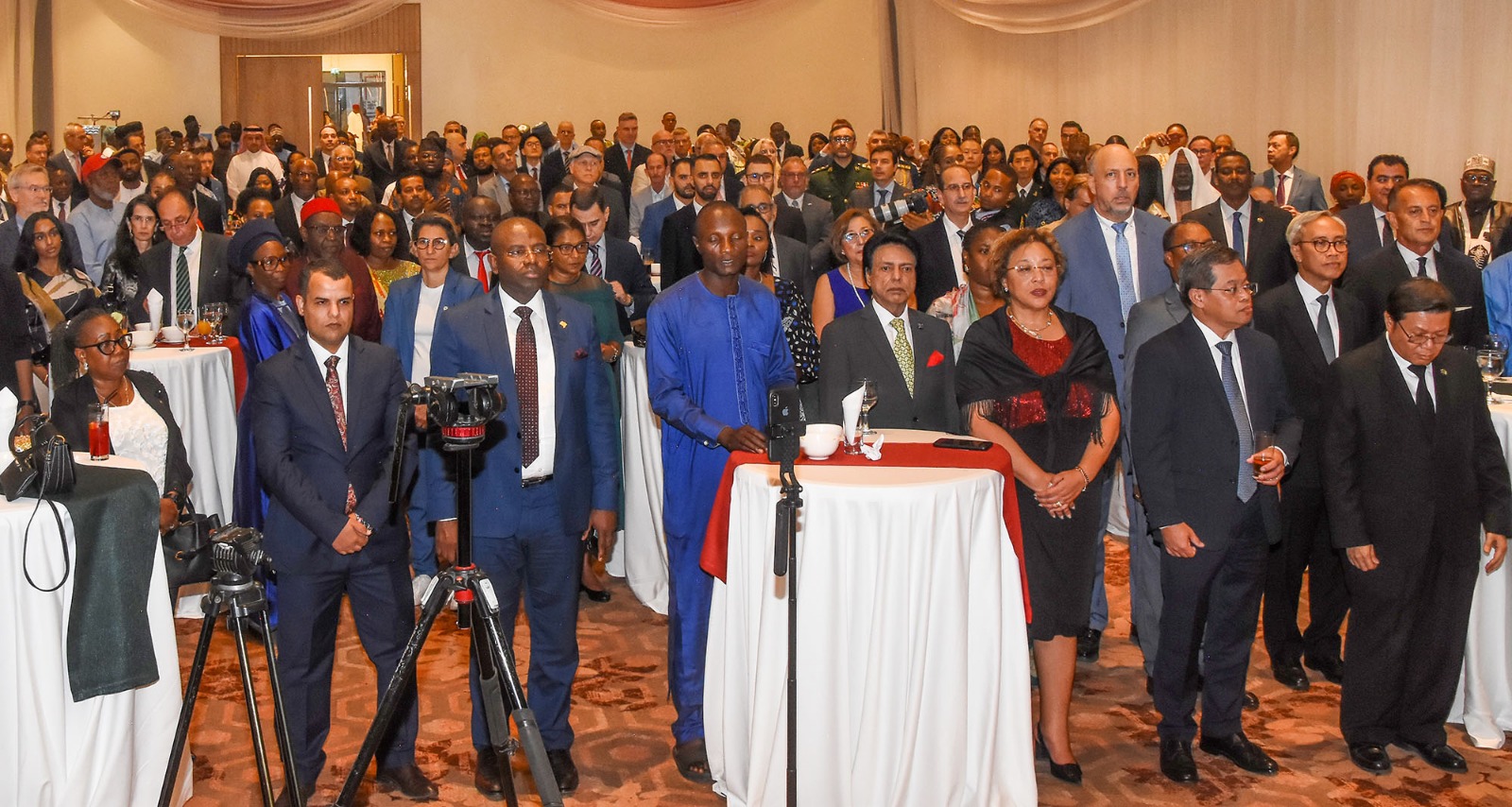
Algeria’s 71st National Day was celebrated in Abuja with colour, pride, and diplomatic elegance, as the Algerian Embassy hosted dignitaries, government officials, and members of the diplomatic community to mark the anniversary of the historic 1954 National Liberation Revolution.
Speaking at the event, the Algerian Ambassador to Nigeria, Hocine Mezoued, described the day as a moment of deep pride for Algerians worldwide.
He recalled that the November Revolution marked the beginning of a courageous struggle that led to independence in 1962 after 132 years of colonial occupation and the sacrifice of more than five million martyrs.
According to the Ambassador, the Revolution remains “an inexhaustible source of pride and patriotism for the entire Algerian people, guiding their path towards development and well-being.”
Ambassador Mezoued outlined Algeria’s accomplishments since independence, noting major investments in human, economic, social, and environmental development. He stated that Algeria is currently Africa’s third-largest economy, with a GDP of nearly US$300 billion, and projections to reach US$400 billion by 2027.
He further emphasized Algeria’s strong commitment to social welfare, which guarantees free access to education, healthcare, and decent housing for all its citizens.
The Ambassador praised the growing bilateral cooperation between Algeria and Nigeria, describing 2025 as a year marked by significant diplomatic and economic milestones. He highlighted deeper collaboration in diplomacy, parliamentary exchange, energy, and trade.
A major step in parliamentary cooperation was the visit of a high-level Nigerian delegation to Algeria last October, led by the Speaker of the House of Representatives, Rt. Hon. Tajudeen Abbas, represented during the Abuja celebrations by Hon. Abubakar Babazango, Chairman of the Nigeria–Algeria Parliamentary Friendship Group.
In the economic sector, he noted fruitful engagements between SONATRACH and NNPC Limited, and the advancement of three key strategic projects. He also announced that Air Algérie commenced direct flights from Algiers to Abuja in April 2025, boosting economic and cultural ties.
Algeria continues to support human-capacity development in Nigeria through scholarships in higher education, vocational training, and religious studies, 270 scholarships during the academic year 2025-2026
The Ambassador also highlighted the success of the 4th Intra-African Trade Fair (IATF) hosted in Algiers in September, which saw strong participation from Nigerian businesses exploring opportunities in Algeria’s agro-food, pharmaceuticals, chemicals, and home appliance sectors. Several trade agreements were signed, opening new commercial prospects between both countries.
In his remarked, the Speaker, House of Representatives Federal Republic of Nigeria Rt. Hon. Tajudeen Abbas, who was represented at the occasion by Chairman, Nigeria Algeria Parliamentary Friendship Group Committee HON. ABUBAKAR BABAZANGO praised the resilience and sacrifice of the Algerian people, describing the Independence anniversary as a symbol of hope across Africa.
He reiterated Nigeria’s commitment to strengthening relations with Algeria, particularly through the Parliamentary Friendship Group, and emphasized cooperation in trade, energy, education, and cultural exchange.
He extended warm greetings to the President and people of Algeria, expressing hope that the friendship between both nations would continue to flourish in unity, progress, and shared prosperity.



Foreign news
Court of Arbitration Declares Indus Waters Treaty Fully Operational Rejects India’s ‘Abeyance’
Cyril Ogar
The Court of Arbitration has unanimously reaffirmed that the Indus Waters Treaty (IWT) remains fully in force, ruling that India cannot unilaterally place the 1960 agreement in “abeyance” or suspend its obligations under the treaty.
The decision represents a significant legal development in the longstanding dispute between India and Pakistan over the management and use of the Indus river system.
The Court’s finding addresses a fundamental issue at the heart of the dispute: whether either party can unilaterally suspend the treaty outside the legal framework agreed by both countries.
In its unanimous determination, the Court made clear that the IWT continues to bind both India and Pakistan and that its obligations cannot be set aside through a unilateral political declaration.
The ruling means India remains subject to the treaty provisions governing the use of the Western Rivers, including requirements relating to the design and operation of hydroelectric projects, as well as the dispute-resolution mechanisms established under the agreement.
The Court has also ordered interim measures concerning the Ratle Hydroelectric Plant, restricting specified construction activities while the broader dispute remains under consideration.
The measures are aimed at preserving the effectiveness of the arbitration process and preventing developments that could prejudice the outcome of the proceedings.
For Pakistan, the decision represents significant legal validation of its longstanding position that the IWT is a binding international agreement and contains no provision allowing either party to unilaterally place it in abeyance.
Pakistan has consistently maintained that disagreements over the treaty should be addressed through the institutional mechanisms established by the agreement, rather than through unilateral action.
The IWT provides a structured framework for resolving disputes through mechanisms including the Permanent Indus Commission, Neutral Expert and Court of Arbitration processes.
The latest ruling therefore reinforces the principle that treaty obligations cannot simply be disregarded because of deteriorating political relations between signatories.
The significance of the decision extends beyond the India-Pakistan dispute. It underscores the broader international-law principle that agreements governing shared rivers and other transboundary resources must be respected and disputes resolved through established legal and institutional channels.
The Indus river system supports agriculture, livelihoods, food security and communities across the region, making the stability of the treaty particularly important.
The ruling also highlights the distinction between seeking to amend an international agreement through mutually agreed procedures and attempting to alter its obligations unilaterally.
The IWT has endured wars, prolonged diplomatic tensions and periods of limited bilateral engagement. Its continued operation demonstrates the importance of rules-based mechanisms in managing shared resources when relations between neighbouring states become strained.
For Pakistan, the outcome provides an opportunity to frame the decision not merely as a bilateral legal victory, but as an affirmation of international law, treaty compliance and peaceful dispute resolution.
The central message from the ruling is clear: the Indus Waters Treaty remains in force, its obligations continue to bind both parties, and disputes concerning shared waters must be addressed through the legal mechanisms agreed by India and Pakistan.
-
 Featured7 years ago
Lampard Names New Chelsea Manager
-
 Featured6 years ago
FG To Extends Lockdown In FCT, Lagos Ogun states For 7days
-
 Featured7 years ago
Children Custody: Court Adjourns Mike Ezuruonye, Wife’s Case To April 7
-
 Featured7 years ago
NYSC Dismisses Report Of DG’s Plan To Islamize Benue Orientation Camp
-

 Featured5 years ago
Transfer Saga: How Mikel Obi Refused to compensate me After I Linked Him Worth $4m Deal In Kuwait SC – Okafor
-
Featured7 years ago
Board urges FG to establish one-stop rehabilitation centres in 6 geopolitical zones
-
Sports4 years ago
TINUBU LAMBAST DELE MOMODU
-

 News2 years ago
Zulu to Super Eagles B team, President Tinubu is happy with you