
News
APC Reaffirms Confidence in Dayo Israel with Second Term Victory

The re-election of Dayo Israel as the National Youth Leader of the All Progressives Congress (APC) has been widely interpreted as a strategic consolidation of youth leadership within the party, with strong backing from key stakeholders across Lagos and the national leadership structure.
Party sources and observers note that the outcome reflects the sustained confidence in Dr. Israel’s leadership capacity and performance during his first term, which saw a significant expansion of youth participation and organizational strength within the party.
The process, which produced Dr. Israel as a returning member of the National Working Committee (NWC) from Lagos State, has been linked to the broader political influence and leadership direction associated with
President Bola Ahmed Tinubu and Lagos State Governor Babajide Sanwo-Olu, both of whom have consistently emphasized youth inclusion and leadership development within the party.
Dr. Israel’s first tenure was marked by the introduction of structured youth mobilization frameworks, leadership development initiatives, and nationwide engagement platforms that repositioned the APC youth wing as a more active and coordinated force in Nigeria’s political landscape.
Through targeted programs including leadership bootcamps, digital engagement strategies, and grassroots activation across all 36 states and the Federal Capital Territory, his administration created pathways for young Nigerians to participate meaningfully in party activities and governance processes.
His re-election is therefore seen not only as a continuation of leadership, but as an endorsement of a model that prioritizes capacity building, inclusion, and results-driven engagement.
Stakeholders within the party have described the development as a move that ensures continuity, stability, and sustained momentum, particularly at a time when youth participation remains critical to political growth and national development.
With a renewed mandate, Dr. Israel is expected to deepen existing structures while scaling new opportunities for youth involvement in policy engagement, leadership development, and political participation.
His return to the NWC reinforces the position of youth as a central pillar within the APC’s evolving political strategy.
Speaking shortly after the election, Dayo Israel expressed his gratitude to the President of the Federal Republic of Nigeria, Asiwaju Bola Ahmed Tinubu, GCFR, and the Governor of Lagos State, His Excellency Babajide Sanwo-Olu.
“I give thanks to God for this opportunity to serve again. It is a profound privilege to lead the youth of the largest and most influential party in sub-Saharan Africa. I am deeply grateful to President Bola Ahmed Tinubu and Governor Babajide Sanwo-Olu for their belief in me and for the honour of representing them from Lagos State. I remain committed to advancing the aspirations of our youth and strengthening our collective future.”



News
DNKI President Champions Humanitarian Service, Sustainable Community Development
Cyril Samania
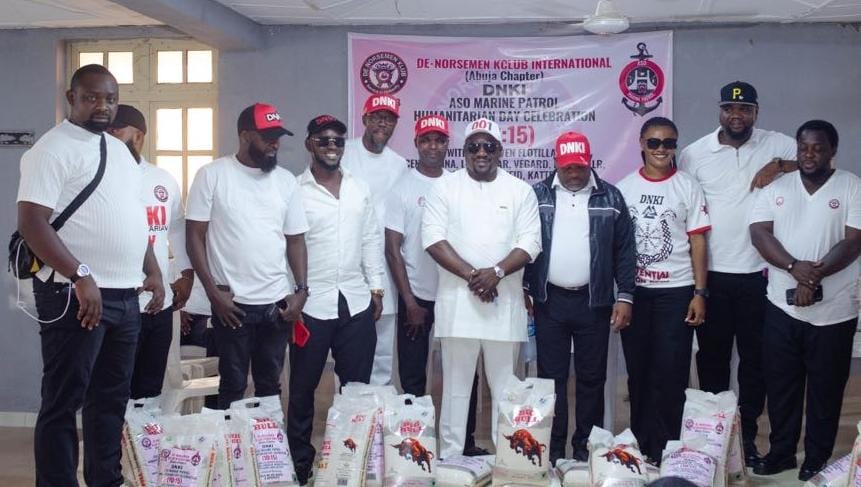
The President of De Norsemen Kclub International (DNKI), Chief Oliver Patrick Ityohegh, has reaffirmed the organisation’s commitment to humanitarian service, stressing the importance of supporting vulnerable people and improving community welfare beyond the annual celebration of Humanitarian Day.
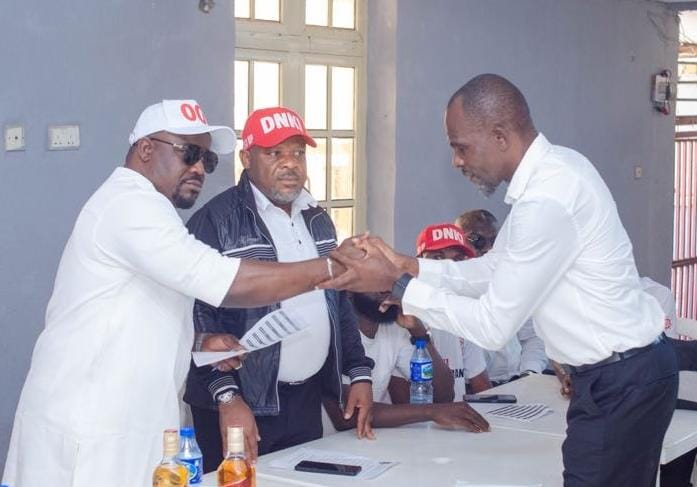
Ityohegh stated this during the organisation’s Cauldron Night and Award Presentation held to commemorate its 2026 Humanitarian Day celebration, theme: “Humanity First: Advancing Hope, Dignity and Community Well-being.” organised by the DNKI Abuja Chapter.
He emphasised that humanitarian service should be a continuous responsibility driven by compassion, solidarity and a commitment to making a meaningful difference in society.
According to him, DNKI’s humanitarian activities reflect its dedication to giving back to society and supporting people in need, while encouraging members to sustain initiatives that promote human dignity and community well-being.
He added that the organisation would continue to strengthen its humanitarian engagements through practical interventions aimed at improving the lives of vulnerable people and promoting community development.
Speaking at the event, the representative of the Abuja Chapter Chairman and Chairman of its Advisory Council, Prince Efiong Okpe, said the organisation’s humanitarian activities extended beyond the annual celebration of Humanitarian Day on October 15.
Okpe explained that DNKI undertook several initiatives throughout the year, including blood donation exercises, visits to hospitals and correctional centres, as well as support for orphanages and other vulnerable groups.
According to him, the organisation also collaborated with humanitarian bodies in the Federal Capital Territory (FCT) to identify areas of need and provide assistance within its available resources.
He described Humanitarian Day as an opportunity for members to renew their commitment to service and demonstrate solidarity with people facing difficult circumstances.
Earlier, the Chairman of the Planning Committee and Coordinator of the DNKI Gwagwalada Zone, Mr Etudaiye Hamzat, disclosed that the chapter had provided financial assistance to some members to help pay their children’s school fees, alongside distributing bags of rice and other relief items to members experiencing hardship.
Hamzat explained that the interventions followed concerns over the difficulties some members faced in meeting their family responsibilities, particularly the rising cost of their children’s education.
He maintained that supporting members in need was consistent with the organisation’s humanitarian principles, adding that DNKI remained committed to extending assistance to non-members and vulnerable communities as part of its commitment to leading by example.
Looking ahead, Hamzat said the Abuja Chapter planned to expand its humanitarian outreach to remote communities within the FCT, with particular attention to orphanages, schools and widows facing difficulties in meeting their family responsibilities.
He also recalled previous interventions for internally displaced persons (IDPs), which included the distribution of food, clothing and educational materials, noting that the chapter intended to scale up such initiatives in the coming year.
The highlight of the event was the presentation of awards to outstanding members and distinguished non-members in recognition of their contributions to humanitarian service.
-
 Featured7 years ago
Lampard Names New Chelsea Manager
-
 Featured7 years ago
FG To Extends Lockdown In FCT, Lagos Ogun states For 7days
-
 Featured7 years ago
Children Custody: Court Adjourns Mike Ezuruonye, Wife’s Case To April 7
-
 Featured7 years ago
NYSC Dismisses Report Of DG’s Plan To Islamize Benue Orientation Camp
-

 Featured5 years ago
Transfer Saga: How Mikel Obi Refused to compensate me After I Linked Him Worth $4m Deal In Kuwait SC – Okafor
-
Featured7 years ago
Board urges FG to establish one-stop rehabilitation centres in 6 geopolitical zones
-
Sports4 years ago
TINUBU LAMBAST DELE MOMODU
-

 News2 years ago
Zulu to Super Eagles B team, President Tinubu is happy with you













