
Basketball
Ban All Contending Parties Killing Nigerian Basketball- Stakeholders Tells Buhari

Concerned Basketball Stakeholders (CBS) has called on President Muhammadu Buhari to with immediate effect ban all the contending parties killing Nigerian basketball to enable the growth of the game in the country.
in an open letter signed by CBS Muhammad Sulaiman (Aka Pro Marquette) sent to President Muhammadu Buhari said that the last five years have equally witnessed an unending Basketball leadership crises with 3 different groups currently in contention urging President to ban all those people bringing crisis in the federation.
According to the open Letter, our attention has been drawn to the recent publication on open letter to President Muhammadu Buhari on the Nigeria Basketball Federation crisis. Firstly, we sincerely thank Mr. President for his bold decision to recluse Nigeria from International Basketball Competitions for two years. Though unpleasant, it is necessary. We also will like to respectfully highlight some facts on the lingering crisis in the Nigeria Basketball Federation, for Mr. President to note: 1.
“Firstly, we sincerely thank Mr. President for his bold decision to recluse Nigeria from International Basketball Competitions for two years.
“Though unpleasant, it is necessary. We also will like to respectfully highlight some facts on the lingering crisis in the Nigeria Basketball Federation, for Mr. President to note:
“Twenty two years of tussle and disagreements in the Basketball Family has all been about leadership and ego and not about developing the game. Our investigations revealed that Chief Jim Nwobodo intervened in 1997 after the 1st democratic election in Sports Federations; Omerua and Ikazabo did in 1999 and Rtd. Col. Musa Mohammed in 2004. All of them threatened drastic measures of dissolution and establishment of Interim Committee for the Sport. They never achieved except now.
“The last five years have equally witnessed an unending Basketball leadership crises with 3 different groups currently in contention.
“This circle of disruptive NBBF elections began in 2017 with 2 factions and presidents (Umar and Kida), and the climax in 2022 following the emergence of a 3rd faction with Igoche Mark as President.
“The court suspension of the National Basketball League for 3 years plus, was because of this leadership disagreements. Youthful local talents have been wasting away for years because of the dysfunctional league.
“National team Players, both Male and Female are entirely drawn from overseas including their Coaches who are all foreigners. At a time there were 10 foreign Coaches attached to our Male team. Harvesting only Nigerian professional Players overseas is not Basketball development. It must go hand in hand with grassroots and home based Players.”
The letter added that: “The unresolved boardroom crisis currently has degenerated into the polarization of National team Players (both Male and Female), and who have expressed their unwillingness to compete for Nigeria under this ugly scenario
“Multiple meetings aimed at resolving the crises have yielded no positive results.
“The Ministry and the Federal Government have been severally misrepresented many times to FIBA and the public by elements from the Kida faction who have used the well-known blackmail tool of Interference to tie Government, and make FIBA call Government a third party. By this, Nigeria’s sovereignty is being challenged and trampled upon by the NBBF gladiators who now want Government to lift the ban.
“Equally well known is that FIBA completely ignored Government’s invitation to visit Nigeria to look into the Basketball crises. The Nigeria Olympic Committee (NOC) was equally snubbed. 1
“Also known, is that the Ministry with the knowledge of FIBA went ahead to set up the Basketball Reconciliation Committee with membership drawn from all disputing parties. The Ministry concurred to the salient recommendations of the Committee. Notwithstanding, the crisis continued.
“Our findings also have shown that there is no NBBF money lodged in the CBN and that the only money in the NBBF account with the CBN is the “Adopt-an-Athlete” funds to the tune of US$230k, to support the 24 Basketball Players that represented the Country at the Olympics. This money has severally been confirmed, was raised by the Ministry and it was domiciled in the NBBF Domiciliary account until disbursement, and that the female Players who have submitted their bank account details have since been paid US$9,500 each last year, and pending is the male Players who are yet to submit their account details for payment.
“It is also confirmed that there is documentary evidence that this money was never diverted, as the balance to date remains in the NBBF account with CBN until disbursement.
“We are aware that from the Tokyo 2020 Olympic Games participation, all athletes have been fully paid their allowances, return flight tickets (where applicable), winning bonuses, as well as their enhanced training grants (increased from 4,500 dollars to 6,000 dollars by the Federal Government), including the Male and Female Basketball Players.
“It is also known, that approval has been received for the balance of outstanding allowances, with the release of the fund being awaited while outstanding claims are being verified by both the Ministries of Finance and Youth and Sports Development.
“We note that the 2019 NBBF Constitution by Kida group remains a hot bone of contention by many segments of Basketball Stakeholders and remains at the heart of the NBBF unending leadership crisis. That same Constitution is not only alien to the Nigeria Sports culture, but is incongruous with the Constitution of other 37 National Sports Federations, and jettisons the Code of Governance of the Sports Ministry.
“Equally central to the crises is the fact that Kida was the architect of the 2019 Constitution in which he had vested interest to return as President, and went on to ensure that sections of the so-called Constitution permitted him and the Vice President to return to office without a constituency with only a voice vote of 2 persons at an Elective Congress. The same Constitution also disqualifies persons who are not resident in Nigeria for 4 consecutive years from being on the board. To a discerning mind, this obviously is targeted at creating a cult group, by eliminating some key Stakeholders that in our opinion are perhaps the most valuable resources the Country has. Obviously, this closes the door for the cream of our top athletes and managers who have retired and currently are key to the development of the game in the US and elsewhere, at a time that the FGN has set up a Diaspora Commission to enhance backward linkages not only in ideas but resources for the development of the Country. The moral question in this illegality is obvious.
“Indeed, efforts to build a national Basketball team around foreign Players and the Afrobasket victories can only be useful to the Country if carefully conceived with backward integration, to have impact on the growth of Basketball in the Country and development of the economy.”
“Open letter continues: “We acknowledge the enormous efforts of past Presidents of the Federation particularly in recent times, HRH U.K Umar and HRM The Gbong Gwom Jos, Elder Buba Gyang for their tireless efforts during their tenure at putting Basketball on a growth trajectory, that has gradually been eroded by ego parading and self-serving so-called administrators. Between these two past Presidents, they have established age group tournaments that saw Nigeria dominate African Junior Championships, win Olympic and World Cup tickets, and established highly competitive local leagues for Men and Women, from where many home grown athletes were drafted to elite leagues worldwide and colleges in the US.
“This advertorial therefore seeks to put the records straight, and in addition by asking that the FGN follow the dissolution of the board, with a ban on the key actors holding the game by the jugular over the last many years. We wish to re-affirm that Basketball is the goose that can lay the golden egg for our teeming youths, but can also with clinical and well thought out reform, provide the template for other Sports to follow so that Nigerian Youths can prosper. ” Open letter concluded.



Basketball
Why Mustapha Abdullahi Is Built for the Job: A New Leadership Opportunity for Nigerian Basketball
Joy Samania
As Nigerian basketball approaches a defining leadership transition, the candidature of Dr. Abdullahi Mustapha is increasingly attracting attention for one simple reason: he is offering the game something beyond an election promise.
He is Offering a Track Record
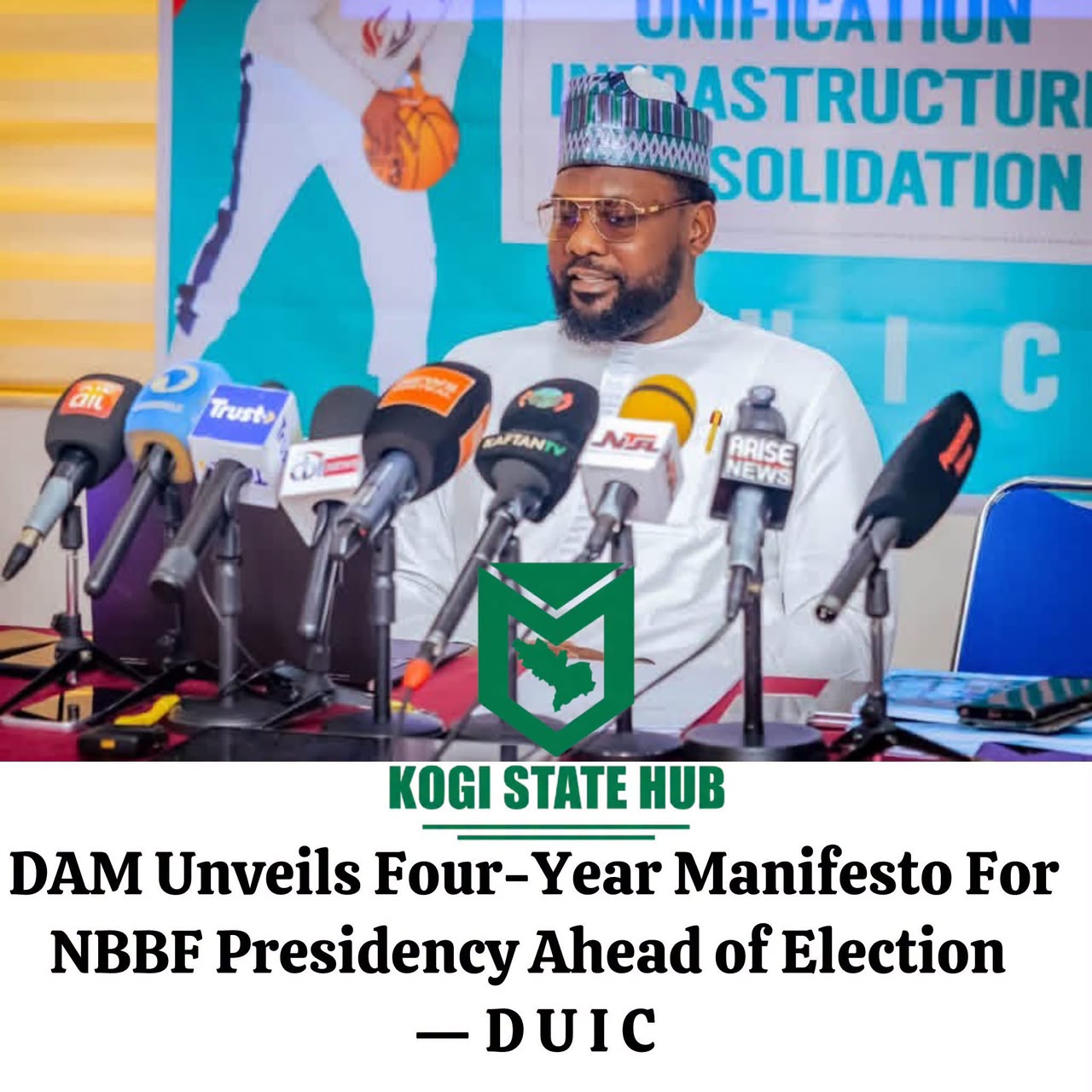
Ahead of the October 15, 2026 Nigeria Basketball Federation, NBBF, elective congress in Abuja, Mustapha has emerged with a proposition anchored on experience inside the game, investment at the grassroots and a professional background built around managing complex institutions.
His message is straightforward: Nigerian basketball does not need another administration that simply manages competitions. It needs an institution that can develop talent, protect players, attract investment, strengthen domestic leagues and build a sustainable pathway from the community court to the national team and, ultimately, the global stage.
That is the thinking behind his “New Dawn” agenda.
And it is also why his candidacy is beginning to resonate with stakeholders looking beyond personalities to the kind of leadership Nigerian basketball needs for its next phase.
From the Basketball Court to the Boardroom
What separates Mustapha from a conventional sports administrator is that his relationship with basketball did not begin with an appointment, a government position or an election.
It began on the court. Reports on his basketball background indicate that his involvement spans more than two decades, including participation with Kano State teams, NUGA competitions, Division One and Premier League basketball, the Nigeria U-18 national team and Trafford Basketball Club in Manchester, United Kingdom.
That playing background gives him an understanding of the sport from the perspective of the athlete, while his subsequent work in grassroots development has given him a close view of the challenges confronting young players long before they reach the national-team level.
For Mustapha, this distinction matters. He has consistently argued that Nigeria’s basketball problem is not a shortage of talent. The problem is the absence of a sufficiently connected system capable of identifying that talent early, developing it consistently and creating opportunities for it to thrive.
That philosophy is already reflected in his work through the Dr. Abdullahi Mustapha Foundation, better known as the DAM Foundation.
He is Already Doing What He Wants the NBBF to do
The strongest argument for Mustapha’s candidacy may be that his campaign promises are not entirely theoretical.
Through the DAM Foundation, he has supported grassroots basketball infrastructure and competitions, including the construction of a basketball court in Kano and the sponsorship of tournaments.
The foundation also runs the annual DAM Foundation Basketball Championship in Okene, Kogi State, providing young players with competitive opportunities and visibility.
Stakeholders have further cited the foundation’s basketball academy, reported to involve more than 500 children, alongside support for player welfare, scholarships, medical assistance, business grants and employment opportunities.
In April 2026, the foundation also backed a North-West regional basketball tournament, reinforcing its focus on using competition and community sport as vehicles for youth development.
This is important because the central pillar of Mustapha’s NBBF programme is grassroots development.
He wants a national schools basketball programme, regional talent centres and a national player-identification and tracking system that can connect schools and communities to academies, clubs, domestic leagues and national teams.
In other words, he is not proposing to start caring about grassroots basketball after winning the election. He has already been putting resources into it.
A Technocrat Who Understands Institutions
Mustapha’s professional career provides another dimension to his candidacy. President Bola Ahmed Tinubu appointed him Director-General and Chief Executive Officer of the Energy Commission of Nigeria in October 2023. The Presidency cited his more than a decade of experience in the Nigerian petroleum regulatory system and his background in energy and space technology.
The position places him at the helm of a federal institution responsible for national energy policy, planning and research. The Energy Commission has subsequently highlighted institutional growth, renewable-energy initiatives, international collaboration and sustainable power development among areas of progress under his leadership.
That experience is potentially significant for the NBBF. Running a national sports federation is not simply about understanding the sport. It requires administration, budgeting, stakeholder management, strategic planning, partnerships, accountability and the ability to turn policy into programmes.
Mustapha’s career has been built around precisely those disciplines. He is a Chartered Engineer and a member of the Institution of Mechanical Engineers. His academic career includes a PhD in Mechanical Engineering from the University of Manchester, where he also worked in the School of Engineering as a researcher and teaching assistant. His professional experience has crossed petroleum regulation, space technology, research, engineering and government policy.
That combination gives his basketball proposition an unusual dimension: sporting understanding backed by institutional and technical management experience.
His Blueprint Goes Beyond Winning Games
Mustapha’s “New Dawn” agenda is deliberately broader than national-team performance. His proposed reforms cover seven interconnected areas: grassroots development, domestic competitions, technical capacity, national teams, infrastructure, commercialisation and unity.
On domestic basketball, he is calling for predictable competition calendars, stronger club structures, proper licensing, improved player contracts and welfare, better venues, digital statistics and stronger broadcasting and commercial platforms. That addresses one of the fundamental problems in any sporting ecosystem: talent cannot develop without meaningful competition.
A young player needs a court. Then a coach. Then regular games. Then a properly organised league. Then exposure. Then a pathway to the national team. Then an ecosystem capable of supporting a career.
Mustapha’s proposed structure is designed around that chain.
From Emergency National Teams to Permanent Development
Perhaps the most consequential part of his proposal concerns Nigeria’s national teams.
Mustapha has argued that D’Tigers, D’Tigress and Nigeria’s age-grade teams should no longer depend on emergency preparations whenever major competitions approach.
His proposal calls for earlier preparation, merit-based selection, professional technical teams, medical support, improved welfare and long-term succession planning. That approach would represent a significant shift from viewing national teams primarily as tournament projects to treating them as the final products of a continuous national development system.
And he has placed women’s basketball firmly within that vision. The remarkable achievements of D’Tigress, he argues, demonstrate what Nigerian basketball can accomplish when talent is properly supported.
His proposed administration would therefore make women’s basketball a major component of its development agenda rather than an afterthought.
He Understands That Basketball Must Become an Economy
Another defining feature of Mustapha’s campaign is his emphasis on commercialisation. He wants the NBBF to move beyond dependence on periodic government support and build sustainable revenue through sponsorship, broadcasting and digital rights, merchandise, event management, corporate partnerships, diaspora engagement and international development funding.
This is a critical proposition for a sport with Nigeria’s enormous basketball population. The objective is not simply to find sponsors for the next tournament.
It is to make Nigerian basketball valuable enough that sponsors, broadcasters, investors, clubs and commercial partners have compelling reasons to remain involved.
That means better competitions. Better data. Better storytelling. Better facilities. Better player visibility. Better commercial packaging. And, ultimately, a federation capable of demonstrating value to its partners.
His campaign is built around a player who understands the court, a grassroots investor who understands development, an engineer who understands systems and a public-sector executive who has experience managing institutions.
That combination is the foundation of his case. He is not presenting himself as someone coming to discover Nigerian basketball after winning an election.
He is presenting himself as someone who has already invested in the game, understands its people and has spent his professional career building systems.
-
 Featured7 years ago
Lampard Names New Chelsea Manager
-
 Featured7 years ago
FG To Extends Lockdown In FCT, Lagos Ogun states For 7days
-
 Featured7 years ago
Children Custody: Court Adjourns Mike Ezuruonye, Wife’s Case To April 7
-
 Featured7 years ago
NYSC Dismisses Report Of DG’s Plan To Islamize Benue Orientation Camp
-

 Featured5 years ago
Transfer Saga: How Mikel Obi Refused to compensate me After I Linked Him Worth $4m Deal In Kuwait SC – Okafor
-
Featured7 years ago
Board urges FG to establish one-stop rehabilitation centres in 6 geopolitical zones
-
Sports4 years ago
TINUBU LAMBAST DELE MOMODU
-

 News2 years ago
Zulu to Super Eagles B team, President Tinubu is happy with you













