
Foreign news
Beauty West Africa exhibition begins in Lagos with 16 Pakistani companies, others
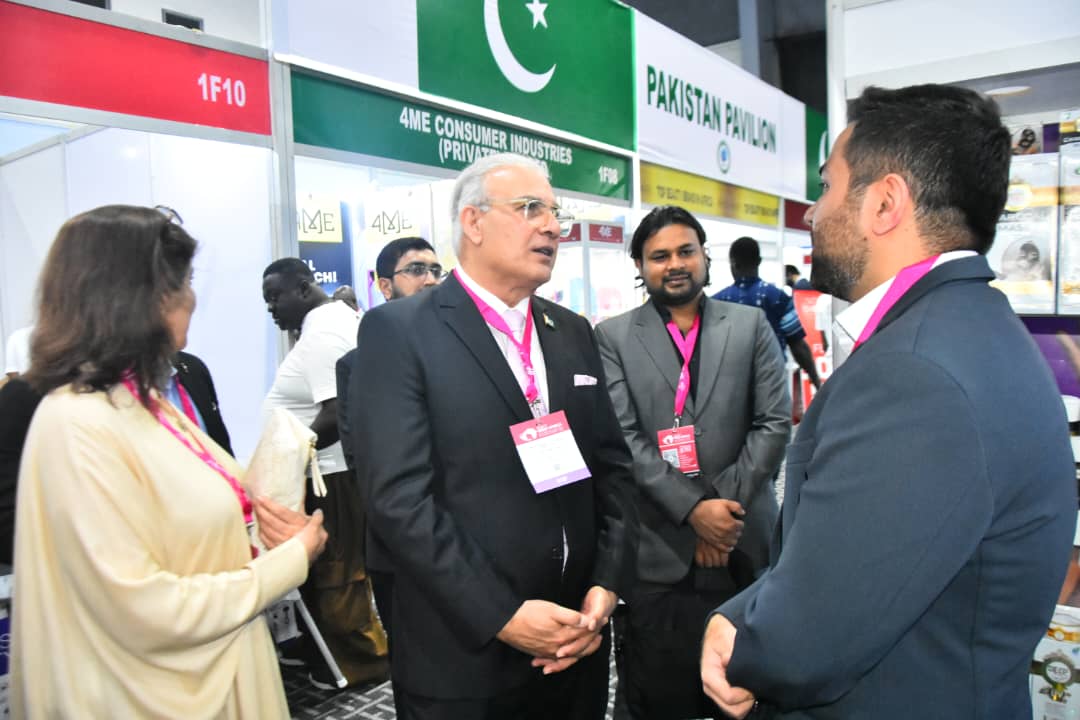
The Beauty West Africa Exhibition begins in Lagos, the commercial city of Nigeria where 16 Pakistani companies, 30 delegations and other exhibitors are in attendance.
The News Agency of Nigeria (NAN) reports that the 7th edition of the exhibition is scheduled to hold from Nov. 26 to 28.
The 2024 event is termed as the biggest of the beauty exhibition in recent years with more companies and exhibitors showcasing hair care products, cosmetics, herbal and organic products among others.
Also, Retired Maj.-Gen. Sohail Khan, the High Commissioner of Pakistan to Nigeria would be addressing the high level delegation during the programme.
The Pakistani delegations would be looking forward to a robust outing as business exchange, signing of Memorandum of Understandings (MoUs) and synergies would be established.
Speaking with NAN on the sidelines of the event, Mr Samnoon Basraa, the Pakistani Trade Attache to Nigeria, said that he was glad to be in Nigeria, participating in the West Africa beauty exhibition to showcase his country’s products.
He said that the government of Pakistan strengthened its focus within African policy since it was formulated in 2017.
He added that since the policy was made, the trade volume between Nigeria and Pakistan had gradually increased.
“Our total trade is increasing, and if you compare the first four months of this fiscal year, from July to October, with the previous year, Pakistani exports have increased by 48 per cent and similarly, Pakistani imports from Nigeria are also increasing.
“Pakistan values are imports of liquefied natural gas and soya bean from Nigeria, which is gradually increasing as well, ‘’he said.
Speaking on the huge demand for beauty products, Samnoon said that both countries’ beauty products and cosmetics offer cost effective, cheap, and good quality products .
“Most Pakistani companies at the exhibition are working towards investing in Nigeria. They are not just in Nigeria to increase on our exports alone, it’s both ways.
“So, this is just the first time that 16 companies were invited by the Lagos State government to participate at the West Africa Beauty Exhibition.
“This shows progress and they are receiving very good responses from the Nigerian market, while some of them are already here registered in Nigeria while others are interested in registering in Nigeria,’’ he said.
NAN also reports that over 300 companies from 52 countries were currently participating at the exhibition in Lagos.
NAN



Foreign news
Court of Arbitration Declares Indus Waters Treaty Fully Operational Rejects India’s ‘Abeyance’
Cyril Ogar
The Court of Arbitration has unanimously reaffirmed that the Indus Waters Treaty (IWT) remains fully in force, ruling that India cannot unilaterally place the 1960 agreement in “abeyance” or suspend its obligations under the treaty.
The decision represents a significant legal development in the longstanding dispute between India and Pakistan over the management and use of the Indus river system.
The Court’s finding addresses a fundamental issue at the heart of the dispute: whether either party can unilaterally suspend the treaty outside the legal framework agreed by both countries.
In its unanimous determination, the Court made clear that the IWT continues to bind both India and Pakistan and that its obligations cannot be set aside through a unilateral political declaration.
The ruling means India remains subject to the treaty provisions governing the use of the Western Rivers, including requirements relating to the design and operation of hydroelectric projects, as well as the dispute-resolution mechanisms established under the agreement.
The Court has also ordered interim measures concerning the Ratle Hydroelectric Plant, restricting specified construction activities while the broader dispute remains under consideration.
The measures are aimed at preserving the effectiveness of the arbitration process and preventing developments that could prejudice the outcome of the proceedings.
For Pakistan, the decision represents significant legal validation of its longstanding position that the IWT is a binding international agreement and contains no provision allowing either party to unilaterally place it in abeyance.
Pakistan has consistently maintained that disagreements over the treaty should be addressed through the institutional mechanisms established by the agreement, rather than through unilateral action.
The IWT provides a structured framework for resolving disputes through mechanisms including the Permanent Indus Commission, Neutral Expert and Court of Arbitration processes.
The latest ruling therefore reinforces the principle that treaty obligations cannot simply be disregarded because of deteriorating political relations between signatories.
The significance of the decision extends beyond the India-Pakistan dispute. It underscores the broader international-law principle that agreements governing shared rivers and other transboundary resources must be respected and disputes resolved through established legal and institutional channels.
The Indus river system supports agriculture, livelihoods, food security and communities across the region, making the stability of the treaty particularly important.
The ruling also highlights the distinction between seeking to amend an international agreement through mutually agreed procedures and attempting to alter its obligations unilaterally.
The IWT has endured wars, prolonged diplomatic tensions and periods of limited bilateral engagement. Its continued operation demonstrates the importance of rules-based mechanisms in managing shared resources when relations between neighbouring states become strained.
For Pakistan, the outcome provides an opportunity to frame the decision not merely as a bilateral legal victory, but as an affirmation of international law, treaty compliance and peaceful dispute resolution.
The central message from the ruling is clear: the Indus Waters Treaty remains in force, its obligations continue to bind both parties, and disputes concerning shared waters must be addressed through the legal mechanisms agreed by India and Pakistan.
-
 Featured7 years ago
Lampard Names New Chelsea Manager
-
 Featured7 years ago
FG To Extends Lockdown In FCT, Lagos Ogun states For 7days
-
 Featured7 years ago
Children Custody: Court Adjourns Mike Ezuruonye, Wife’s Case To April 7
-
 Featured7 years ago
NYSC Dismisses Report Of DG’s Plan To Islamize Benue Orientation Camp
-

 Featured5 years ago
Transfer Saga: How Mikel Obi Refused to compensate me After I Linked Him Worth $4m Deal In Kuwait SC – Okafor
-
Featured7 years ago
Board urges FG to establish one-stop rehabilitation centres in 6 geopolitical zones
-
Sports4 years ago
TINUBU LAMBAST DELE MOMODU
-

 News2 years ago
Zulu to Super Eagles B team, President Tinubu is happy with you