
Foreign news
Chinese FM makes proposal on building China-Africa community with shared future
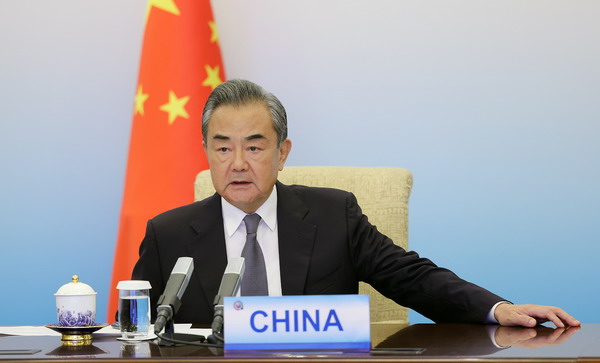
Chinese State Councilor and Foreign Minister Wang Yi on Thursday proposed building a China-Africa community with a shared future in the new era at a meeting reviewing the progress made in China-Africa cooperation.
At the 8th Ministerial Conference of the Forum on China-Africa Cooperation (FOCAC) held in Dakar, Senegal, last November, China announced it would implement nine programs jointly with African countries, demonstrating sustained cooperation and commitment to the continent.
Wang said the two sides had implemented those decisions with good progress and brought tangible benefits to the African people in his speech to the Coordinators’ Meeting on the Implementation of the Follow-up Actions of the Eighth Ministerial Conference of the Forum on China-Africa Cooperation (FOCAC) which he hosted via video link.
China and Africa have worked with absolute sincerity to safeguard international fairness and justice, push forward infrastructural construction to facilitate the industrialization drive of Africa, jointly cope with the global food crisis and the COVID-19 pandemic, pursue sustainable development through clean energy cooperation and climate change response, and promote regional peace and stability, Wang said.
Noting that this year marks the 20th anniversary of the founding of the African Union (AU), Wang said China and Africa should unite more closely to pursue common development and revitalization and earnestly build a China-Africa community with a shared future in the new era.
First, both sides should uphold the principle of sincerity, real results, amity and good faith, and strengthen unity and mutual assistance. China is ready to work with Africa to carry forward the Five Principles of Peaceful Coexistence, practice true multilateralism and jointly safeguard the legitimate rights and interests of developing countries.
Second, both sides should be committed to common development. China will continue to take an active role in Africa’s major infrastructure construction, continue to increase imports from Africa, support the growth of Africa’s agriculture and manufacturing industries, and expand cooperation in emerging industries.
Third, both sides should be committed to independence and jointly promote regional peace. China will continue to support African solutions to African issues, oppose external interference in the internal affairs of African countries, and oppose creating confrontations and conflicts in Africa.
Fourth, both sides should uphold traditional friendship and promote people-to-people exchanges. China is ready to overcome difficulties caused by the pandemic and help African students who previously studied in China to return. China supports think tanks, media, non-governmental organizations, youth and women of both sides to strengthen exchanges and cooperation.
Fifth, both sides should adhere to openness and win-win cooperation to promote the sound development of international cooperation with Africa.
The meeting was attended by Aissata Tall Sall, foreign minister of Senegal, the African co-chair country of the FOCAC, as well as representatives of African subregions and the AU Commission, and diplomatic envoys of African countries in China.
They reaffirmed their adherence to the principles of international fairness and justice and non-interference in internal affairs and to the one-China principle, and their firm support for China’s efforts to safeguard national sovereignty and territorial integrity.
The African side is willing to work with China to continue to strengthen the construction of forum mechanisms and promote the continuous upgrading of Africa-China cooperation, according to the African diplomats.
The meeting also adopted the Joint Statement of the Coordinators’ Meeting on the Implementation of the Follow-up Actions of the Eighth Ministerial Conference of the FOCAC.



Foreign news
Court of Arbitration Declares Indus Waters Treaty Fully Operational Rejects India’s ‘Abeyance’
Cyril Ogar
The Court of Arbitration has unanimously reaffirmed that the Indus Waters Treaty (IWT) remains fully in force, ruling that India cannot unilaterally place the 1960 agreement in “abeyance” or suspend its obligations under the treaty.
The decision represents a significant legal development in the longstanding dispute between India and Pakistan over the management and use of the Indus river system.
The Court’s finding addresses a fundamental issue at the heart of the dispute: whether either party can unilaterally suspend the treaty outside the legal framework agreed by both countries.
In its unanimous determination, the Court made clear that the IWT continues to bind both India and Pakistan and that its obligations cannot be set aside through a unilateral political declaration.
The ruling means India remains subject to the treaty provisions governing the use of the Western Rivers, including requirements relating to the design and operation of hydroelectric projects, as well as the dispute-resolution mechanisms established under the agreement.
The Court has also ordered interim measures concerning the Ratle Hydroelectric Plant, restricting specified construction activities while the broader dispute remains under consideration.
The measures are aimed at preserving the effectiveness of the arbitration process and preventing developments that could prejudice the outcome of the proceedings.
For Pakistan, the decision represents significant legal validation of its longstanding position that the IWT is a binding international agreement and contains no provision allowing either party to unilaterally place it in abeyance.
Pakistan has consistently maintained that disagreements over the treaty should be addressed through the institutional mechanisms established by the agreement, rather than through unilateral action.
The IWT provides a structured framework for resolving disputes through mechanisms including the Permanent Indus Commission, Neutral Expert and Court of Arbitration processes.
The latest ruling therefore reinforces the principle that treaty obligations cannot simply be disregarded because of deteriorating political relations between signatories.
The significance of the decision extends beyond the India-Pakistan dispute. It underscores the broader international-law principle that agreements governing shared rivers and other transboundary resources must be respected and disputes resolved through established legal and institutional channels.
The Indus river system supports agriculture, livelihoods, food security and communities across the region, making the stability of the treaty particularly important.
The ruling also highlights the distinction between seeking to amend an international agreement through mutually agreed procedures and attempting to alter its obligations unilaterally.
The IWT has endured wars, prolonged diplomatic tensions and periods of limited bilateral engagement. Its continued operation demonstrates the importance of rules-based mechanisms in managing shared resources when relations between neighbouring states become strained.
For Pakistan, the outcome provides an opportunity to frame the decision not merely as a bilateral legal victory, but as an affirmation of international law, treaty compliance and peaceful dispute resolution.
The central message from the ruling is clear: the Indus Waters Treaty remains in force, its obligations continue to bind both parties, and disputes concerning shared waters must be addressed through the legal mechanisms agreed by India and Pakistan.
-
 Featured7 years ago
Lampard Names New Chelsea Manager
-
 Featured7 years ago
FG To Extends Lockdown In FCT, Lagos Ogun states For 7days
-
 Featured7 years ago
Children Custody: Court Adjourns Mike Ezuruonye, Wife’s Case To April 7
-
 Featured7 years ago
NYSC Dismisses Report Of DG’s Plan To Islamize Benue Orientation Camp
-

 Featured5 years ago
Transfer Saga: How Mikel Obi Refused to compensate me After I Linked Him Worth $4m Deal In Kuwait SC – Okafor
-
Featured7 years ago
Board urges FG to establish one-stop rehabilitation centres in 6 geopolitical zones
-
Sports4 years ago
TINUBU LAMBAST DELE MOMODU
-

 News2 years ago
Zulu to Super Eagles B team, President Tinubu is happy with you