
News
COAS, Samdaddy, Yahaya Bello, others top list of 2022 Friends of Nollywood Awards

As the preparations for the 2022 edition of the prestigious Friends of Nollywood Awards gets to advanced stage, the honours list for this year’s edition has got Chief of Army Staff, Leitnant General Yahaya Farouk, Kogi State Governor, Yahaya Bello, Lagos State Governor, Babajide Sanwa-Olu, PDP national Secretary Samuel Anyanwu, topping the list of awardees
This was contained in a statement signed by Nzeh Frankwhite and Steve Eboh, Team Lead and Chairman Award selection committee respectively
According to the statement, ” this year’s list was carefully selected to reflect the a balance of men and women that have been of immense support and encouragement to the developmental strides of the Nigerian movie industry from their various little spaces.
Other prominent Nigerians that made the list are; IGP, Usman Alkali Baba, Dr Young Toby Ekechi, MD/CEO First Generations Mortgage Bank, Chief Chris Igbokwe, Barrister Uju Kennedy, Chief of the Air Staff, AVM Isiaka Amao, Prof Ali Pantami, Princess Adejoke Adefulire, Abubakar Abdullahi Kure, Prince Alex Mbata among others
According to the organisers, the 2022 edition of this prestigious award promises to be different as it will be presented as part of the closing sessions of the maiden Nollywood Technology & Security Summit.
A night of glitz, glamour and razzmatazz, with numerous industry stakeholder, actors, producers, directors, etc.
The Friends of Nollywood Award was birthed in 2006, in partnership with top industry stakeholders to reward, honour and celebrate non film practitioners who have partnered and supported the growth and progress of the Nigeria movie industry, directly or indirectly
This year’s edition is scheduled for the 15th day of November, with the theme, Nollywood a Pillar in Nigeria’s Socioeconomic Development to be delivered by Dr Young Toby Ekechi, MD/CEO First Generations Mortgage Bank, at the prestigious Bolingo Xpera Hotels, Abuja
Some of the past recipients of this prestigious award includes; former president Olusegun Obasanjo, former President Goodluck Jonathan, Late former president Umar Musa Yar’Adua, Mr Emeka Mba, Sir Mike Okiro, Mallam Isa Yuguda, Alhaji Rabiu Isiaku Rabiu, Alhaji Buba Marwa, among several others



News
NJC Cannot Dictate Chief Judge Nominee to Imo JSC, Attorney-General Insists
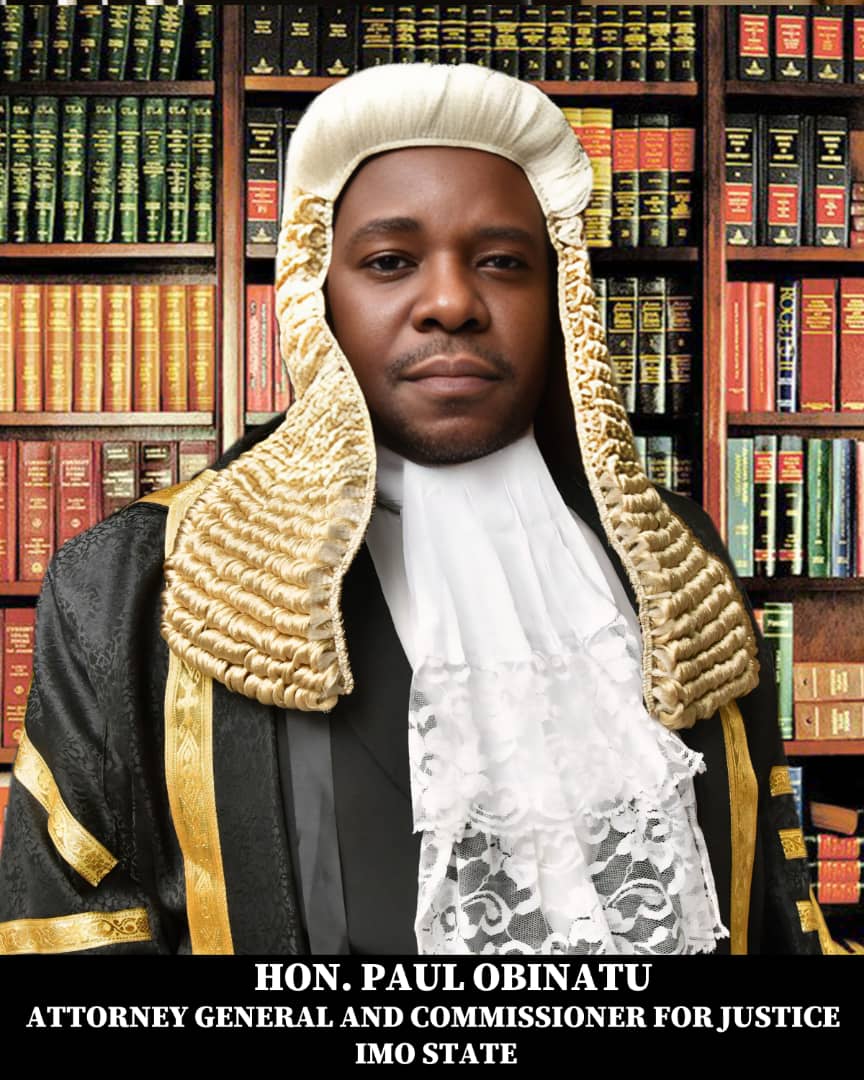
Joel Ajayi
The Imo State Attorney-General and Commissioner for Justice, Hon. Paul Obinatu has challenged the constitutional authority of the National Judicial Council (NJC) to direct the Imo State Judicial Service Commission (JSC) on the candidate whose name it should submit for consideration in the appointment of a substantive Chief Judge of the state, describing such an intervention as an encroachment on the constitutionally guaranteed independence of the State Commission.
In a statement issued on November 6, 2026, the Attorney-General maintained that the NJC lacks the constitutional authority to dictate, control or substitute its preferred candidate for the independent assessment and recommendation process entrusted to the Imo State JSC under the 1999 Constitution, as amended.
The objection follows a directive reportedly issued by the NJC to the Imo State JSC at its 112th meeting held on November 3, 2026, concerning the appointment of a substantive Chief Judge for the state.
The Attorney-General argued that the NJC’s constitutional responsibility to recommend a candidate to the Governor does not confer on it the additional power to determine or dictate the candidate the State Judicial Service Commission must submit to it. He maintained that the directive is constitutionally untenable because it interferes with a responsibility expressly vested in the State Judicial Service Commission.
SECTION 202 GUARANTEES IMO JSC’S INDEPENDENCE
Central to the Attorney-General’s objection is Section 202 of the Constitution, which expressly provides that the State Judicial Service Commission shall not be subject to the direction or control of any other authority or person in exercising its constitutionally assigned powers.
He argued that this provision establishes a clear constitutional safeguard against external interference in the Commission’s responsibilities and cannot be overridden by the NJC through administrative directives or procedural guidelines.
According to him, the NJC cannot invoke its national institutional status or its recommendation powers to exercise control over the Imo State JSC in a manner inconsistent with the Constitution.
Consequently, any directive requiring the State JSC to submit a particular candidate or dictating the outcome of its independent assessment would, in the Attorney-General’s interpretation, amount to unconstitutional interference.
CONSTITUTION ASSIGNS DISTINCT RESPONSIBILITIES TO NJC AND STATE JSC
The Attorney-General anchored his position on Section 271(1) and the relevant provisions of the Third Schedule to the Constitution.
Paragraph 6(a) of Part II of the Third Schedule empowers the State Judicial Service Commission to advise the NJC on suitable persons for nomination as Chief Judge of the state.
Conversely, Paragraph 21(c) of Part I of the Third Schedule empowers the NJC to recommend to the Governor, from among the list of persons submitted by the State JSC, a candidate for appointment as Chief Judge.
Section 271(1) further provides that the appointment shall be made by the Governor on the recommendation of the NJC, subject to confirmation by the State House of Assembly.
According to the Attorney-General, these provisions establish a clear constitutional sequence: the State JSC identifies and advises on suitable candidates, the NJC considers the submitted names and makes its recommendation to the Governor, while the Governor exercises the appointing authority subject to legislative confirmation.
He insisted that the NJC’s recommendation powers cannot be interpreted as authority to dictate which candidate the State JSC must select or submit, as doing so would effectively transfer the Commission’s constitutional responsibility to the NJC and render Section 202 meaningless.
NJC GUIDELINES CANNOT OVERRIDE THE CONSTITUTION
Addressing the NJC’s Guidelines and Procedural Rules for the Appointment of Judicial Officers, the Attorney-General acknowledged the Council’s authority to prescribe and enforce procedural requirements for judicial appointments.
However, he maintained that such guidelines cannot confer powers beyond those granted by the Constitution or be used to compromise the independent functions of the State JSC.
He stressed that the NJC’s responsibility to ensure compliance with appointment procedures must not be extended to usurping the constitutional authority of the Imo State Judicial Service Commission.
COURT DECISIONS REINFORCE ATTORNEY-GENERAL’S POSITION
In support of his argument, the Attorney-General cited several judicial authorities which he said affirm the importance of constitutional boundaries and institutional independence.
They include Elelu-Habeeb & Anor. v. Attorney-General of the Federation & Ors. (2012) LPELR-15515(SC), Kano State Public Complaints and Anti-Corruption Commission & Anor. v. Salisu & Ors. (2019) LPELR-47107(CA), and Bamisile v. National Judicial Council & Ors. (2012) LPELR-8381(CA).
Other authorities referenced are FRN v. Nganjiwa (2022) LPELR-58066(SC), NJC & Ors. v. Senlong & Ors. (2010) LPELR-4582(CA), and Attorney-General of the Federation v. Attorney-General of Abia State & Ors. (2024) LPELR-62576(SC).
The Attorney-General maintained that these authorities reinforce the principle that every constitutional institution must exercise its powers strictly within the limits prescribed by law, irrespective of its institutional standing.
IMO CHIEF JUDGE APPOINTMENT MUST FOLLOW CONSTITUTIONAL PROCEDURE
The Attorney-General warned that allowing the NJC to assume functions constitutionally assigned to the State JSC would undermine the integrity of the judicial appointment process and compromise the independence of the Commission.
He maintained that the issue is not a contest for institutional superiority between the NJC and the State JSC, but the need for each institution to respect the constitutional boundaries of its authority.
He further emphasised that the NJC’s responsibility to recommend a candidate to the Governor must not be confused with the power to control the independent selection and submission process of the State Commission.
The Attorney-General insisted that the ongoing appointment process must be conducted strictly in accordance with the Constitution, without interference that could undermine public confidence in the judiciary.
For the Imo State Attorney-General, the constitutional position is clear: while the NJC has the responsibility to recommend a candidate to the Governor, it has no authority to dictate to the Imo State Judicial Service Commission the candidate whose name it must submit in the exercise of its independent constitutional mandate.
-
 Featured7 years ago
Lampard Names New Chelsea Manager
-
 Featured7 years ago
FG To Extends Lockdown In FCT, Lagos Ogun states For 7days
-
 Featured7 years ago
Children Custody: Court Adjourns Mike Ezuruonye, Wife’s Case To April 7
-
 Featured7 years ago
NYSC Dismisses Report Of DG’s Plan To Islamize Benue Orientation Camp
-

 Featured5 years ago
Transfer Saga: How Mikel Obi Refused to compensate me After I Linked Him Worth $4m Deal In Kuwait SC – Okafor
-
Featured7 years ago
Board urges FG to establish one-stop rehabilitation centres in 6 geopolitical zones
-
Sports4 years ago
TINUBU LAMBAST DELE MOMODU
-

 News2 years ago
Zulu to Super Eagles B team, President Tinubu is happy with you













