
News
Corruption In Tax Administration: Nigerians Urge Govt To Leverage Technology
… say use of touts in tax collection abetting corruption
Joel Ajayi
To curb corruption and arbitrariness in tax administration, governments at all levels have been urged to leverage technology and desist from using touts in collecting revenue.
The call for federal, state, and local government to address the problem of tax fraud and other forms of irregularities was made by participants during an anti-corruption radio program, PUBLIC CONSCIENCE, produced by the Progressive Impact Organization for Community Development, PRIMORG, Wednesday in Abuja.
It follows separate investigative reports published by the International Center for Investigative Reporting (ICIR) on how millions of naira generated from cattle taxes in Kano State end up in private pockets.
It was also reported that residents of Ardo Kola and Gassol Local Government Areas (LGAs) of Taraba State continue groaning under ‘excess taxation and corruption.
Speaking during the radio programme, financial analyst Agaba Wilson Agaba cautioned that tax administration in Nigeria will remain ineffective and laden with corruption if authorities continue using touts popularly called ‘agberos’ to collect revenues rather than deploy technology.
Agaba noted that arbitrary taxes at the local government level have become a norm over the years, lamenting that the situation is killing the economy of several communities.
He knocked state governments, allowing the corruption in tax administration to fester. At the same time, citizens bear the brunt, blaming state governors for deliberately allowing non-state actors to collect arbitrary taxes as political patronage.
“Touts or ‘agberos’ collecting tax should be abolished. Let us legislate so that these kinds of activities are removed. We shouldn’t have non-state actors collecting taxes on behalf of the government in days when we have technology that can do that.
“People in the LGAs should have their IT departments to monitor these kinds of software, and these revenues can be collected. There should be accredited agent bankers within the markets, just like POS operators, to collect the taxes and issue receipts, and then you can do your checks and balances and give them a small commission.
“What you see in many states is that since the governors loot the local government funds, they leave the people at the grassroots to find other means to fund themselves – our democracy is highly corrupted.
“The reasons these things happen are political, and once you leave these kinds of things to non-state actors, they are bound to do whatever they deem fit,’ he warned.
Agaba called on citizens to demand accountability from leaders that are superintending over their taxes while applauding PRIMORG for educating Nigerians on their rights and responsibilities vis-à-vis tax administration.
“What your organization (PRIMORG) is doing today is commendable – creating awareness and public awareness. I call on more NGOs and organizations to go out there and do more of these kinds of enlightenment,” Agaba stated.
On his part, a member of the Ardo Kola LGA, Taraba State, Pius Naphtali, corroborated ICIR’s investigative report and lamented that residents and business owners in the community are facing excessive taxation, alleging that 50 percent of the taxes are diverted.
Naphtali stated that not all tax payments are given receipt for, adding that the ripping off of residents and business owners through arbitrary taxes was happening across the state.
He urged the government to look into the problem as the people are running out of patience and beginning to resist paying indiscriminate taxes to touts working for the local council.
“It’s quite endemic and something that needs to be looked into for a change. If Small and Medium Enterprises (SMEs) have to be encouraged, multiple taxations need to be dealt with, the reason being that local government authorities come up with various means of taxation without checking how much the business owner is earning. They just give a fixed amount in tax without trying to match the corresponding income.
Asked to justify the allegation that the local government tax collectors are diverting revenues into their pockets, Naphtali said, “It has often been observed that people that pay tax are given receipts, but sometimes, the receipt is foul. A situation where people who pay more than N5,000 are given receipts and people who pay less are not given receipts; instead, their names are written in a tax book.
“It got me wondering where the funds go because I believe it goes into individual pockets. Fifty percent doesn’t get into the government coffers. It’s something that needs to be brought to a stop, “Naphtali said.
Earlier, Investigative Journalist Shamsiyya Hamza Sulaiman called on the Kano state government to take a close look at the investigation and stop arbitrary taxes slammed on cattle businesses in the state.
Sulaiman explained how millions of naira generated from cattle tax are diverted and do not get to the government coffers, saying that cattle markets at Wudil, Dambatta, and Bichi generate at least N120,000,000 each. Still, the state government gets nothing from them.
She revealed that each market receives no fewer than 5,000 heads of cattle each week at N500 per head. Additionally, cattle traders are sad over the multiple taxation and do not get a receipt every time they pay.
“Kano State government is aware of this investigation, but they said they are unaware of arbitrary tax at the cattle markets. Local government authorities are not interested in the accountability of the taxes collected.
“No law indicates that cattle tax should be collected in Kano State. There used to be a rule 50 years back, but it’s been ruled out.
“The traders said that they don’t see the use for the taxes, they are not comfortable, and that they are forced to pay. Sometimes, they don’t get to make sales, yet they pay taxes on each cattle. Still, the market union said they use the tax to pay for the refuse bin, the cleaning and tidying of the market square, security, road repairs, electricity bills and water supply,” Sulaiman stated.
Public Conscience is a syndicated weekly anti-corruption radio program PRIMORG uses to draw government and citizens’ attention to corruption and integrity issues in Nigeria.
The program has the support of the MacArthur Foundation.



Foreign news
Algeria’s Glorious Revolution: Embassy Marks 72nd Anniversary in Abuja
Joel Ajayi
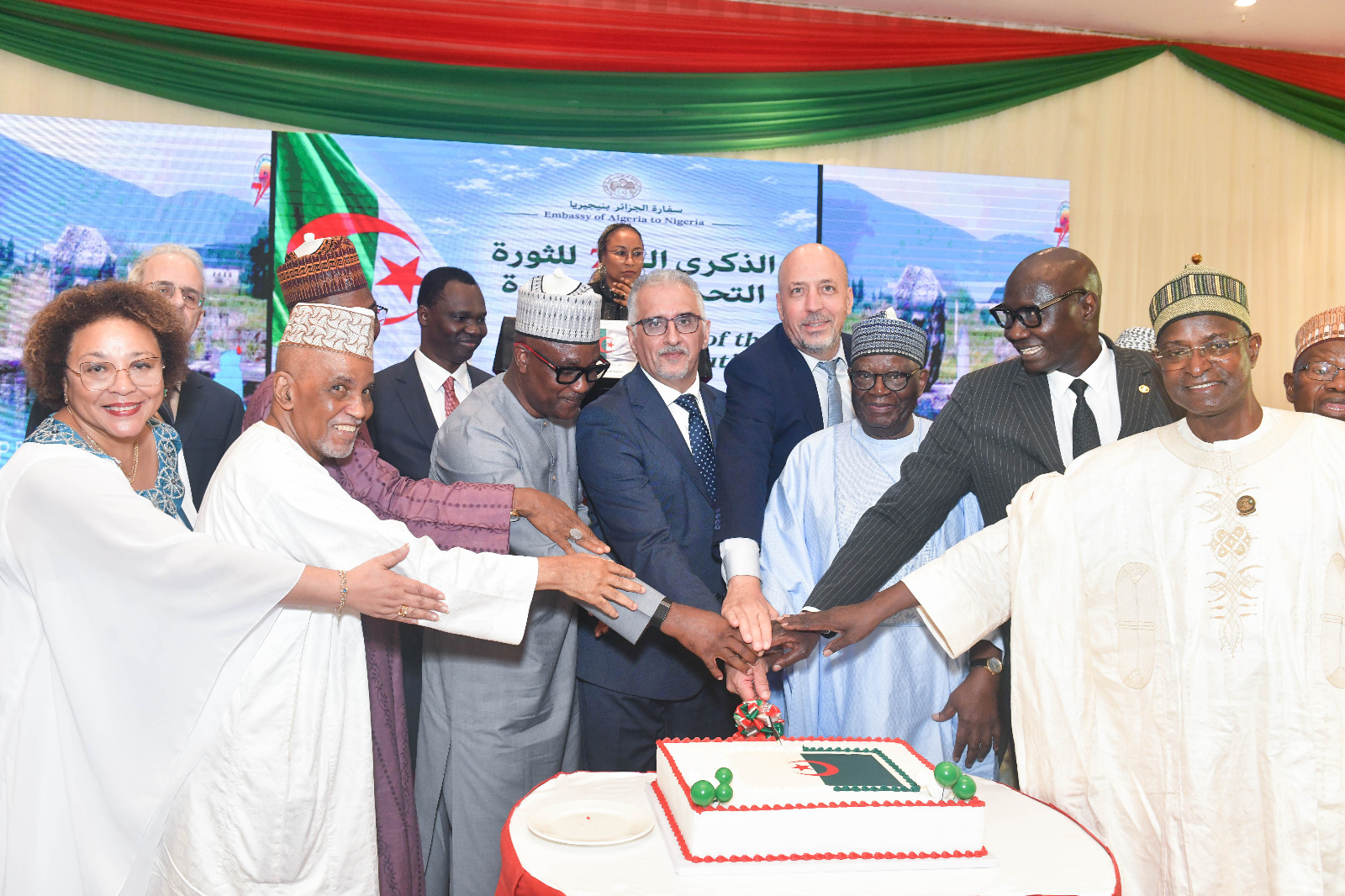
The Embassy of Algeria in Nigeria has commemorated the 72nd anniversary of the country’s Glorious Revolution of November 1, 1954, with a reception in Abuja, highlighting Algeria’s liberation struggle and strengthening diplomatic relations with Nigeria.
The event, held on November 9, 2026, at Continental Suites Hotel, attracted prominent personalities, including the Speaker of the House of Representatives, Dr Tajudeen Abbas, members of the Federal Government, senior government officials, heads of diplomatic missions and other friends of Algeria.
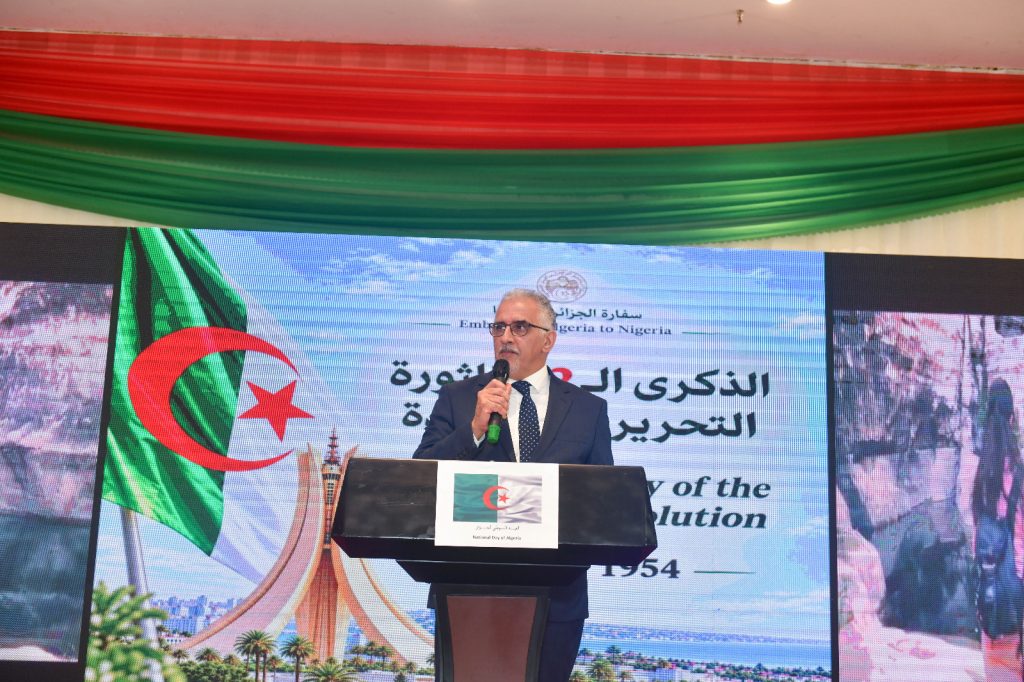
Speaking at the reception, Algeria’s Ambassador to Nigeria, Hocine Mezoued, welcomed guests and paid tribute to the country’s freedom fighters who sacrificed their lives during the struggle for independence.
He described the November 1, 1954 revolution as the foundation of modern Algeria, noting that the sacrifices of the nation’s martyrs made it possible for the country to reclaim its sovereignty.
On Algeria’s development agenda, Mezoued said President Abdelmadjid Tebboune’s administration had continued to pursue economic reforms, diversification and national development under its New Algeria vision.
He noted that the country was recording progress in non-hydrocarbon exports, while improvements in the business environment had boosted investor confidence and attracted significant foreign investments.
On foreign policy, the ambassador reaffirmed Algeria’s commitment to non-interference, respect for national sovereignty, peaceful conflict resolution and the right of peoples to self-determination.
Addressing security challenges in the Sahel, he stressed that lasting peace could not be achieved through military measures alone, insisting that economic development, inclusive dialogue and peaceful resolution of disputes remained essential.
Turning to Nigeria-Algeria relations, Mezoued described the partnership as one founded on shared values and the commitment of both countries’ leaders to advancing African development.
He identified the Trans-Saharan Highway, Trans-Saharan Gas Pipeline and Trans-Saharan Fibre Optic Backbone as major strategic projects receiving attention from both countries.
The ambassador also disclosed that Algeria had continued to provide scholarships to Nigerian students to strengthen human capital development and capacity building.
He further announced that Air Algérie expanded its Nigerian operations on October 26, 2026, with the introduction of two weekly flights to Lagos, expressing confidence that the service would boost trade and tourism.
Looking ahead, Mezoued said 2027 would offer fresh opportunities to deepen bilateral cooperation, particularly through the fifth Joint High Bi-National Commission scheduled to hold in Abuja.
He expressed optimism that the meeting would provide an opportunity to assess existing partnerships, identify new areas of cooperation and move Nigeria-Algeria relations towards a more practical and results-driven phase.
-
 Featured7 years ago
Lampard Names New Chelsea Manager
-
 Featured7 years ago
FG To Extends Lockdown In FCT, Lagos Ogun states For 7days
-
 Featured7 years ago
Children Custody: Court Adjourns Mike Ezuruonye, Wife’s Case To April 7
-
 Featured7 years ago
NYSC Dismisses Report Of DG’s Plan To Islamize Benue Orientation Camp
-

 Featured5 years ago
Transfer Saga: How Mikel Obi Refused to compensate me After I Linked Him Worth $4m Deal In Kuwait SC – Okafor
-
Featured7 years ago
Board urges FG to establish one-stop rehabilitation centres in 6 geopolitical zones
-
Sports4 years ago
TINUBU LAMBAST DELE MOMODU
-

 News2 years ago
Zulu to Super Eagles B team, President Tinubu is happy with you













