
News
FLAM 2025 Advocates Deeper Legal Education to Strengthen Football Governance
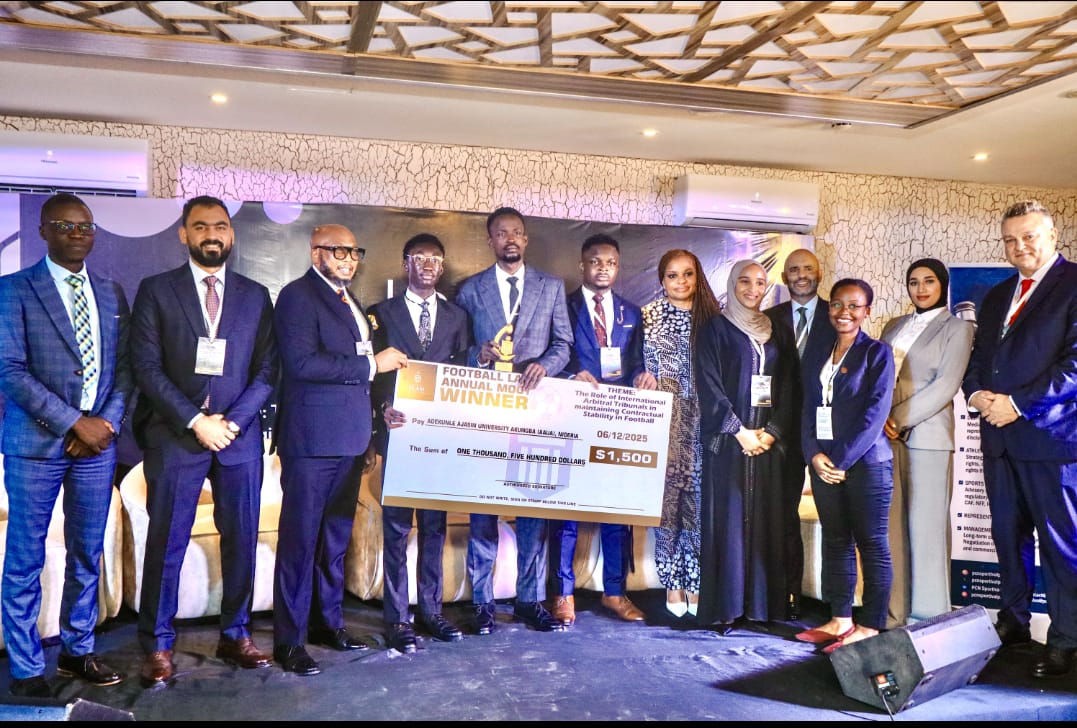
…Adekunle Ajasin University Defeats UNILAG to Win Abuja Moot
Joel Ajayi
The 2025 Football Law Annual Moot (FLAM) has amplified calls for greater investment in legal education within the football ecosystem, particularly among clubs, managers, and academy owners. The event brought together leading sports lawyers from around the world to examine the legal challenges facing the industry, with a special focus on contractual stability in football.
Organised by legal practitioner Pius C. Ndubuokwu, the conference—held under the theme “The Role of International Arbitral Tribunals in Maintaining Contractual Stability in Football”—placed a spotlight on the contractual vulnerabilities experienced by Nigerian players abroad.
Speaking at the conference, Ndubuokwu revealed staggering statistics on player transfers and rights abuses.
“In the last 10 years, Nigeria has transferred about 17,200 players abroad. Of these, more than 30% have faced contractual violations. Shockingly, up to 80–90% of them are unaware their contracts were breached,” he said.
He stressed that FLAM 2025 serves as a foundation for educating players on their rights, noting that poor legal awareness affects not just athletes but the entire football economy.
“When players cannot protect their rights, it affects everyone—clubs, lawyers, agents. This programme addresses the core of contractual stability because contracts are the foundation of football. Clubs and academies invest heavily in scouting but often neglect the legal structures that are just as critical,” he added.
Ricardo de Buen, a long-standing arbitrator at the Court of Arbitration for Sport (CAS) with over three decades of experience in labour and sports law, reinforced Ndubuokwu’s concerns.
He noted that many footballers lack knowledge of their rights and have limited access to legal support in their home countries.
“Events like this will improve the capacity of local lawyers, enabling them to better support athletes and even clubs involved in international disputes. Strengthening legal defence for players will ultimately benefit the entire sector,” he said.
On the sidelines of the conference, the Football Law Annual Moot featured 44 universities from seven countries, progressing through three rigorous phases: a written brief competition, virtual oral rounds, and the grand finale.
In a repeat of last year’s outcome, Adekunle Ajasin University and the University of Lagos—who met in the 2024 semi-finals—once again emerged as the top two teams in the 2025 edition.
Both teams impressed the panel of arbitrators led by Georgi Gradev with their delivery, articulation, and command of sports law. Adekunle Ajasin University clinched the championship, earning a $1,500 cash prize, while the University of Lagos finished as runners-up with $1,000.
The 2025 edition of FLAM underscored the pressing need for systemic reforms in football administration, starting with stronger legal frameworks and improved education for players, clubs, and practitioners across the continent.



Health
New Malaria Plan Puts States, Local Data At Centre Of Nigeria’s 2030 Response

Cyril Ogar
Nigeria’s latest malaria data point to a country making progress overall but facing sharply different disease burdens from one state to another, prompting health authorities to shift emphasis towards locally tailored interventions under a new five-year strategy.
The National Malaria Strategic Plan (NMSP) 2026–2030, launched alongside the 2025 Nigeria Malaria Indicator Survey (NMIS) report, seeks to cut malaria parasite prevalence and deaths by 50 per cent from 2025 levels by 2030.
Rather than applying a uniform national response, the plan prioritises interventions based on local epidemiological evidence, while also calling for stronger domestic financing, improved diagnosis and treatment, better surveillance and clearer accountability.
The Coordinating Minister of Health and Social Welfare, Prof. Muhammad Ali Pate, represented by the ministry’s Permanent Secretary, Mrs Daju Kachallom, presented the government’s position at the joint launch in Abuja.
Pate described the survey and strategic plan as essential tools for identifying weaknesses in malaria control and directing resources towards areas with the greatest need.
He said the survey’s findings on prevalence, prevention, diagnosis and treatment would support policy development, programme implementation, resource allocation and performance assessment.
The minister said the strategic plan was designed to accelerate progress towards a malaria-free Nigeria while remaining consistent with national health priorities and the World Health Organisation’s global malaria strategy.
He commended the National Malaria Elimination Programme (NMEP), the National Population Commission (NPC), development partners and other stakeholders involved in producing the survey and plan.
Pate also called for a shared national effort involving federal and state governments, the private sector, communities and households, stressing that malaria elimination could not be achieved by government alone.
The 2025 NMIS shows that malaria parasite prevalence among children aged six to 59 months, measured through microscopy, fell from 42 per cent in 2010 to 23 per cent in 2018, 22 per cent in 2021 and 15 per cent in 2025.
However, the national improvement masks substantial differences between states. Prevalence among children in the same age group ranged from two per cent in Lagos State to 31 per cent in Ebonyi State.
The figures indicate that progress has not been evenly distributed and that malaria control efforts must be adapted to the conditions in individual states and communities.
Earlier, the National Coordinator of NMEP, Dr Nnenna Ogbulafor, said the NMSP was developed from the 2025 NMIS findings and other programme data.
She said the evidence would help policymakers locate high-burden areas, improve the design of interventions and direct limited resources to communities most in need.
Ogbulafor said the plan was aligned with Nigeria’s health sector priorities and the WHO Global Technical Strategy for Malaria 2016–2030.
She identified policy alignment, state-level leadership, domestic financing, partnerships and accountability as central to implementation.
The national coordinator urged state governments, civil society organisations and development partners to take ownership of the plan and support coordinated, adequately funded malaria programmes.
She said the differences in prevalence across states made subnational planning indispensable to meeting the national targets.
Ogbulafor called on states to develop comprehensive malaria control programmes reflecting local disease burdens, epidemiological evidence and available resources.
She also stressed the need for sustained domestic financing and partnerships to close funding gaps and maintain implementation through 2030.
NMEP, she said, would work with the National Malaria Working Group and international partners to track implementation, assess performance and review results regularly.
The plan aims to raise access to and use of preventive interventions to at least 80 per cent, achieve at least 90 per cent effective coverage of malaria diagnosis and appropriate treatment among at-risk populations, and improve surveillance performance from a baseline of 47 per cent to 70 per cent by 2030.
It also targets stronger governance and organisational capacity, with at least 60 per cent of malaria programme resources expected to come from domestic sources by 2030.
The survey data show that prevention remains uneven. Only 54 per cent of households had at least one insecticide-treated net, while 45 per cent of children under five and 54 per cent of pregnant women aged 15–49 slept under a net on the night before the survey.
Protection during pregnancy was also incomplete. Among women aged 15–49 who had a live birth in the preceding two years, 62 per cent received at least one dose of sulphadoxine-pyrimethamine during their last pregnancy, but only 33 per cent received three or more doses.
The findings point to the need to expand access to insecticide-treated nets and intermittent preventive treatment for pregnant women.
Diagnosis is another major gap. Of children under five who had a fever in the two weeks before the survey, 59 per cent had advice or treatment sought, but only 18 per cent had blood taken for malaria testing.
The strategic plan therefore places emphasis on prompt testing, appropriate treatment, preventive services and public awareness.
In his remarks, the Director-General of NPC, Dr Abubakar Muhammed, pledged the commission’s continued support for credible demographic and health data to guide policymaking and malaria elimination efforts.
Muhammed said the survey reflected the partnership between the Federal Ministry of Health and Social Welfare, through NMEP, and the NPC.
He said the collaboration brought together expertise in malaria control, demographic surveys and data management to produce information for national planning and development.
The NPC director-general said the commission would continue to modernise its survey operations through technologies such as the Global Positioning System (GPS) and spatial techniques.
He urged policymakers, programme managers, researchers and development partners to use the findings to refine strategies, improve implementation and target communities where interventions were most needed.
Muhammed commended the ministry, NMEP, technical consultants, state enumerators and field teams for their roles in conducting the survey.
He said the report would provide a strong evidence base for a coordinated national malaria response.
The launch of the NMIS report and NMSP 2026–2030 places the next phase of Nigeria’s malaria response on a clearer understanding of where the disease remains most entrenched, while challenging states and partners to convert that evidence into measurable local action.
-
 Featured7 years ago
Lampard Names New Chelsea Manager
-
 Featured7 years ago
FG To Extends Lockdown In FCT, Lagos Ogun states For 7days
-
 Featured7 years ago
Children Custody: Court Adjourns Mike Ezuruonye, Wife’s Case To April 7
-
 Featured7 years ago
NYSC Dismisses Report Of DG’s Plan To Islamize Benue Orientation Camp
-

 Featured5 years ago
Transfer Saga: How Mikel Obi Refused to compensate me After I Linked Him Worth $4m Deal In Kuwait SC – Okafor
-
Featured7 years ago
Board urges FG to establish one-stop rehabilitation centres in 6 geopolitical zones
-
Sports4 years ago
TINUBU LAMBAST DELE MOMODU
-

 News2 years ago
Zulu to Super Eagles B team, President Tinubu is happy with you