
News
CSCCN Calls for Probe of Alleged Legal Impersonation, Forgery by Two Individuals
Cyril Ogar
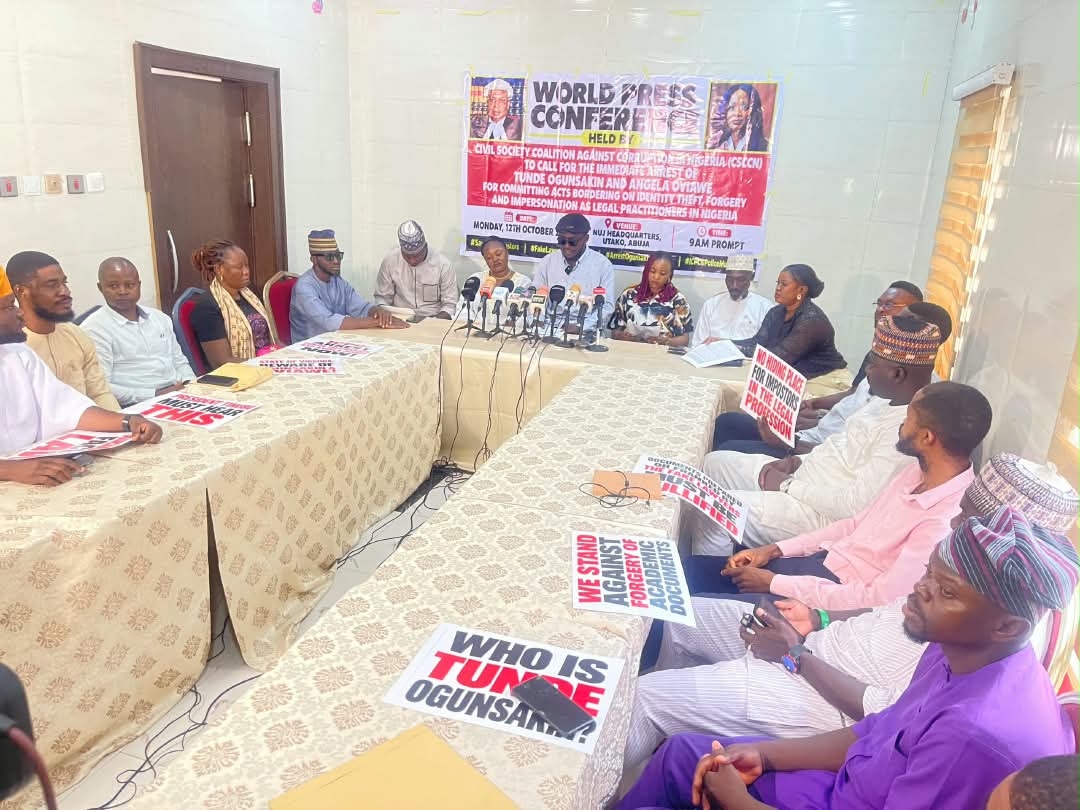
The Civil Society Coalition Against Corruption in Nigeria (CSCCN) has called on the Independent Corrupt Practices and Other Related Offences Commission (ICPC) and the Nigeria Police Force to investigate allegations of identity theft, forgery, impersonation and unauthorised legal practice involving Tunde Ogunsakin and Angela Oviawe.
The coalition made the call at a press conference held on Monday in Abuja, where its Chief Convener, Comrade Omoba Michael, urged relevant authorities to verify the professional credentials of the two individuals and take appropriate legal action if the allegations are substantiated.
Michael said the demand followed Freedom of Information requests submitted by Overt Legacy and Human Development Initiative to the Chief Registrar of the Supreme Court of Nigeria, seeking official clarification regarding the professional status of Ogunsakin and Oviawe.
According to the coalition, the requests, dated April 24 and May 6, 2026, also sought clarification about legal services allegedly offered through Tunde Ogunsakin & Co., with an office at No. 101, Ebitu Ukiwe Street, Jabi District, Abuja.
Michael said the Supreme Court, in a letter dated May 21, 2026, responded that the names of Ayotunde Johnson Ogunsakin, Tunde Ogunsakin and Angela Oviawe were not found on the Roll of Legal Practitioners.
The coalition also raised concerns about reports that Ogunsakin’s law firm operated offices in London, United Kingdom, and Virginia, United States.
It further referenced a 2010 publication by Modern Ghana alleging that Ogunsakin was investigated by the University of Abuja over examination malpractice while pursuing a Bachelor of Laws degree and was subsequently expelled following an internal disciplinary process.
The coalition questioned whether he subsequently obtained the requisite academic qualifications to proceed to the Nigerian Law School.
However, the allegations remain subject to independent verification and investigation by the relevant authorities.
Michael said Overt had submitted petitions dated October 9, 2026, to several institutions, including the ICPC, the Nigeria Police Force, the Attorney-General of the Federation, the Council of Legal Education, the Nigerian Bar Association (NBA) and the Legal Practitioners Disciplinary Committee (LPDC).
The British High Commission and the United States Embassy were also reportedly petitioned over the alleged operations of the firm in their respective jurisdictions.
Citing Section 2(1) of the Legal Practitioners Act, the coalition maintained that only individuals whose names appear on the Roll of Legal Practitioners maintained by the Supreme Court are entitled to practise as barristers and solicitors in Nigeria.
It also referenced Section 22(1) of the Act, which provides penalties for specified acts involving unqualified persons holding themselves out as legal practitioners.
The coalition further cited Sections 364 and 366 of the Penal Code Act applicable in the Federal Capital Territory, relating to forgery and the knowing use of forged documents as genuine.
Among its demands, CSCCN urged the ICPC and police to investigate the allegations and pursue prosecution where sufficient evidence and legal grounds exist.
It also called on the Council of Legal Education, NBA and LPDC to examine the activities of Tunde Ogunsakin & Co. and take appropriate regulatory action if unauthorised legal practice is established.
The coalition urged the British and American authorities to refer the alleged operations of the firm in their jurisdictions to the appropriate regulatory bodies for verification and investigation.
It further requested that documents allegedly prepared, signed, filed or issued without the requisite professional authority be examined, with any necessary legal steps taken to protect affected individuals.
Michael called on President Bola Tinubu, through the Attorney-General of the Federation and Minister of Justice, to facilitate inter-agency coordination and engagement with relevant foreign authorities.
The coalition gave the institutions and public authorities it had petitioned 48 hours to demonstrate that meaningful steps had been initiated to address the allegations.
It warned that failure to respond appropriately would prompt a peaceful mass protest at the ICPC and Nigeria Police Force headquarters in Abuja.
Michael stressed that the coalition’s intervention was intended to protect the integrity of the legal profession and safeguard members of the public from potential deception.
He urged the media and concerned citizens to support the campaign for accountability, insisting that the allegations should be addressed through due process and the enforcement of applicable laws.



News
Civil Society Coalition Kicks Against Proposed 20% Deduction from NCDMB
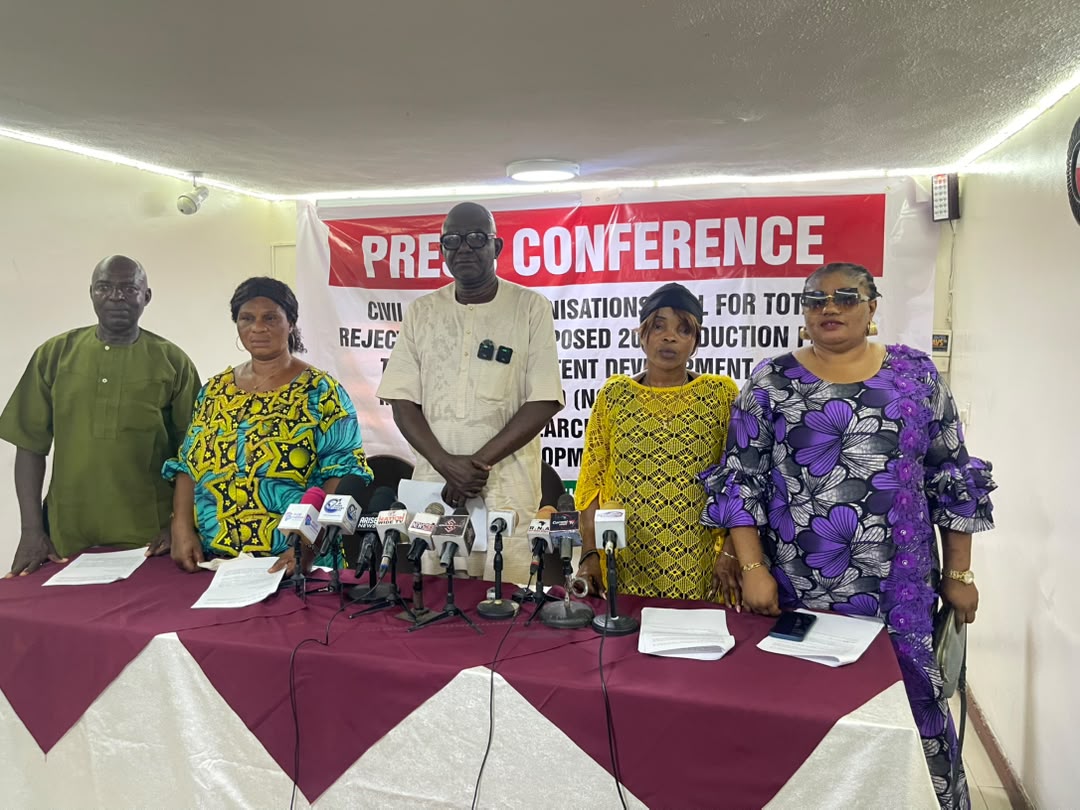
The Coalition of Civil Society Organisations in Nigeria (COCSON) has rejected a proposed 20 per cent deduction from the Nigerian Content Development and Monitoring Board (NCDMB) to finance the proposed National Research and Innovation Development Fund.
The coalition described the proposed funding arrangement as unacceptable, warning that it could undermine the development of indigenous capacity and local value addition in Nigeria’s oil and gas industry.
Speaking at a press conference in Abuja on Thursday, November 26, 2026, COCSON spokesperson, Tabuko Kennedy, said the coalition was not opposed to the establishment of a national research and innovation fund but strongly objected to the proposed funding mechanism.
Kennedy argued that funds allocated to the NCDMB were specifically meant to develop local capacity, support indigenous companies, train Nigerian engineers and promote value addition within the oil and gas sector.
He warned that diverting 20 per cent of the board’s revenue to finance another institution could weaken its ability to fulfil its statutory responsibilities.
According to him, the funds domiciled with the NCDMB are not surplus government revenue but contributions from companies operating in the oil and gas industry, specifically earmarked for local content development.
He maintained that diverting such funds without the consent of industry stakeholders would amount to a breach of trust and undermine the original purpose for which the resources were collected.
The coalition also warned that the proposed deduction could establish a dangerous precedent where financially viable government agencies would have portions of their revenues diverted to fund newly established institutions.
Kennedy questioned what would prevent similar deductions from other specialised intervention funds, including the Tertiary Education Trust Fund, the Universal Service Provision Fund and the Police Trust Fund.
He said such a practice could discourage revenue-generating agencies from improving their financial performance, create inter-agency rivalry and undermine long-term institutional planning.
COCSON further argued that the proposed deduction could violate the Nigerian Oil and Gas Industry Content Development Act, which provides the legal framework for the management and utilisation of funds accruing to the NCDMB.
The coalition maintained that the legislation did not envisage using the board’s resources to finance an unrelated research and innovation institution, describing the proposed diversion as inconsistent with the original statutory purpose of the funds.
Consequently, COCSON called on the leadership of the National Assembly, relevant committees and the Federal Executive Council to reject the proposed 20 per cent deduction.
It also appealed to President Bola Tinubu not to assent to the bill if the controversial funding provision remains in it.
The coalition disclosed that it had mobilised organised labour, pressure groups, religious organisations and other civil society groups to resist the proposed legislation.
It, however, stressed that it was not against research, innovation or the establishment of a national research funding institution, urging the government and lawmakers to explore alternative funding arrangements that would not undermine existing development agencies.
COCSON also called on Nigerians and industry stakeholders to oppose what it described as a legislative overreach, insisting that the country’s local content development programme should not be weakened to finance a new institution.
-
 Featured7 years ago
Lampard Names New Chelsea Manager
-
 Featured7 years ago
FG To Extends Lockdown In FCT, Lagos Ogun states For 7days
-
 Featured7 years ago
Children Custody: Court Adjourns Mike Ezuruonye, Wife’s Case To April 7
-
 Featured7 years ago
NYSC Dismisses Report Of DG’s Plan To Islamize Benue Orientation Camp
-

 Featured5 years ago
Transfer Saga: How Mikel Obi Refused to compensate me After I Linked Him Worth $4m Deal In Kuwait SC – Okafor
-
Featured7 years ago
Board urges FG to establish one-stop rehabilitation centres in 6 geopolitical zones
-

 News2 years ago
Zulu to Super Eagles B team, President Tinubu is happy with you
-
Sports4 years ago
TINUBU LAMBAST DELE MOMODU













