
Sports
Educational Policies Have Killed University Sports-Ex-UI Director Of Sports
Dr. Abiodun Isiaka Salami, the immediate past University of Ibadan Director of Sports, has taken a swipe at the various educational policies in the country which have killed University student’s participation in sports.
The former Green Eagles winger who spoke at the weekend, said participation in sports in the University is virtually dead, because of the jam-packed academic curriculum that has made it impossible for students to effectively combine education with sports.
He said in the past that many athletes, especially footballers combined their academics with football, even playing for clubs and national teams. But, these days, you hardly see such because the University educational policies have made it extremely difficult for that to happen. Most of the University lecturers still believe that sportsmen are unserious people.
The University system no longer makes it possible for sports to thrive. Take for instance the University of Ibadan where I served for 32 years, our sporting edifices which were our centre of attraction have been destroyed. Our football pitch and cricket field which were one of the best in the country now have building structures on them. The supposed new sports center that was built in a very remote part of the University community, is not easily accessible to the students, and has only a football pitch and a basketball court. No other sport exists there”.
Dr Salami, however, advised young football players not to jettison their education while playing football, as their certificates may be their rallying point after football. According to him, “football surely has an expiry date. It can either be due to injuries or age or something that can make you stop abruptly. It is then that your certificates will be important. You will rely on that for the rest of your life”.
Dr. Abiodun Isiaka Salami abandoned his flourishing football career at then IICC Shooting Stars and Green Eagles team preparing for the 1980 AFCON to proceed to the University of Ibadan to pursue an academic career starting from a Diploma certificate to a Doctorate Degree in Sports and Administration.



Sports
Youth Olympics: AFN TD Hails Home-Based Athletes, Credits NSC for Gold Success
By Joel Ajayi
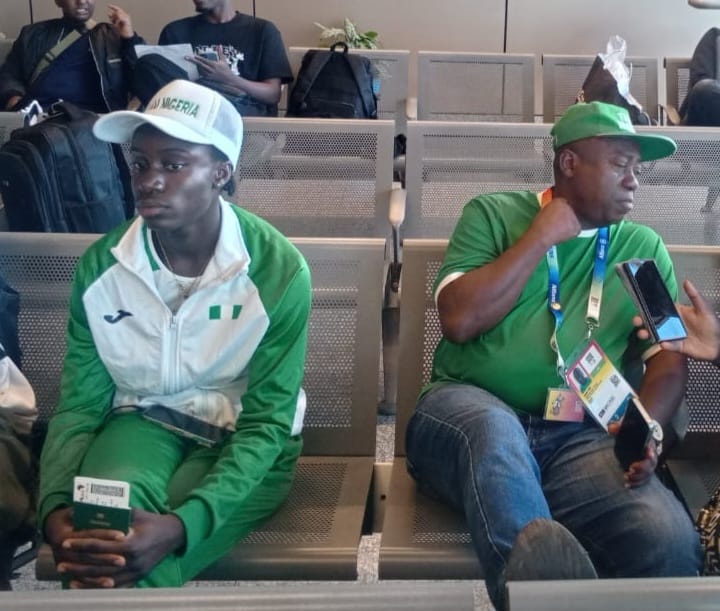
Athletics Federation of Nigeria (AFN) Technical Director, Gabriel Okon, has attributed Nigeria’s impressive performance at the Youth Olympic Games to collective efforts, improved support and the growing potential of home-based athletes.
Okon, who expressed delight at the country’s medal-winning performance, particularly commended the National Sports Commission (NSC), the AFN leadership for their contributions to the achievement.
He said Nigeria’s success in the sprint events, particularly the 100m and 400m, was a product of dedication, professionalism and adequate preparation.
According to him, the financial support provided by the NSC was crucial to ensuring that the athletes and coaching crew had the necessary resources to compete successfully.
“We have to thank God and also appreciate the NSC for its support because without the necessary financial assistance, this achievement would not have been possible.”
Okon also praised the leadership of the AFN under Tony Okowa, noting that collaboration among the federation, coaches and athletes contributed significantly to Nigeria’s success.
He described the performance as evidence that Nigeria has considerable athletics talent at home and does not have to depend exclusively on foreign-based athletes to achieve success at international competitions.
He explained that the federation had been deliberately working towards developing home-based athletes, stressing that the latest achievement was not an isolated development.
According to him, Nigeria had previously demonstrated the competitiveness of its locally based athletes at international competitions, citing the African Athletics Relays in Gaborone, Botswana, where the country competed with an entirely home-based contingent.
He recalled that Nigeria secured qualification for the World Championships through its performances in the relay events, with subsequent qualifications also achieved through competitive times.
Okon said the development showed that Nigerian athletes training within the country were steadily improving and becoming increasingly competitive against their foreign-based counterparts.
He added that the growing confidence among Nigerian athletes, particularly the men, was another encouraging development for the country’s athletics programme.
“It is not something new that our home-based athletes are beginning to perform well. We have been working on this for some time.
“Previously, people focused more on our women, but now the men are also stepping forward and showing that they can compete at the highest level,” he said.
He maintained that the progress was being driven by a structured programme, technical cooperation and the encouragement provided by the NSC and AFN.
The technical director further explained that members of the federation’s technical department and coaching crew regularly interacted and shared ideas, describing their collaboration as an important ingredient in the team’s success.
Looking ahead, he identified relay events, particularly the 4x100m, as another area where Nigeria could have improved its medal prospects if additional opportunities had been available at the competition.
He expressed confidence that the country’s sprinting strength could have produced more impressive results in both the men’s and women’s relay categories, including the mixed relay.
Okon also disclosed that Nigeria’s progress in sprinting had attracted the attention of international athletics personalities, who had sought to understand the country’s approach to developing its athletes.
He recalled a conversation with former British international sprinter John Regis during the Commonwealth Games in Glasgow, Scotland, where they discussed Nigeria’s improving sprint performances.
According to him, the interest shown by international athletics figures indicated that Nigeria’s emerging talents were beginning to command greater respect.
He attributed the improvement partly to the experience Nigerian coaches and athletes had gained through international exposure and professional training systems, which they were now adapting to local conditions.
“We are simply doing what we have always known how to do. Many of us have studied and trained abroad, and we have come back home to replicate what we learnt and do what we know best,” he said.
Reflecting on Nigeria’s performance, Okon described the achievement as a moment of national pride, attributing the success to God’s grace, hard work and the support of stakeholders.
He said the medal haul had exceeded expectations, noting that the team’s initial target was more modest before the athletes delivered their impressive performances.
He expressed happiness that the achievement had brought excitement and renewed confidence among Nigerians, adding that the smiles and celebrations surrounding the athletes’ success were a reward for the collective sacrifices made by everyone involved.
He urged stakeholders to sustain their support and commitment to ensure that Nigeria’s emerging athletics talents continue to develop and win more medals at future international competitions.
-
 Featured7 years ago
Lampard Names New Chelsea Manager
-
 Featured7 years ago
FG To Extends Lockdown In FCT, Lagos Ogun states For 7days
-
 Featured7 years ago
Children Custody: Court Adjourns Mike Ezuruonye, Wife’s Case To April 7
-
 Featured7 years ago
NYSC Dismisses Report Of DG’s Plan To Islamize Benue Orientation Camp
-

 Featured5 years ago
Transfer Saga: How Mikel Obi Refused to compensate me After I Linked Him Worth $4m Deal In Kuwait SC – Okafor
-
Featured7 years ago
Board urges FG to establish one-stop rehabilitation centres in 6 geopolitical zones
-
Sports4 years ago
TINUBU LAMBAST DELE MOMODU
-

 News2 years ago
Zulu to Super Eagles B team, President Tinubu is happy with you













