
Uncategorized
Emmanuel Godswill Nwokeji Joins Enyimba After Rising Through Nigeria’s Top Flight
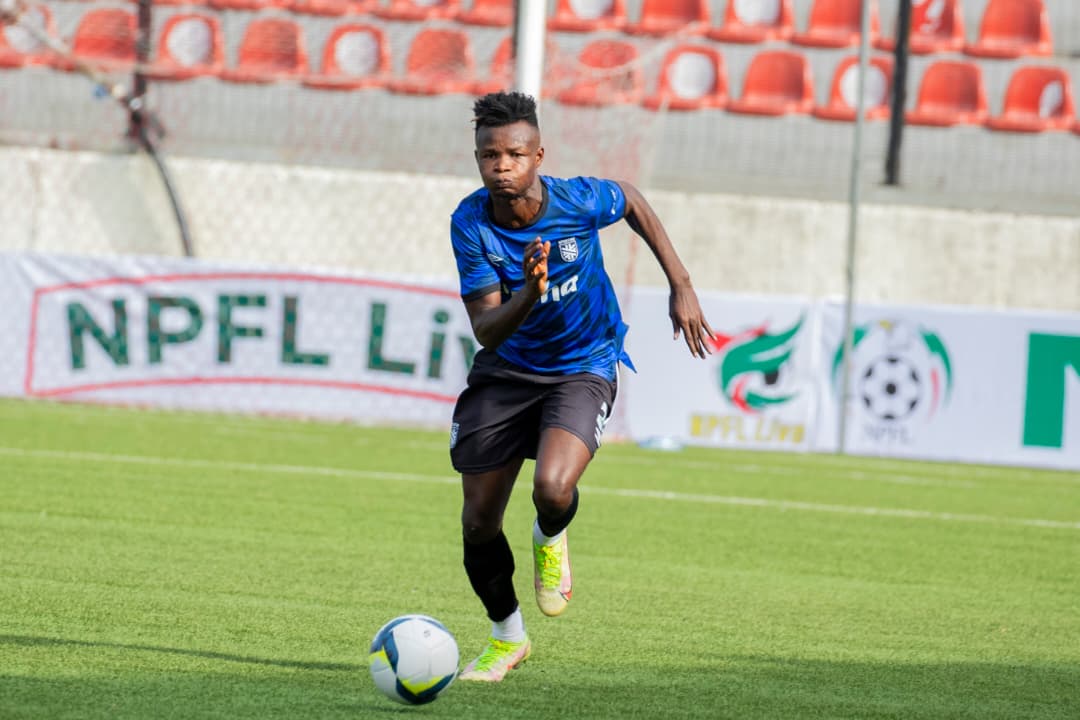
Nigerian left-back Emmanuel Godswill Nwokeji has joined seven-time Nigeria Premier Football League champions Enyimba FC, marking another significant step in the career of the talented defender.
Born on December 25, 2002, Nwokeji began his football development at Taye Academy, the renowned Owerri-based academy that also produced Nigerian international and 2013 FIFA U-17 World Cup winner Kelechi Iheanacho. Iheanacho’s youth career at Taye Academy is well documented, having represented the academy before moving on to Manchester City.
Nwokeji moved into professional football as a teenager, joining his first professional club on January 1, 2018 after graduating from Taye Academy. His early transition into senior football provided the foundation for a career that has seen him feature for several established clubs in the Nigerian top flight.
The left-footed defender subsequently played for Heartland FC, Warri Wolves, Kwara United, Sporting Lagos and Remo Stars, gaining valuable experience across different stages of the Nigerian professional game.
His career progression has been reflected in the transfer records of several of his former clubs. Records show his movement from Warri Wolves to Kwara United, followed by a transfer to Sporting Lagos, before he joined Remo Stars ahead of the 2024/25 campaign.
At Remo Stars, Nwokeji became part of a squad competing at the highest level of Nigerian domestic football. He made the move to Enyimba following his spell with the Ikenne-based club, with transfer records subsequently listing the move as a transfer between the two NPFL sides.
Enyimba’s acquisition represents another important chapter for Nwokeji, who has steadily built his career through Nigeria’s domestic football structure since emerging from Taye Academy.
The move also places him at one of the country’s most decorated clubs, where he will compete for opportunities at left-back and bring his experience from previous spells in the NPFL.
For Nwokeji, the journey from Taye Academy to Enyimba represents the latest stage of a professional career that began as a teenager and has taken him through Heartland, Warri Wolves, Kwara United, Sporting Lagos and Remo Stars before arriving in Aba.
His progression also adds another link between Taye Academy’s player-development tradition and the senior professional game, following in the footsteps of Iheanacho, one of the academy’s most celebrated graduates.



Uncategorized
Eight Athletes, 11 Medals: Applauding Asagba’s Sports Leadership At DELSU
By Godspower Odedede
Delta State University (DELSU), Abraka, has recorded an impressive outing at the 15th West Africa University Games (WAUG) 2026, winning 11 medals with just eight athletes who represented the university in only three sporting events.
The university won seven gold, two silver and two bronze medals to occupy seventh position on the medal table, an achievement that underscores the potential of its athletes and the importance of purposeful investment in university sports.
DELSU participated in the men’s 100-metre sprint with two athletes, women’s judo with two athletes, and swimming with four male athletes. Despite the limited number of athletes and sporting events, the university’s medal haul was a commendable performance and a source of pride for the institution.
The achievement deserves particular recognition given the restricted scope of DELSU’s participation. With representation in only three sports, the university demonstrated that focused preparation, adequate support and the effective deployment of available talent can produce encouraging results at major university competitions.
A major highlight of DELSU’s preparation for WAUG 2026 was the approval by the Vice-Chancellor, Professor Samuel Ogheneovo Asagba, for a quality two-week training programme for the university’s athletes in Asaba.
The camp provided the athletes with an opportunity to prepare using the excellent and up-to-date training facilities available in the state capital.
The initiative is particularly noteworthy as it represents a significant commitment to structured preparation for university sports. Rather than relying solely on athletes’ natural abilities, the training programme recognised the importance of preparation, access to appropriate facilities and institutional investment in performance.
Professor Asagba deserves commendation for this intervention and for demonstrating a willingness to provide practical support for sports development at DELSU. The university’s WAUG performance offers an encouraging indication of what can be achieved when athletes receive purposeful preparation and administrative backing.
The Vice-Chancellor’s broader vision for sports infrastructure is also encouraging. Plans are understood to be underway for the construction of an ultra-modern sports complex for the university in the near future. If delivered as anticipated, the facility could significantly strengthen DELSU’s capacity for athlete development, training, competitions and sports science activities.
Such infrastructure would also support the university’s ambitions to improve its performance at national and international university games. A modern sports complex could provide a foundation for more systematic talent identification, performance monitoring, coaching development and the preparation of athletes across a wider range of sporting events.
Special recognition must also go to Mrs Epebi-Ebi Noah, the swimming coach, who was physically present at Obafemi Awolowo University (OAU), Ile-Ife, with the DELSU swimming team during the competition. Her presence and involvement underline the importance of coaching support, technical guidance and close supervision of athletes during major sporting events.
The performance also calls for commendation of the Chairman of the University Sports Committee, Professor Ochuko Nabofa, whose leadership has brought renewed attention and energy to sports development at DELSU. His role in supporting the university’s sports administration and helping to strengthen the sporting environment deserves recognition.
Similarly, the Acting Director of Sports, Peter Omojuwa, deserves commendation for his administrative responsibilities and contribution to the university’s sporting programme. The Chief Coach, Lucky Ajaino, should also be recognised for his role in the technical preparation and development of DELSU athletes.
The combined efforts of the university management, sports committee, sports administrators and coaches are essential to sustaining progress. While medals provide a visible measure of success, the systems established to prepare athletes and support their development are equally important to the long-term growth of university sports.
DELSU’s WAUG achievement follows another notable outing at the last Nigeria University Games Association (NUGA) Games, where the university finished fourth. That result was regarded as one of the finest performances in the institution’s sporting history and strengthened expectations that DELSU could become an even more formidable force in university sports.
The latest WAUG performance provides another reason for optimism. However, the university’s participation in only three events also reveals an opportunity for further growth. Expanding participation across more sports, identifying talented students and improving access to specialised training could help DELSU compete for a higher position on future medal tables.
The proposed sports complex, if realised, could play a central role in this expansion. It should ideally be supported by sustained funding, modern equipment, qualified coaches, athlete welfare programmes and collaboration with relevant sports science professionals. These measures would help ensure that infrastructure investment translates into measurable improvements in performance.
The university could also consider strengthening performance analysis, sports medicine, strength and conditioning, talent identification and systematic monitoring of athletes’ progress. Such an approach would help transform individual successes into a sustainable university-wide sports development programme.
DELSU’s performance at WAUG 2026 is worthy of celebration. Eight athletes competed in just three sporting events and returned with 11 medals, including seven gold. The result reflects the potential within the university and provides a strong basis for building a more ambitious sports programme.
Professor Asagba’s approval of the two-week training camp and the prospect of an ultra-modern sports complex offer reasons to look forward to the next phase of DELSU sports development. The challenge now is to sustain the momentum, broaden participation and ensure that the university’s sporting ambitions are matched by consistent investment and effective implementation.
With continued support from the Vice-Chancellor, the University Sports Committee, the Directorate of Sports, coaches and other stakeholders, DELSU can build on its recent achievements and strengthen its position among Nigeria’s leading sporting universities.
The message from WAUG 2026 is clear: DELSU has demonstrated what a small but well-supported contingent can achieve. With broader participation, sustained preparation and modern sporting infrastructure, the university has the potential to accomplish even greater things.
-
 Featured7 years ago
Lampard Names New Chelsea Manager
-
 Featured7 years ago
FG To Extends Lockdown In FCT, Lagos Ogun states For 7days
-
 Featured7 years ago
Children Custody: Court Adjourns Mike Ezuruonye, Wife’s Case To April 7
-
 Featured7 years ago
NYSC Dismisses Report Of DG’s Plan To Islamize Benue Orientation Camp
-

 Featured5 years ago
Transfer Saga: How Mikel Obi Refused to compensate me After I Linked Him Worth $4m Deal In Kuwait SC – Okafor
-
Featured7 years ago
Board urges FG to establish one-stop rehabilitation centres in 6 geopolitical zones
-
Sports4 years ago
TINUBU LAMBAST DELE MOMODU
-

 News2 years ago
Zulu to Super Eagles B team, President Tinubu is happy with you













