
Foreign news
EU Cautiously optimistic on Syria engagement – Official
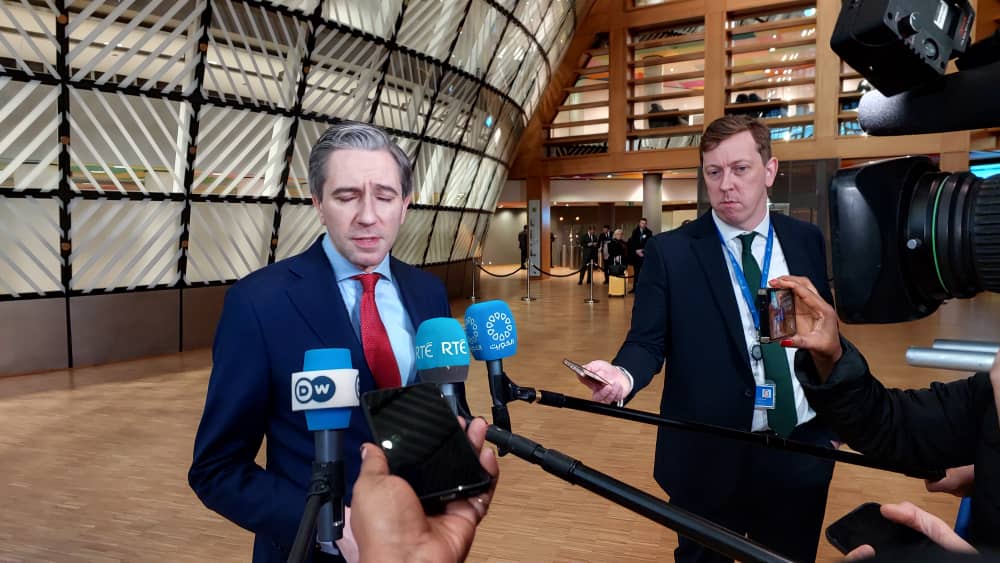
Irish foreign minister Simon Harris said on Monday that the European Union (EU) “is cautiously optimistic on Syria engagement” but called for more deeper engagement to strengthen relations with the country.
Harris said this at a news conference held at the EU Headquarters in Brussels, the Belgian capital.
“It’s early days, but I think there are signs of optimism. But it is important that we continue to engage.
“I don’t think it would be a good scenario if any other geopolitical actors and forces engage with Syria and for the European Union not to be in a position to intensively engage with them,“ he said.
In her remarks, Ms. Kaja Kallas, the Vice-President of the EU described Syria’s future as fragile but said that the bloc needed to take the right steps.
“But of course, we need to see the right steps as well. Right now, they’re saying all the right words, and they are doing also the right things.
“Therefore, we have this set step-for-step approach, and if they take the steps, then we are willing to take the steps as well,’’ she said.
On the war in Gaza, Harris said President Donald Trump and his team are very much a party to the ceasefire deal between Israel and Hamas after the intensive work that was put in.
He conceded that the Trump administration put in a lot of effort to arrive at a ceasefire agreement in the days before his assumption of office for a return to the White House.
“I think that was important and there is no doubt that the intensive work invested by the Trump administration played a very significant role in helping to bring about a ceasefire – a ceasefire that has now seen a cessation of hostilities, the killing, and the bombings.
“Also, that has seen the flow and has seen hostages being released. It’s really important that the ceasefire is in place.
“It is also important, though, to acknowledge in that ceasefire agreement itself, it does talk about people being able to return, and therefore, I think it’s important that we’re consistent in the approach that we take.
“The priority, I think, needs to be on implementing to the letter, the ceasefire agreement.”



Foreign news
Court of Arbitration Declares Indus Waters Treaty Fully Operational Rejects India’s ‘Abeyance’
Cyril Ogar
The Court of Arbitration has unanimously reaffirmed that the Indus Waters Treaty (IWT) remains fully in force, ruling that India cannot unilaterally place the 1960 agreement in “abeyance” or suspend its obligations under the treaty.
The decision represents a significant legal development in the longstanding dispute between India and Pakistan over the management and use of the Indus river system.
The Court’s finding addresses a fundamental issue at the heart of the dispute: whether either party can unilaterally suspend the treaty outside the legal framework agreed by both countries.
In its unanimous determination, the Court made clear that the IWT continues to bind both India and Pakistan and that its obligations cannot be set aside through a unilateral political declaration.
The ruling means India remains subject to the treaty provisions governing the use of the Western Rivers, including requirements relating to the design and operation of hydroelectric projects, as well as the dispute-resolution mechanisms established under the agreement.
The Court has also ordered interim measures concerning the Ratle Hydroelectric Plant, restricting specified construction activities while the broader dispute remains under consideration.
The measures are aimed at preserving the effectiveness of the arbitration process and preventing developments that could prejudice the outcome of the proceedings.
For Pakistan, the decision represents significant legal validation of its longstanding position that the IWT is a binding international agreement and contains no provision allowing either party to unilaterally place it in abeyance.
Pakistan has consistently maintained that disagreements over the treaty should be addressed through the institutional mechanisms established by the agreement, rather than through unilateral action.
The IWT provides a structured framework for resolving disputes through mechanisms including the Permanent Indus Commission, Neutral Expert and Court of Arbitration processes.
The latest ruling therefore reinforces the principle that treaty obligations cannot simply be disregarded because of deteriorating political relations between signatories.
The significance of the decision extends beyond the India-Pakistan dispute. It underscores the broader international-law principle that agreements governing shared rivers and other transboundary resources must be respected and disputes resolved through established legal and institutional channels.
The Indus river system supports agriculture, livelihoods, food security and communities across the region, making the stability of the treaty particularly important.
The ruling also highlights the distinction between seeking to amend an international agreement through mutually agreed procedures and attempting to alter its obligations unilaterally.
The IWT has endured wars, prolonged diplomatic tensions and periods of limited bilateral engagement. Its continued operation demonstrates the importance of rules-based mechanisms in managing shared resources when relations between neighbouring states become strained.
For Pakistan, the outcome provides an opportunity to frame the decision not merely as a bilateral legal victory, but as an affirmation of international law, treaty compliance and peaceful dispute resolution.
The central message from the ruling is clear: the Indus Waters Treaty remains in force, its obligations continue to bind both parties, and disputes concerning shared waters must be addressed through the legal mechanisms agreed by India and Pakistan.
-
 Featured7 years ago
Lampard Names New Chelsea Manager
-
 Featured7 years ago
FG To Extends Lockdown In FCT, Lagos Ogun states For 7days
-
 Featured7 years ago
Children Custody: Court Adjourns Mike Ezuruonye, Wife’s Case To April 7
-
 Featured7 years ago
NYSC Dismisses Report Of DG’s Plan To Islamize Benue Orientation Camp
-

 Featured5 years ago
Transfer Saga: How Mikel Obi Refused to compensate me After I Linked Him Worth $4m Deal In Kuwait SC – Okafor
-
Featured7 years ago
Board urges FG to establish one-stop rehabilitation centres in 6 geopolitical zones
-
Sports4 years ago
TINUBU LAMBAST DELE MOMODU
-

 News2 years ago
Zulu to Super Eagles B team, President Tinubu is happy with you