
News
Experts Urge Government to Leverage Social Cohesion Data for Policy Reform, National Development

Experts have called on the government to utilise social cohesion data to enhance national policies and programmes to address critical development issues across the country and promote national development.
The experts made this call on Tuesday at a Capacity Building Workshop organised by Africa Polling Institute (API), an independent, non-profit opinion research think-tank.
The workshop tagged is “The Use of Social Cohesion Data in Enhancing National Policies and Programmes and Promoting Effective Media Reportage”.
Prof.Bell Ihua, Executive Director API, said the workshop supported by Ford Foundation was to ensure that the Nigeria Social Cohesion data did not stay on the shelves.He said from the findings of the research carried out across the country by API the indicators of lack of social cohesion which was the bane of development include issues of trust, social justice, gender inequality, security issues among others.
“So it’s for us to make use of this data we share with the government so that the government can begin to do what it needs to do.
“We want the social cohesion data to permeate the society, such that public institutions are integrating it in their policy and programme planning, and media practitioners are engaging in socially-cohesive news reportage.
“One of the first major finding API noted is the fact that citizens have very little trust for the government, governors and public institutions.
“The second big issue we found is now that citizens are united in a shared struggle. You know, we didn’t used to have this before, but the data shows that citizens are united in shared struggle.
“We want the government to be aware because by being aware, they can now use this data for their policy and planning,” Ihua said.
A member of the Board of Trustees of API, Dr Soji Adeniyi, on his part said the goal of the training was to bring together people that are involved in managing social cohesion in the country.
“The goal is for us to begin to tackle the issue of social cohesion from an understanding of data perspective.
“It’s not enough for us as a country to think that perception is everything. Perception has its place and scientific data has its place.
“We’ve been gathering this data since 2019 and it has been changing year after year based on the perception of what is going on within the country.
“We felt it is time to start sharing this data so that those institutions that the government constitutionally has put together to address those challenges will rise up to the challenge.”
Also speaking at the workshop, Dr Steve Ogidan, CEO, Successory Nigeria Ltd, said the government in making use of social cohesion data must be intentional in integrating youths, women and the marginalised in the society.
He added that prioritising budgets based on performance would translate to social investments policies targeted interventions for enhanced cohesion.
Mrs Amina Zemo, a participant, said the workshop was enlightening, highlighting the need to have national cohesion within the country and the need to use the data available to address issues facing the country.
She added that the government had to build trust of the people and with the use of accurate data the government would find out actually what citizens need and give it to them.
our correspondent reports that the workshop had the National Human Rights Commission (NHRC), National Orientation Agency (NOA), National Sports Commission (NSC) among others.



Foreign news
Algeria’s Glorious Revolution: Embassy Marks 72nd Anniversary in Abuja
Joel Ajayi
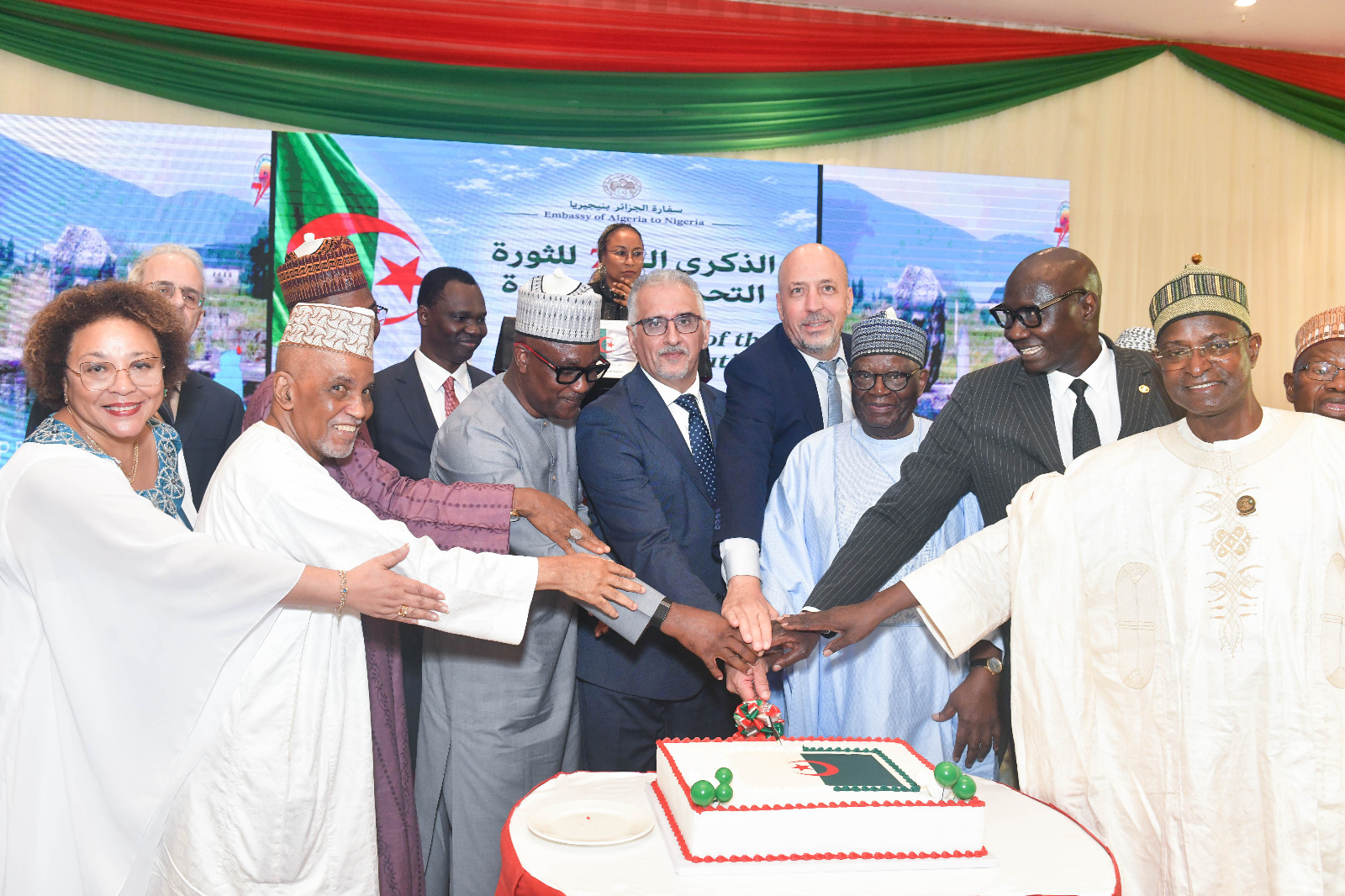
The Embassy of Algeria in Nigeria has commemorated the 72nd anniversary of the country’s Glorious Revolution of November 1, 1954, with a reception in Abuja, highlighting Algeria’s liberation struggle and strengthening diplomatic relations with Nigeria.
The event, held on November 9, 2026, at Continental Suites Hotel, attracted prominent personalities, including the Speaker of the House of Representatives, Dr Tajudeen Abbas, members of the Federal Government, senior government officials, heads of diplomatic missions and other friends of Algeria.
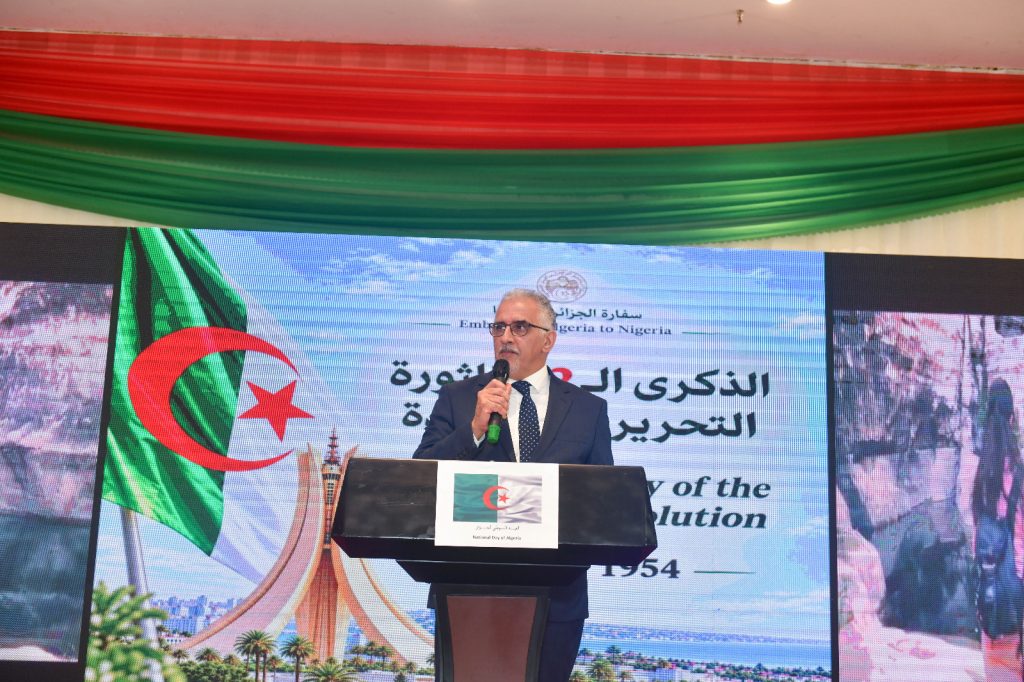
Speaking at the reception, Algeria’s Ambassador to Nigeria, Hocine Mezoued, welcomed guests and paid tribute to the country’s freedom fighters who sacrificed their lives during the struggle for independence.
He described the November 1, 1954 revolution as the foundation of modern Algeria, noting that the sacrifices of the nation’s martyrs made it possible for the country to reclaim its sovereignty.
On Algeria’s development agenda, Mezoued said President Abdelmadjid Tebboune’s administration had continued to pursue economic reforms, diversification and national development under its New Algeria vision.
He noted that the country was recording progress in non-hydrocarbon exports, while improvements in the business environment had boosted investor confidence and attracted significant foreign investments.
On foreign policy, the ambassador reaffirmed Algeria’s commitment to non-interference, respect for national sovereignty, peaceful conflict resolution and the right of peoples to self-determination.
Addressing security challenges in the Sahel, he stressed that lasting peace could not be achieved through military measures alone, insisting that economic development, inclusive dialogue and peaceful resolution of disputes remained essential.
Turning to Nigeria-Algeria relations, Mezoued described the partnership as one founded on shared values and the commitment of both countries’ leaders to advancing African development.
He identified the Trans-Saharan Highway, Trans-Saharan Gas Pipeline and Trans-Saharan Fibre Optic Backbone as major strategic projects receiving attention from both countries.
The ambassador also disclosed that Algeria had continued to provide scholarships to Nigerian students to strengthen human capital development and capacity building.
He further announced that Air Algérie expanded its Nigerian operations on October 26, 2026, with the introduction of two weekly flights to Lagos, expressing confidence that the service would boost trade and tourism.
Looking ahead, Mezoued said 2027 would offer fresh opportunities to deepen bilateral cooperation, particularly through the fifth Joint High Bi-National Commission scheduled to hold in Abuja.
He expressed optimism that the meeting would provide an opportunity to assess existing partnerships, identify new areas of cooperation and move Nigeria-Algeria relations towards a more practical and results-driven phase.
-
 Featured7 years ago
Lampard Names New Chelsea Manager
-
 Featured7 years ago
FG To Extends Lockdown In FCT, Lagos Ogun states For 7days
-
 Featured7 years ago
Children Custody: Court Adjourns Mike Ezuruonye, Wife’s Case To April 7
-
 Featured7 years ago
NYSC Dismisses Report Of DG’s Plan To Islamize Benue Orientation Camp
-

 Featured5 years ago
Transfer Saga: How Mikel Obi Refused to compensate me After I Linked Him Worth $4m Deal In Kuwait SC – Okafor
-
Featured7 years ago
Board urges FG to establish one-stop rehabilitation centres in 6 geopolitical zones
-
Sports4 years ago
TINUBU LAMBAST DELE MOMODU
-

 News2 years ago
Zulu to Super Eagles B team, President Tinubu is happy with you













