
FCT news
FCT Minister To Reopens Dei-Dei Building Materials Market Friday
Joel Ajayi
Federal Capital Territory (FCT) Minister, Malam Muhammad Musa Bello has announced the reopening of the Dei-Dei building materials market and the adjoining markets which were shut following the crisis that erupted at the market on the 18th of May, 2022.
The markets will re-open for business on Friday, 27th May 2022
Malam Bello broke the news on Thursday, 26th of May while addressing journalists after a meeting with major stakeholders of the Dei-Dei community, held at the FCDA Conference Hall, Garki, Abuja.
According to the Minster, all stakeholders at the meeting agreed that the Dei-Dei market fracas was not a ethnic inspired incident but a traffic accident that was hijacked by hoodlums. He revealed that the market will going forward, be re-organized and placed under relevant and proper supervision.
In the words of the Minister “This morning, we held a very important meeting with the stakeholders of the Dei Dei community, the leadership and the head of that community, His Royal Highness, Dr Idris Musa, MFR, the Sarkin Jiwa and all the leaders of the five major markets within that community, as well as religious leaders.
“Basically, we reaffirmed the need for peace in that community, as well as FCT in general, and discussed at length, all issues relating to last week’s incident that led to the destruction of properties and unfortunately, loss of lives.
“The conclusion of our meeting is that all the communities agreed that what happened was not a tribal or religious crisis. What happened was just an unfortunate accident that was overtaken by hoodlums in the community who created havoc. The general consensus now is that every community will make sure that miscreants and hoodlums are flushed out”.
Malam Bello also said that the meeting equally resolved that many of the structures in the market were erected in non-conformity with the Abuja Masterplan and corrective measures will be taken to correct these development anomalies.
Speaking on the activities of commercial motorcyclists known popularly as Okada, the Minister said that their operations will be brought under full regulation and control.
“Generally, the entire stakeholders agreed that peace is very important. Without peace, there will not be economic development and without peace, there will be no society. It was clearly reiterated that the FCT Administration will ensure that all rules and regulations are adhered to” the Minister added
Malam Bello also announced the constitution of a technical committee that would provide a comprehensive report and a roadmap for the re-development of the whole area for the benefit of the citizens.
The committee, which has four weeks to submit its report is chaired by TPL Ibrahim Ismaila, the Senior Special Assistant to the Minister on Land and Urban and Regional Planning and draws membership from the local and business community of the Dei-Dei area, the security agencies as well as officials of the FCT Administration.
The traditional ruler of the Dei-Dei area, HRH Dr. Idris Musa the Sarkin Jiwa also sued for peace, saying they were all brothers and sisters and so should endeavour to live in peace at all times.
He said “We should be our brothers’ keepers and we should endeavour to live in peace with one another. We should instruct our followers to keep away from the past ugly incident to see that peace reigns in that area”, he admonished.
Corroborating the Minister and Sarkin Jiwa, Chairman of the Dei-Dei International Building Materials Market, Mr. Kingsley Orabuego, urged: “We have to live in peace as one nation.
“We are here to make ends meet and we cannot live without each other. We cannot progress without each other. So, I’m urging all the people of Dei-Dei Building Materials Market to live in peace and embrace each other”.
All the stakeholders expressed gratitude to the Minister for the decision to re-open the market
Also present at the meeting were Permanent Secretary, FCTA Mr Olusade Adesola, Chief of Staff to the Minister, Malam Bashir Mai-Bornu, the ES FCDA, Engr Shehu Hadi Ahmed, the FCT Commissioner of Police, Sunday Babaji, the Secretary of the Area Council Services Secretariat, Alh Ibrahim Dantsoho, other community leaders and senior officials of the FCTA.



FCT news
Beyond Displacement: How Vocational Training Is Empowering Over 100 Women and Girls in Abuja
By Joel Ajayi
For women and girls living at the New Kuchingoro Internally Displaced Persons (IDP) Camp in Abuja, rebuilding their lives requires more than shelter and basic necessities. The opportunity to acquire practical skills, earn an income and provide for their families can also play a crucial role in restoring confidence and creating a pathway towards economic independence.
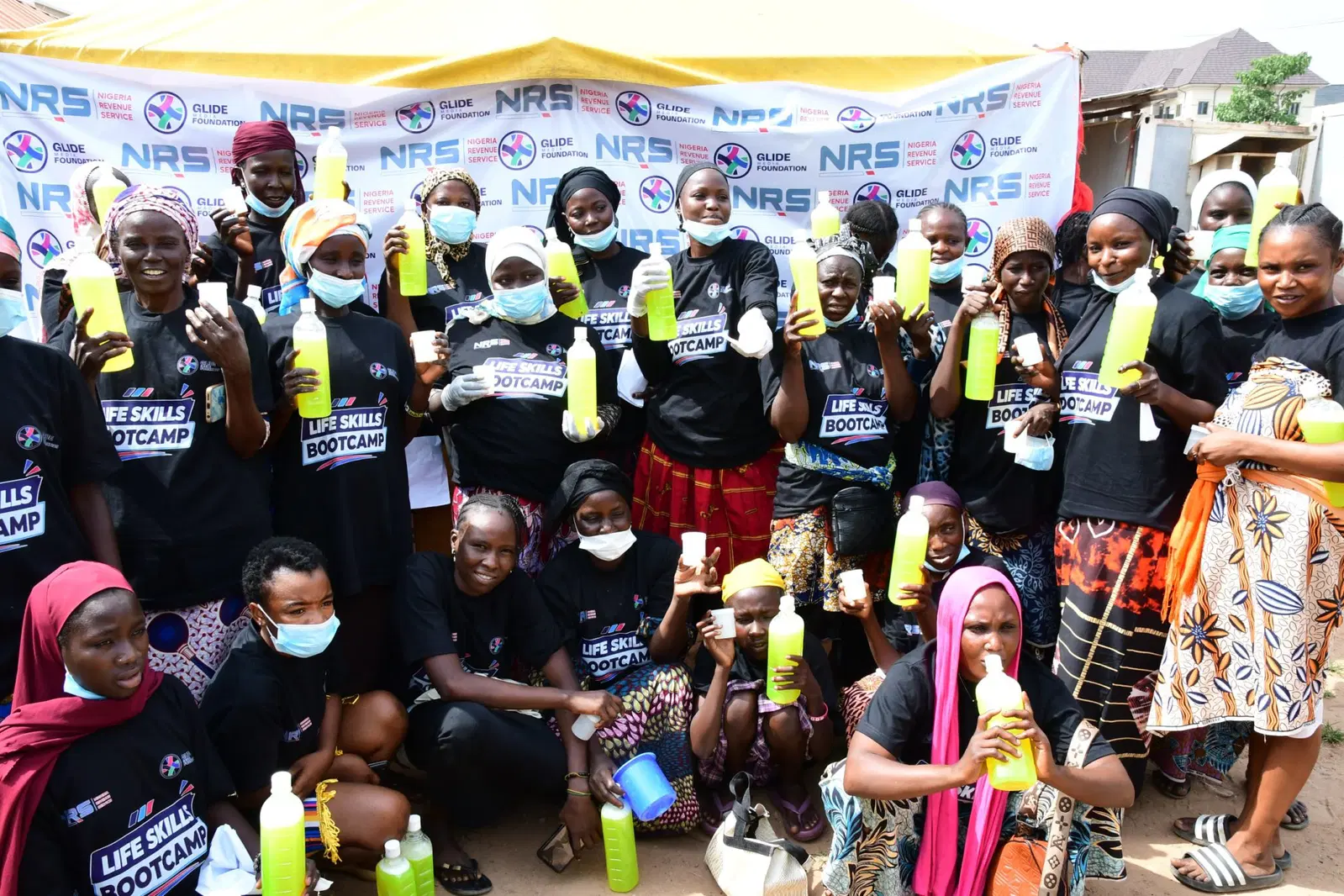
This aspiration informed the five-day Life Skills Bootcamp organised by GLIDE Media Foundation in partnership with the Nigeria Revenue Service (NRS), which provided more than 100 displaced women and girls with vocational training and start-up funding.
The programme, which culminated in a grand finale on Saturday, October 24, 2026, was designed to equip participants with practical knowledge, entrepreneurial skills and financial management techniques to help them establish small businesses and improve their livelihoods.
For the participants, the initiative offered an opportunity to explore income-generating activities that could help them support their families while navigating the economic difficulties associated with displacement.
Turning Skills into Opportunities
At the heart of the programme was the recognition that practical skills can open doors to economic opportunities, particularly for people facing difficult living conditions.
The bootcamp combined classroom-style sessions with hands-on vocational training, allowing participants to learn both the principles of running a business and the practical steps involved in producing goods for sale.
During the practical sessions, participants received training in making beaded slippers, baking, producing soap and preparing petroleum jelly.
They were divided into three groups, with specialised trainers demonstrating production techniques and supervising their activities.
Beyond learning how to make the products, participants received guidance on packaging, marketing and selling their goods. These additional skills were intended to help them understand how to turn their newly acquired abilities into viable small-scale businesses.
The provision of start-up funds at the conclusion of the programme was another important component, offering participants financial support to begin applying what they had learnt.
By combining vocational instruction with initial funding, the organisers sought to bridge the gap between acquiring skills and putting them to productive use.
Building Financial Confidence
The programme also recognised that earning money is only one part of running a successful business. Knowing how to manage income, control expenditure and save for future needs is equally important.
Consequently, the theoretical sessions covered budgeting, saving, expenditure planning and the need to keep personal finances separate from business funds.
Participants were encouraged to understand how financial decisions could affect their businesses and household welfare.
Facilitators also introduced digital financial services, including OPay and Moniepoint, highlighting their potential to support transactions and the management of small businesses.
The sessions provided an opportunity for participants already engaged in business to share their experiences, including the challenges of managing earnings and attracting customers.
Discussions also explored how social media could help entrepreneurs promote their products beyond their immediate communities and reach a wider customer base.
For aspiring business owners, these lessons offered a foundation for thinking beyond production to the practical demands of operating a business in an increasingly competitive environment.
Confidence, Parenting and Personal Development
While economic empowerment remained central to the initiative, the bootcamp also addressed personal development, decision-making, leadership and wellbeing.
Participants were encouraged to build confidence, identify achievable goals and recognise their capacity to contribute to their families and communities despite the challenges associated with displacement.
Parenting and child protection also featured prominently during the sessions.
Discussions covered positive parenting practices, children’s emotional wellbeing, school attendance and the difficulties of balancing childcare responsibilities with income-generating activities.
Facilitators emphasised the importance of supportive home environments and explained how parental behaviour could influence children’s development.
The inclusion of these subjects reflected the programme’s broader focus on helping participants navigate both their economic responsibilities and family obligations.
For women and girls managing several demands, the combination of livelihood training and personal development offered a more comprehensive approach to building resilience.
A Pathway Towards Economic Independence
GLIDE Media Foundation said the initiative was designed to equip displaced women and girls with practical skills that could support their families and reduce their dependence on external assistance.
The partnership with the NRS provided support for a programme that combined entrepreneurship, financial literacy, vocational instruction and start-up funding.
The foundation expressed hope that participants would continue developing their skills and translate the training into sustainable businesses capable of improving their economic circumstances.
However, the long-term impact of the initiative will depend partly on participants’ ability to establish businesses, attract customers and manage their earnings effectively.
Continued guidance, access to markets and opportunities to strengthen their skills could further support their efforts to build sustainable livelihoods.
For the more than 100 women and girls who participated, the bootcamp represents an opportunity to move from learning to action.
Ultimately, its success will be reflected not only in the skills acquired during the five days but also in how effectively participants use their training and start-up funds to generate income, support their families and build greater economic independence.
-
 Featured7 years ago
Lampard Names New Chelsea Manager
-
 Featured7 years ago
FG To Extends Lockdown In FCT, Lagos Ogun states For 7days
-
 Featured7 years ago
Children Custody: Court Adjourns Mike Ezuruonye, Wife’s Case To April 7
-
 Featured7 years ago
NYSC Dismisses Report Of DG’s Plan To Islamize Benue Orientation Camp
-

 Featured5 years ago
Transfer Saga: How Mikel Obi Refused to compensate me After I Linked Him Worth $4m Deal In Kuwait SC – Okafor
-
Featured7 years ago
Board urges FG to establish one-stop rehabilitation centres in 6 geopolitical zones
-
Sports4 years ago
TINUBU LAMBAST DELE MOMODU
-

 News2 years ago
Zulu to Super Eagles B team, President Tinubu is happy with you













