
News
FG’s Digital Reform Deepens As Ministry Goes Live on 1-Gov Cloud

Joel Ajayi
The Federal Ministry of Works formally joined the league of Ministries, extra-ministerial Departments and Agencies (MDAs) on the 1-GOV Enterprise Content Management (ECM) platform, marking a major milestone in its transition from analogue operations to a secure, efficient, and fully digital work processes and flows.
The Go-Live event took place on Tuesday, 23 December, 2025 at the Ministry’s Headquarters, bringing together the Head of the Civil Service of the Federation (HCSF), Transformative Permanent Secretaries, senior government officials and Civil Servants, and key stakeholders committed to advancing the digitalisation of the Public Service.
Speaking at the event, the Honourable Minister of Works, Sen. Engr. David Umahi, CON, FNSE, FNATE, who was represented by the Honourable Minister of State, Bello Muhammad Goronyo, Esq., expressed delight at the presence of the HCSF for the launch.
He commended her dedication to institutional reforms and digital transformation across the Service, describing the Ministry’s transition as a thing of joy and pride. He pledged the leadership’s full support for the initiative and its successful implementation.
The HCSF, Mrs. Didi Esther Walson-Jack, OON, mni, hailed the launch as a demonstration of the Ministry’s readiness to align service delivery with modern, secure, and efficient digital best practices. She highlighted the Ministry’s critical role in national development, through the planning, construction, reconstruction, expansion, rehabilitation, and maintenance of the Federal road network that connects communities, enables commerce, and facilitates economic growth.
“Strengthening its information management systems,” she noted, “is both timely and strategic.”
Mrs. Walson-Jack commended the Ministry’s leadership for their foresight and shared commitment to a seamless transition. She also praised Directors and staff for their openness to change, saying that “in a sector where records, approvals, and institutional memory are fundamental, the deployment of the ECM solution reinforces professionalism, continuity, and accountability.”
She further emphasised that the migration extends beyond technology, representing a fundamental improvement in how work is organised, decisions are documented, and collaboration is enabled. Furthermore, with its integration into the 1-Gov. Cloud ecosystem, the Ministry is now better positioned to operate seamlessly and securely, in alignment with broader Public Service standards.
The Head of Service hinted that this achievement follows the successful migration of the Office of the Head of the Civil Service of the Federation (OHCSF), some time ago, to reflect growing momentum in collective digitalisation efforts across the Service.
She added that the epoch-making initiative contributes meaningfully to the Federal Government’s roadmap for the full digitalisation of work processes and flows by 31 December, 2025, which advances Pillar 5 of the Federal Civil Service Strategy and Implementation Plan 2021–2025 (FCSSIP 25).
She further acknowledged Galaxy Backbone (GBB) Limited for its professionalism in hosting the digital infrastructure, which strengthens data sovereignty and provides a shared, secured digital platform, in line with one of the items on the Renewed Hope Agenda of His Excellency, President Bola Ahmed Tinubu, GCFR – improving governance for effective service delivery.
Earlier, the Permanent Secretary, Mr. Rafiu Adeladan, welcomed guests and staff to the Go Live ceremony and expressed gratitude to the HCSF for attending the formal unveiling.
He described the occasion as a defining moment in the Ministry’s journey towards a more efficient, transparent, and digitally driven operation.
Mr. Adeladan also expressed appreciation to His Excellency, President Tinubu, GCFR, for his visionary leadership and commitment to Public Service reforms, noting that the support and approvals received made the milestone reachable.
He explained that “the Ministry’s digital transformation journey began on 19 April, 2023 as a comprehensive reform programme to eliminate manual processes through the deployment of ECM solutions.
The programme, according to him, was implemented in two strategic phases: Phase One, completed in 2024, laid the foundation for system deployment and digitisation, followed by Phase Two, covering application deployment, secure cloud hosting, experimental onboarding, and extensive capacity building.
Among the key achievements highlighted were the rollout of the DocuFlow ECM software, using a hybrid on-premises and cloud infrastructure, the creation of over 2,000 official email accounts to enable secure electronic correspondence, and the establishment of a dedicated ECM scanning centre to support ongoing digitisation. Capacity building remained central to the transition, with numerous training, onboarding, and awareness programmes conducted across departments, units, and field offices.
The Permanent Secretary further disclosed that the Ministry has digitised over 70% of its records, despite the volume and complexity of the documentation being attended to.
He disclosed that collaboration with the OHSCF, the OECD ECM Preparation Team, and GBB has strengthened institutional efficiency, secured records management, and improved service delivery to Nigerians.



News
DNKI President Champions Humanitarian Service, Sustainable Community Development

Cyril Samania
The President of De Norsemen Kclub International (DNKI), Chief Oliver Patrick Ityohegh, has reaffirmed the organisation’s commitment to humanitarian service, stressing the importance of supporting vulnerable people and improving community welfare beyond the annual celebration of Humanitarian Day.
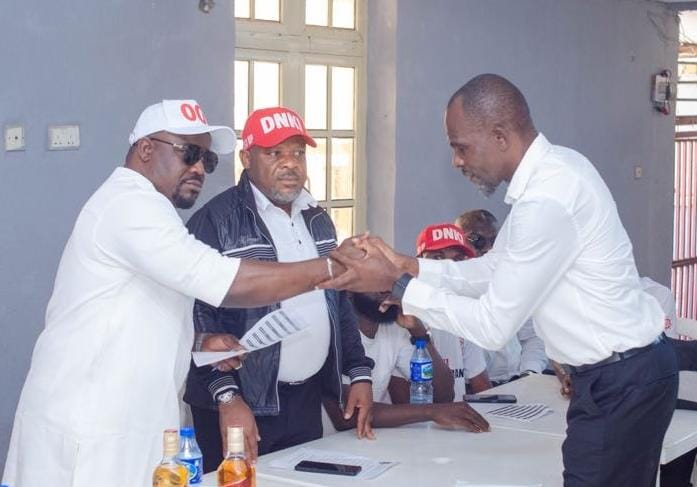
Ityohegh stated this during the organisation’s Cauldron Night and Award Presentation held to commemorate its 2026 Humanitarian Day celebration, theme: “Humanity First: Advancing Hope, Dignity and Community Well-being.” organised by the DNKI Abuja Chapter.
He emphasised that humanitarian service should be a continuous responsibility driven by compassion, solidarity and a commitment to making a meaningful difference in society.
According to him, DNKI’s humanitarian activities reflect its dedication to giving back to society and supporting people in need, while encouraging members to sustain initiatives that promote human dignity and community well-being.
He added that the organisation would continue to strengthen its humanitarian engagements through practical interventions aimed at improving the lives of vulnerable people and promoting community development.
Speaking at the event, the representative of the Abuja Chapter Chairman and Chairman of its Advisory Council, Prince Efiong Okpe, said the organisation’s humanitarian activities extended beyond the annual celebration of Humanitarian Day on October 15.
Okpe explained that DNKI undertook several initiatives throughout the year, including blood donation exercises, visits to hospitals and correctional centres, as well as support for orphanages and other vulnerable groups.
According to him, the organisation also collaborated with humanitarian bodies in the Federal Capital Territory (FCT) to identify areas of need and provide assistance within its available resources.
He described Humanitarian Day as an opportunity for members to renew their commitment to service and demonstrate solidarity with people facing difficult circumstances.
Earlier, the Chairman of the Planning Committee and Coordinator of the DNKI Gwagwalada Zone, Mr Etudaiye Hamzat, disclosed that the chapter had provided financial assistance to some members to help pay their children’s school fees, alongside distributing bags of rice and other relief items to members experiencing hardship.
Hamzat explained that the interventions followed concerns over the difficulties some members faced in meeting their family responsibilities, particularly the rising cost of their children’s education.
He maintained that supporting members in need was consistent with the organisation’s humanitarian principles, adding that DNKI remained committed to extending assistance to non-members and vulnerable communities as part of its commitment to leading by example.
Looking ahead, Hamzat said the Abuja Chapter planned to expand its humanitarian outreach to remote communities within the FCT, with particular attention to orphanages, schools and widows facing difficulties in meeting their family responsibilities.
He also recalled previous interventions for internally displaced persons (IDPs), which included the distribution of food, clothing and educational materials, noting that the chapter intended to scale up such initiatives in the coming year.
The highlight of the event was the presentation of awards to outstanding members and distinguished non-members in recognition of their contributions to humanitarian service.
-
 Featured7 years ago
Lampard Names New Chelsea Manager
-
 Featured7 years ago
FG To Extends Lockdown In FCT, Lagos Ogun states For 7days
-
 Featured7 years ago
Children Custody: Court Adjourns Mike Ezuruonye, Wife’s Case To April 7
-
 Featured7 years ago
NYSC Dismisses Report Of DG’s Plan To Islamize Benue Orientation Camp
-

 Featured5 years ago
Transfer Saga: How Mikel Obi Refused to compensate me After I Linked Him Worth $4m Deal In Kuwait SC – Okafor
-
Featured7 years ago
Board urges FG to establish one-stop rehabilitation centres in 6 geopolitical zones
-
Sports4 years ago
TINUBU LAMBAST DELE MOMODU
-

 News2 years ago
Zulu to Super Eagles B team, President Tinubu is happy with you













