
Featured
From U.S. Alarm to Tinubu’s Validation
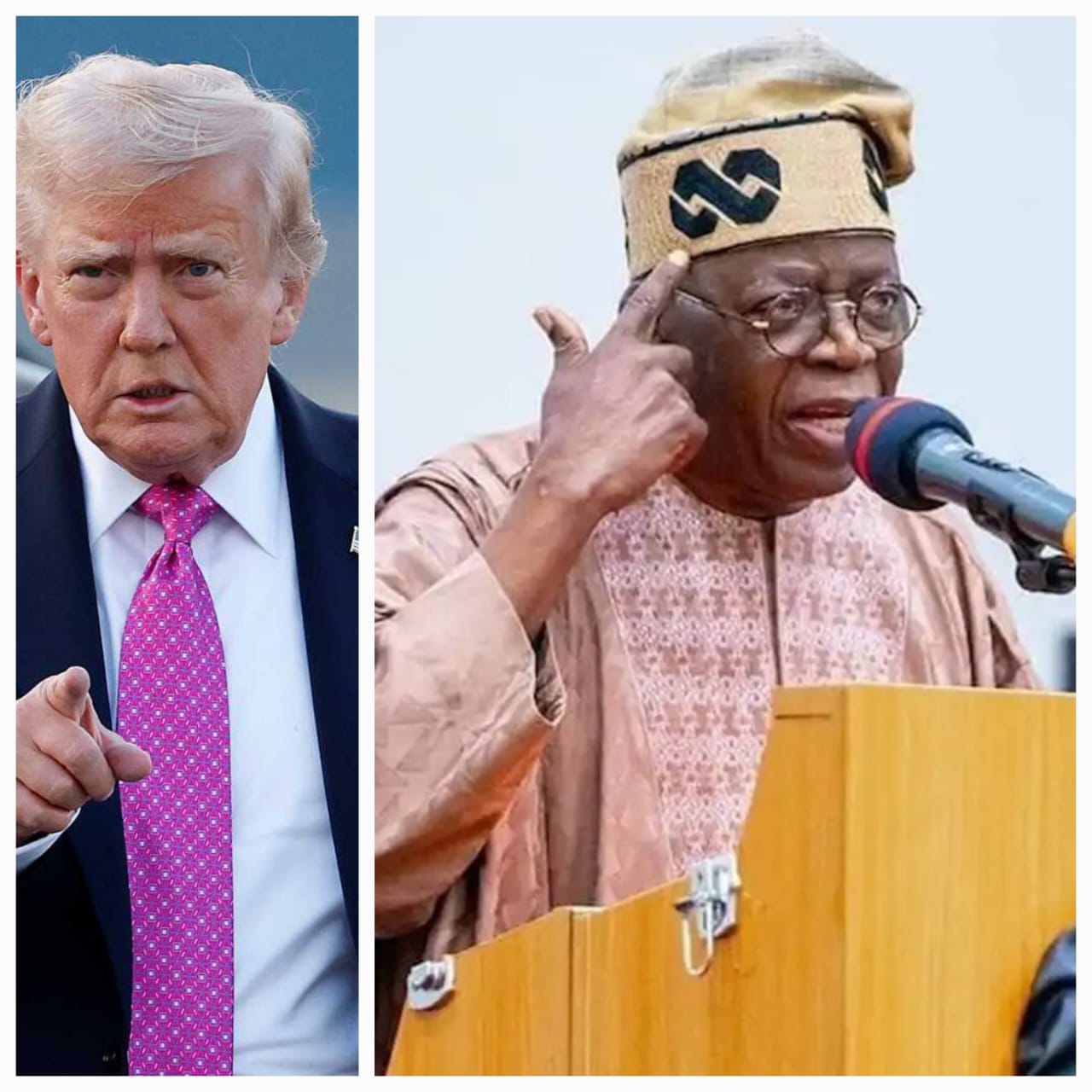
U.S. President Donald Trump’s recent decision to list Nigeria as a “Country of Particular Concern” triggered a wave of reactions across diplomatic and political circles.
While many Nigerians viewed the designation as a national embarrassment and critics seized it as evidence of deepening instability, the development has taken on a surprising twist: it has become an unintended validation of President Bola Ahmed Tinubu’s ongoing reforms.
For global observers, Trump’s warning underscored the security and governance challenges facing Africa’s largest democracy. But within Nigeria, it cast renewed attention on Tinubu’s attempts to tackle the very issues that led to the U.S. designation from terror attacks and mass kidnappings to deep rooted economic distortions.
Political analysts note that long before Trump’s statement, Tinubu had already begun overhauling Nigeria’s security and economic systems, taking steps more far-reaching than those implemented by his predecessors. Trump may have amplified global concern, but Tinubu had already moved into the repair phase.
Upon assuming office, Tinubu inherited a nation strained by years of structural decline a costly fuel subsidy regime, an opaque multi-tiered foreign exchange system, rising insecurity, and widening regional imbalances. Instead of opting for gradualism, he pursued sweeping measures aimed at resetting Nigeria’s foundations.
One of his earliest actions was an overhaul of the security architecture. Tinubu dismissed and replaced the previous service chiefs, appointed field tested commanders, strengthened joint operations, and demanded measurable results. The armed forces intensified land and air offensives, resulting in major arrests, rescue operations, and the neutralisation of terror cells. Security improvements were coupled with community-level interventions to break cycles of violence and restore economic activity in long neglected regions.
Economically, Tinubu took two of the most contentious decisions in decades: removal of petrol subsidy and unification of the exchange rate. His administration framed the decisions as necessary to end fiscal leakages and curb entrenched rent-seeking. Though the reforms generated short-term hardships, they also freed revenue for federal and state governments and signaled to investors that Nigeria was ready for structural cleanup.
In governance, Tinubu implemented what analysts describe as an equity-driven restructuring of the federation. Every geopolitical zone now has a dedicated regional development commission a move designed to institutionalise fairness and ensure balanced growth. This expansion is widely regarded as one of the administration’s most strategic long-term decisions.
Meanwhile, Nigeria is witnessing what officials describe as a new wave of infrastructure expansion. Work is underway on the multi-state Lagos–Calabar Coastal Highway, the Sokoto–Badagry Super Highway, major rail upgrades, power sector reforms, and the rehabilitation of key federal roads. Port modernization projects are also accelerating to position Nigeria as a competitive maritime hub.
International confidence appears to be responding to these reforms. Tinubu has pursued aggressive economic diplomacy, securing investment commitments from the UAE, Germany, Saudi Arabia, the United States, and leading multinationals. Government officials report that more than $30 billion in investment pledges were recorded during the administration’s first year.
The government has also launched a comprehensive tax reform effort aimed at curbing multiple taxation, expanding the tax net, and strengthening transparency a shift intended to help raise Nigeria’s historically low tax-to-GDP ratio.
As global reactions to Trump’s warning continue, Nigerian officials argue that the designation inadvertently highlights a turning point rather than a downward spiral. While the U.S. warning spotlighted Nigeria’s challenges, Tinubu’s defenders say the administration is already confronting those challenges with bold, long-term reforms.
In this framing, Trump’s alarm has become a backdrop that underscores the urgency of Tinubu’s agenda and, paradoxically, the evidence of its relevance.
Supporters of the president say the label “country of concern” is being transformed into a story of a country in recovery, driven by a leader intent on reversing years of stagnation. According to them, Tinubu’s approach prioritising difficult reforms over popular short-term fixes is precisely what positions Nigeria for renewed global confidence.
In a twist of geopolitical irony, what was meant to warn the world about Nigeria may now be drawing attention to an unfolding attempt at national renewal.



Featured
CELEBRATING A CENTURY-OLD CIVIL AVIATION SECTOR TRAJECTORY IN NIGERIA

This week, millions of Nigerians and others across the globe will join the Ministry of Aviation and Space Development under the irrepressible leadership of the Honourable Minister, Festus Keyamo(SAN),and all the notable Aviation sector stakeholders in and outside the country,in celebrating a century of Nigeria’s civil aviation history.
There is no doubt that under the present leadership of the Honourable Minister and within the short spell of time in his stewardship,he has consciously and intentionally embarked on a “silent revolution” for the industry with very veritable and laudable landmarks that have consistently grown the industry.
Some of these spirited efforts for instance have consequently led to trust restoration amongst international lessors, financier,any global partners.Of note also is assidiously working for the full domestication and implementation of the “Cape Town Convention Agreement” ,which gives Airlines access to modern fleets of competitive rates as well as enforcement of IDERA(Irrevocable Deregulation and Export Request Authorization).
Having well applauded these vital contemporary initiatives,it will also be germane to cast our minds in retrospect by taking a peep into our history over several decades to recognise some of the notable forebears in the industry whose impressionabl efforts cannot be overlooked,as they took the impetuous initiatives of breaking the ice at the nascent stage.
It will aptly corroborate the truism which says that… ” a journey of a thousand miles starts with one step”.
The above is vividly captured from a tribute by the First Republic Minister of Aviation Chief Mbazulike Amaechi at the funeral of late Igwe of Oba,HRH Peter Ezenwa(MFR) in 2018.
It states inter alia…”One significant thing I will say many people didn’t know is that the first indigenous airline that was to run in Nigeria was known as “STANDARD AIRLINE”.It was founded in 1966 by a company formed by Igwe Peter Ezenwa from Oba,and had on board,John Nwankwu from Abagana,Edward Ebo from Ezinifitte,(all from Anambra state),John Anyaehie from Nkwerre in Imo state,and lastly my very self Mbazulike Amaechi.
The five of us later acquired two brand new aircrafts,and had four pilots,namely;Unachievable,John Emma Ngwu and Felix Offor,who was to be the General Manager of the airline.
But just about the time for the take-off the crisis of the military takeover erupted in the North as the planes were on their way for delivery to us.In fact the bank handling the transaction was to allow the planes to be flown from the USA,but the news of the war broke out in 1967,the insurance company cabled for the cancellation of the deal as they will not be able to cover the risk cost of aircrafts being flown into war zone.
So,we asked the manufacturers to take the two aircrafts back to their country and hold on for six months with the hope of that the war will end within the requested time frame,but the war didn’t end as thought.We consequently asked for refund and they deducted some money and refunded the balance which was deposited at the London branch of African Continental Bank(ACB).
When the government took over the operations of ACB,we still hoped for the refund but unfortunately were disappointed that the Federal government took over the whole money and we lost everything.”
Further in line with our historical perspective,it will also be pertinent some of the later years reformists in the likes of Engr Onyereri and Harold Demuren who advertently sponsored some far reaching regulations that eventually steered the industry towards greater autonomy with the passage of the 2005 Civil Aviation Act,which I was also a prime participant of in my capacity as an Aviation sub chair in then House of Representatives.
As we mark this great century milestone,and with the clear evidential pathway set out by the current managers of the industry under the indomitable leadership of Honourable Minister, I do not see the sky posing any limitations as they say,but rather availing new vistas of limitless growth opportunities.
CONGRATULATIONS.
Hon Chidi Nwogu
Former member House of Representatives & presently Governing Council member
,African Aviation and Aerospace University,Abuja.
-
 Featured6 years ago
Lampard Names New Chelsea Manager
-
 Featured6 years ago
FG To Extends Lockdown In FCT, Lagos Ogun states For 7days
-
 Featured6 years ago
Children Custody: Court Adjourns Mike Ezuruonye, Wife’s Case To April 7
-
 Featured6 years ago
NYSC Dismisses Report Of DG’s Plan To Islamize Benue Orientation Camp
-

 Featured4 years ago
Transfer Saga: How Mikel Obi Refused to compensate me After I Linked Him Worth $4m Deal In Kuwait SC – Okafor
-
Sports3 years ago
TINUBU LAMBAST DELE MOMODU
-

 News12 months ago
Zulu to Super Eagles B team, President Tinubu is happy with you
-
Featured6 years ago
Board urges FG to establish one-stop rehabilitation centres in 6 geopolitical zones













