
Agriculture
Lack Of Awareness Bane Of Organic Agriculture Processes-Expert
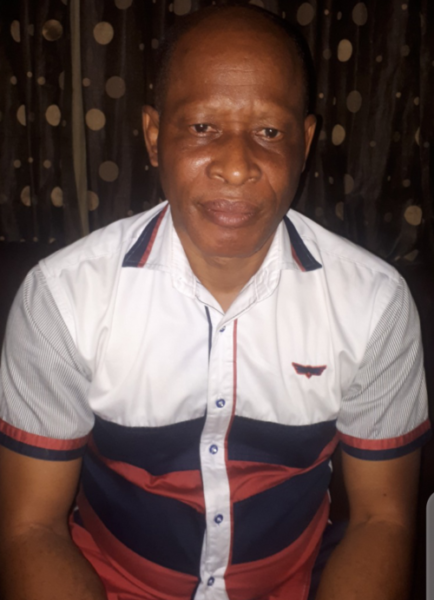
Lecturer, Department of Soil Science and Land Resources Management, University of Uyo Dr. Jude Obi, has described a lack of awareness as the cog in the wheel of acceleration of organic agriculture processes and practices in the country.
Obi said this during his online presentation on `Organic Agriculture to the Rescue’ organized by Journalists Go Organic Initiative.
He stated that although conventional production system and practices have compromised the overall environmental parameters, organic agriculture practices and production systems have come to the rescue.
According to him, the conventional system was presented as the only alternative to sustainable food production and security but did not foresee the debilitating effect it will have on both the environment and health of humanity.
“The conventional practice was packaged, popularised and widely adopted either for the available knowledge as at then or for the selfish capitalist end as obtained now e.g. GM foods.
“While the previously practiced traditional system was presented as deficient in the prerequisites to feed the geometrically growing human population.
“The developed countries made tremendous progress with intensive use of systems that led to deteriorated global climatic conditions with which Africa currently does not have the capacity to withstand, therefore, we must go back to healthy farming.”
Obi who is also the Coordinator for the Knowledge Centre for Organic Agriculture (KCOA) in Africa reiterated, however, that organic agriculture is about the dire need to feed the world’s growing population with healthy food.
“Humans has been confronted with strange ailments that are clearly pointing at the conventional agricultural practices, hence the need and every reason to practice agriculture with safety and health as priorities.
`Organic agriculture is the affordable way to provide quality agricultural goods and services in harmony with nature.
“Therefore, efforts should be made by all stakeholders to popularise the practice’’.



Agriculture
ARCN Executive Secretary Dabbán Earns Double Recognition for Excellence
Joel Ajayi
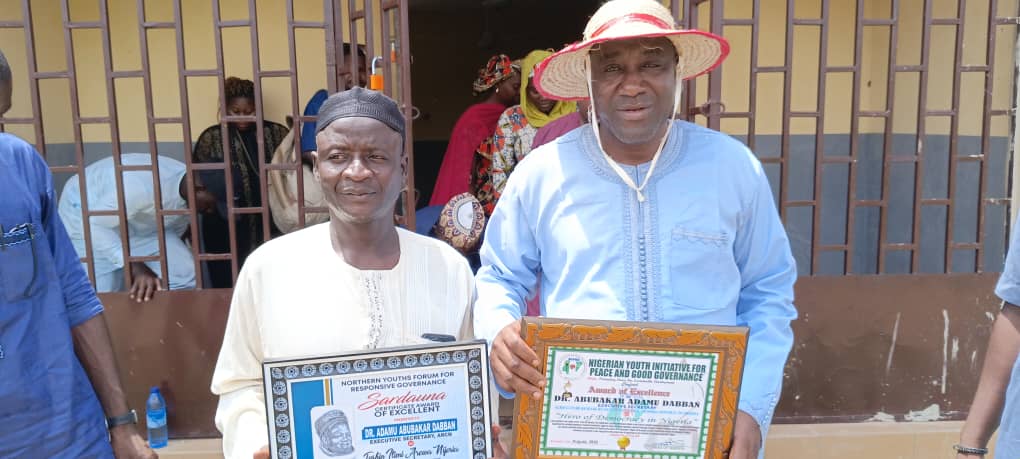
The Executive Secretary of the Agricultural Research Council of Nigeria (ARCN), Dr. Adamu Abubakar Dabban, has been honoured with a Double Award of Excellence by two youth-focused organisations for his leadership, commitment to good governance and contributions to the development of Nigeria’s agricultural sector.
In a statement signed on Tuesday by the ANIPR PRO, Agricultural Research Council of Nigeria Khadijat Ameen in Abuja stated that the honours were conferred on Dr. Dabban by the Nigeria Youth Initiative for Peace and Good Governance and the Northern Youth Forum for Responsive Governance.
The organisations recognised the ARCN Executive Secretary for what they described as his outstanding leadership and dedication to good governance, as well as his efforts toward advancing agricultural development in Nigeria.
The double recognition highlights the growing attention being given to leadership and institutional efforts aimed at strengthening Nigeria’s agricultural research and development ecosystem.
Receiving the honours, Dr. Dabban expressed appreciation to the organisations for the recognition, noting that such awards serve as encouragement to remain committed to the responsibilities entrusted to him and to the broader goal of advancing agricultural development.
The recognition comes as the ARCN continues its mandate of coordinating and promoting agricultural research and development in support of Nigeria’s food and agricultural priorities.
Congratulations to the Executive Secretary, Dr. Adamu Abubakar Dabban, on this distinguished double honour.
-
 Featured7 years ago
Lampard Names New Chelsea Manager
-
 Featured7 years ago
FG To Extends Lockdown In FCT, Lagos Ogun states For 7days
-
 Featured7 years ago
Children Custody: Court Adjourns Mike Ezuruonye, Wife’s Case To April 7
-
 Featured7 years ago
NYSC Dismisses Report Of DG’s Plan To Islamize Benue Orientation Camp
-

 Featured5 years ago
Transfer Saga: How Mikel Obi Refused to compensate me After I Linked Him Worth $4m Deal In Kuwait SC – Okafor
-
Featured7 years ago
Board urges FG to establish one-stop rehabilitation centres in 6 geopolitical zones
-
Sports4 years ago
TINUBU LAMBAST DELE MOMODU
-

 News2 years ago
Zulu to Super Eagles B team, President Tinubu is happy with you