
Sports
Maryam Shehu Highlights Economic Prospects as AACT 2026 Countdown Hits 17 Days
Joy Samania
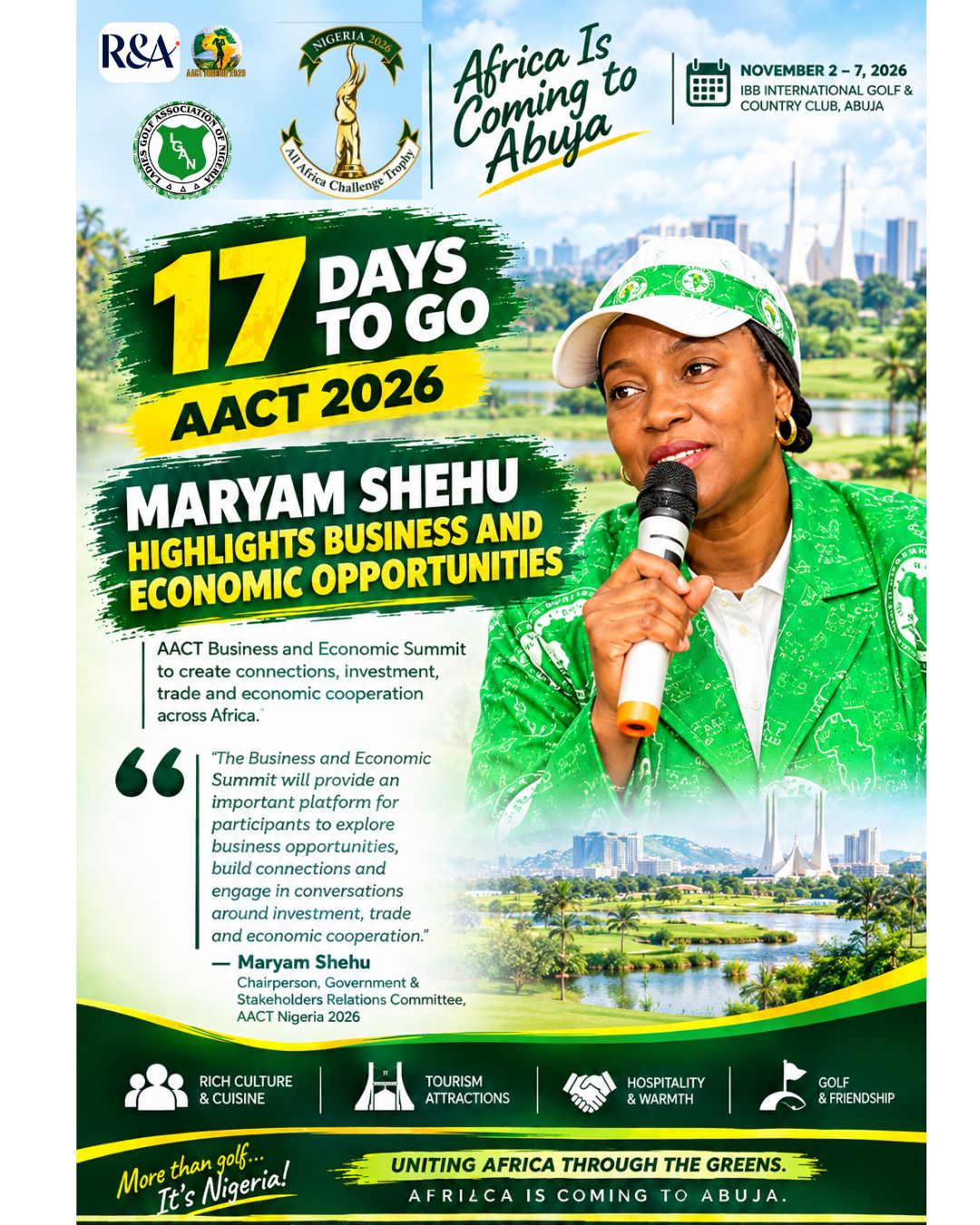
With 17 days to the 2026 All Africa Challenge Trophy (AACT), attention is turning to the business and economic opportunities the continental women’s golf championship is expected to create, including through a planned Business and Economic Summit.
Maryam Shehu, Chairperson of the Government and Stakeholders Relations Committee for AACT Nigeria 2026, says the summit will provide an important platform for participants to explore business opportunities, build connections and engage in conversations around investment, trade and economic cooperation.
The initiative reflects the broader vision of AACT 2026 as more than a sporting competition, bringing together golf, business, tourism and cultural exchange in a celebration of African unity and shared opportunities.
With golf bringing together players, officials, administrators and other stakeholders from across the continent, the championship presents an opportunity to strengthen professional networks and showcase Abuja as a destination for sporting events, business engagement and tourism.
The Business and Economic Summit is expected to complement the on-course action by creating room for discussions on how sporting events can stimulate economic activity, encourage partnerships and open doors for businesses and other participating stakeholders.
For businesses, entrepreneurs and investors, such engagements can offer opportunities to establish contacts, exchange ideas and explore areas of mutual interest. The gathering also provides a platform to consider how sport can contribute to tourism development, hospitality, service delivery and wider economic relations across African countries.
Shehu’s role in government and stakeholder relations places her at the centre of efforts to connect the championship with relevant institutions, partners and other stakeholders, ensuring that the event’s potential benefits extend beyond the golf course.
The summit also aligns with the spirit of the 2026 championship, whose slogan is “Uniting Africa through the greens.” The message underscores the power of golf to bring people and nations together while creating opportunities for dialogue, collaboration and development.
Nigeria will host the All Africa Challenge Trophy for the third time, following previous editions in Lagos in 1996 and Abuja in 2010. The 2026 championship is scheduled for November 2 to 7 at the IBB International Golf & Country Club, Abuja.
As preparations continue, the focus is increasingly on delivering an event that celebrates women’s golf while showcasing Nigeria’s hospitality, strengthening African connections and highlighting the wider social and economic value of hosting major sporting competitions.
17 DAYS TO GO.
AACT 2026: UNITING AFRICA THROUGH THE GREENS. AFRICA IS COMING TO ABUJA.



Sports
Beyond Participation: How Mal. Dikko and Hon. Olopade Are Rewriting Nigeria’s International Sports Strategy Through Sports Science

Joel Ajayi
One of the most significant, yet largely understated, achievements of the National Sports Commission (NSC) under its current leadership is the introduction of a scientific, data-driven approach to Nigeria’s participation in major international sporting competitions.
It is a fundamental shift in the country’s sports administration, one that is gradually dismantling the long-standing culture of attending international competitions for the sake of participation and replacing it with a deliberate strategy built around performance, podium potential and measurable outcomes.
Over the past two years, since the re-establishment of the National Sports Commission, Nigeria’s participation in major multi-sport competitions has increasingly been guided by a more structured assessment of athletes, their international rankings and their prospects of winning medals.
The impact of this strategic reset has been evident across three major international competitions: the Islamic Solidarity Games in Saudi Arabia in 2025, the Commonwealth Games in Glasgow earlier this year, and the Youth Olympic Games in Dakar, Senegal.
Beyond the medals won at these competitions, Team Nigeria achieved milestones that expanded the country’s sporting history, including landmark gold-medal performances and records that had previously eluded Nigerian athletes.
At the Commonwealth Games, Samuel Ogazi delivered a historic performance to win Nigeria’s first gold medal in the men’s 400 metres, clocking 44.25 seconds. Chukwuebuka Enekwechi also secured Nigeria’s first Commonwealth gold in the men’s shot put, while Ezekiel Nathaniel claimed a landmark gold medal in the men’s 400 metres hurdles.
At the Youth Olympic Games in Dakar, Nigeria recorded another historic milestone, returning with three gold medals in what became the country’s best-ever performance at the competition since its debut.
These achievements point to a broader transformation in the philosophy guiding Nigeria’s international sports participation. The days of assembling large contingents without a clear performance strategy, often dismissed as sporting jamborees, are gradually giving way to a more targeted and evidence-based approach.
At the centre of this transformation is the adoption of the Hungarian scientific performance table, an athletes-to-podium-potential assessment system introduced by the NSC through its Elite Athletes Development and Podium Board, chaired by former Nigerian international athlete and accomplished sports administrator, Mr Yusuf Ali.
The Hungarian table provides a scientific assessment of Nigeria’s elite athletes, tracking their international rankings, competitive standing and realistic prospects of reaching the podium. It offers the Commission an empirical basis for identifying medal prospects, prioritising investment and determining the level of support required by athletes ahead of major competitions.
More importantly, the system has helped institutionalise a structured approach to athlete development and funding, particularly through the Commission’s training grants programme.
This is perhaps one of the most consequential aspects of the reform. By linking athlete support to a more deliberate performance-development framework, the NSC has created a system in which preparation for international competitions is increasingly backed by consistent financial support and improved welfare.
In the last two years, more than $1 million, approximately ₦1.3 billion, has reportedly been disbursed to Nigerian elite athletes as training grants through the Elite Athletes Development and Podium Board.
Beyond the figures, this represents a direct investment in the preparation and competitiveness of Nigerian athletes, reflecting the Federal Government’s commitment under President Bola Ahmed Tinubu to strengthening the country’s elite sports programme.
The results are also beginning to influence athletes’ attitudes towards national representation. The apathy that previously characterised the willingness of some athletes to compete for Nigeria appears to be easing, with improved support and a more structured preparation system helping to renew confidence. Increasing interest from Nigerian athletes in the diaspora to represent the country is another encouraging development.
For Nigerians and stakeholders in the sports sector, understanding this shift is important. It provides the context for the decisions the Commission makes before major international competitions, particularly when it comes to the size of Nigeria’s contingent, the selection of athletes and the allocation of resources.
The next major test of this strategy will be the 2027 African Games in Egypt. Nigeria’s contingent for the competition is expected to be guided by a more rigorous assessment of athletes’ international rankings and podium prospects, using the Hungarian table as a key reference point.
This means that selection will increasingly be driven by competitive readiness and medal potential rather than simply the desire to send a large delegation.
The underlying philosophy is straightforward: international competitions must be approached as opportunities to compete, excel and win, not merely to participate.
As NSC Director General, Hon. Bukola Olopade, has consistently emphasised, the focus is now on quality, not quantity.
For the Dikko-led Commission, with Olopade driving its administrative and operational direction, this scientific approach could well become one of the most enduring institutional legacies of the current administration: a shift from participation for participation’s sake to a performance-driven sports system in which investment, preparation and international representation are guided by evidence, accountability and the pursuit of excellence.
-
 Featured7 years ago
Lampard Names New Chelsea Manager
-
 Featured7 years ago
FG To Extends Lockdown In FCT, Lagos Ogun states For 7days
-
 Featured7 years ago
Children Custody: Court Adjourns Mike Ezuruonye, Wife’s Case To April 7
-
 Featured7 years ago
NYSC Dismisses Report Of DG’s Plan To Islamize Benue Orientation Camp
-

 Featured5 years ago
Transfer Saga: How Mikel Obi Refused to compensate me After I Linked Him Worth $4m Deal In Kuwait SC – Okafor
-
Featured7 years ago
Board urges FG to establish one-stop rehabilitation centres in 6 geopolitical zones
-

 News2 years ago
Zulu to Super Eagles B team, President Tinubu is happy with you
-
Sports4 years ago
TINUBU LAMBAST DELE MOMODU













