
News
Minister of Works Meets World Bank Delegation on Strengthening Nigeria’s Infrastructure

Joel Ajayi
The Honourable Minister of Works, His Excellency Sen. (Engr.) David Umahi, CON, FNSE, FNATE, on Friday, January 23, 2026, received a high-level delegation from the World Bank in his office for a strategic meeting focused on improving Nigeria’s infrastructure, particularly the road sector.
In his welcome remarks, the Honourable Minister expressed appreciation to the World Bank delegation for their interest in Nigerian infrastructure projects. He noted that infrastructure development remains the most critical requirement for Nigeria to attain its desired position in global economic competitiveness, emphasizing that efficient road networks are fundamental to national growth, trade, and social development.
Sen. Umahi briefed the delegation on the Federal Government’s Development Management Initiative, as well as the “Build, Update and Maintain” strategy, under which the government is responsible for constructing roads while the private sector is engaged to maintain them. According to him, this model is designed to ensure sustainability, efficiency, and value for money in road infrastructure delivery.
The Honorable Minister highlighted the challenges facing the road sector, noting that the cost of road construction and availability of funds became more difficult following the removal of fuel subsidy and floating of the naira. He explained that experience has shown that roads constructed with asphalt often fail to last beyond ten years, which informed the Ministry’s decision to adopt reinforced concrete pavement as a more durable and long-lasting alternative.
He identified key priority road projects currently being handled by the Ministry, including:
The East–West Road, comprising over eight sections,
The Enugu–Onitsha Road Project,
The Kano–Jigawa–Maiduguri Road Corridor, and
The Lagos–Ibadan Expressway.
The Honourable Minister disclosed that when he assumed office, the Ministry inherited about 260 weak road links, 50 dilapidated bridges, and numerous failed road sections nationwide. To address these urgent challenges, President Bola Ahmed Tinubu, GCFR, approved ₦20 billion for the completion of some priority road projects, many of which are currently being commissioned across the country, as observed by journalists.
Sen. Umahi explained that, given current realities, long-term planning is less feasible, and the focus must be on short-term interventions aimed at completing major ongoing road projects. He stressed that funding remains a major constraint and reiterated that new projects cannot be initiated while existing ones remain incomplete.
Consequently, the Honourable Minister formally requested the World Bank to consider financing road infrastructure projects through the Federal Ministry of Works via the Presidency. He explained that such funds would be committed to a number of strategic ongoing road projects for completion, with tolling mechanisms introduced to ensure sustainability and repayment. He emphasized that additional funding is urgently required to complete critical infrastructure projects across Nigeria.
The World Bank delegation, led by Mr. Matthew Verghis, stated that the purpose of the visit was to discuss practical ways of improving Nigerian roads, which he described as the country’s most important infrastructure asset.
Speaking during the meeting, Mr. Franz Drees-Gross, a member of the delegation, explained that the World Bank’s overarching objective is to create jobs and reduce poverty. He stressed that infrastructure is central to poverty reduction, as it generates employment directly and indirectly across various sectors of the economy. He highlighted priority areas of interest, including the establishment of State Roads Funds, State Road Maintenance Agencies, improved flood control through effective drainage systems, and increased Private Sctor financing.
Mr. Verghis further noted that the World Bank can only fund contracts that comply with World Bank procurement standards, stressing the importance of transparency, accountability, and due process in project execution.
The meeting ended on a positive note, with both parties expressing commitment to strengthening collaboration towards the development of sustainable, resilient, and inclusive infrastructure in Nigeria.
The Honourable Minister of State for Works, Barr. Mohammed A. Goronyo, Esq., delivered the vote of thanks, appreciating the World Bank delegation for the visit and reaffirming the Ministry’s readiness to work closely with the Bank to achieve shared development goals.



News
DNKI President Champions Humanitarian Service, Sustainable Community Development
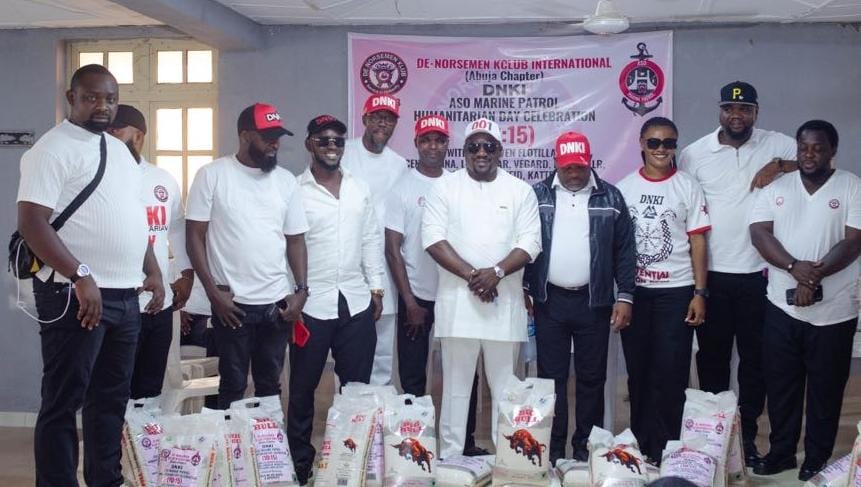
Cyril Samania
The President of De Norsemen Kclub International (DNKI), Chief Oliver Patrick Ityohegh, has reaffirmed the organisation’s commitment to humanitarian service, stressing the importance of supporting vulnerable people and improving community welfare beyond the annual celebration of Humanitarian Day.
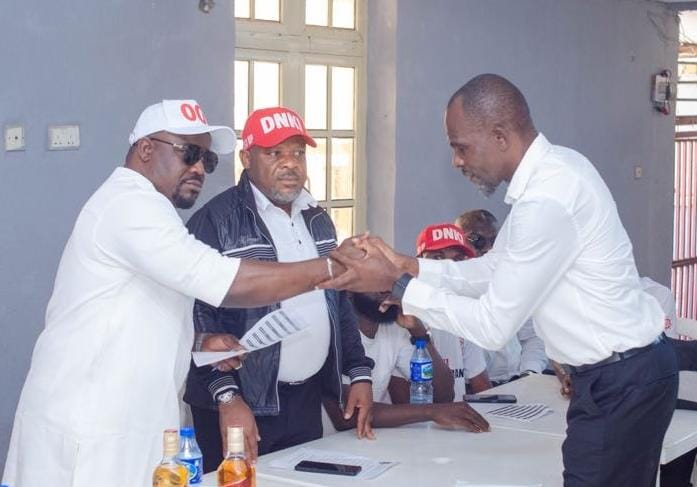
Ityohegh stated this during the organisation’s Cauldron Night and Award Presentation held to commemorate its 2026 Humanitarian Day celebration, theme: “Humanity First: Advancing Hope, Dignity and Community Well-being.” organised by the DNKI Abuja Chapter.
He emphasised that humanitarian service should be a continuous responsibility driven by compassion, solidarity and a commitment to making a meaningful difference in society.
According to him, DNKI’s humanitarian activities reflect its dedication to giving back to society and supporting people in need, while encouraging members to sustain initiatives that promote human dignity and community well-being.
He added that the organisation would continue to strengthen its humanitarian engagements through practical interventions aimed at improving the lives of vulnerable people and promoting community development.
Speaking at the event, the representative of the Abuja Chapter Chairman and Chairman of its Advisory Council, Prince Efiong Okpe, said the organisation’s humanitarian activities extended beyond the annual celebration of Humanitarian Day on October 15.
Okpe explained that DNKI undertook several initiatives throughout the year, including blood donation exercises, visits to hospitals and correctional centres, as well as support for orphanages and other vulnerable groups.
According to him, the organisation also collaborated with humanitarian bodies in the Federal Capital Territory (FCT) to identify areas of need and provide assistance within its available resources.
He described Humanitarian Day as an opportunity for members to renew their commitment to service and demonstrate solidarity with people facing difficult circumstances.
Earlier, the Chairman of the Planning Committee and Coordinator of the DNKI Gwagwalada Zone, Mr Etudaiye Hamzat, disclosed that the chapter had provided financial assistance to some members to help pay their children’s school fees, alongside distributing bags of rice and other relief items to members experiencing hardship.
Hamzat explained that the interventions followed concerns over the difficulties some members faced in meeting their family responsibilities, particularly the rising cost of their children’s education.
He maintained that supporting members in need was consistent with the organisation’s humanitarian principles, adding that DNKI remained committed to extending assistance to non-members and vulnerable communities as part of its commitment to leading by example.
Looking ahead, Hamzat said the Abuja Chapter planned to expand its humanitarian outreach to remote communities within the FCT, with particular attention to orphanages, schools and widows facing difficulties in meeting their family responsibilities.
He also recalled previous interventions for internally displaced persons (IDPs), which included the distribution of food, clothing and educational materials, noting that the chapter intended to scale up such initiatives in the coming year.
The highlight of the event was the presentation of awards to outstanding members and distinguished non-members in recognition of their contributions to humanitarian service.
-
 Featured7 years ago
Lampard Names New Chelsea Manager
-
 Featured7 years ago
FG To Extends Lockdown In FCT, Lagos Ogun states For 7days
-
 Featured7 years ago
Children Custody: Court Adjourns Mike Ezuruonye, Wife’s Case To April 7
-
 Featured7 years ago
NYSC Dismisses Report Of DG’s Plan To Islamize Benue Orientation Camp
-

 Featured5 years ago
Transfer Saga: How Mikel Obi Refused to compensate me After I Linked Him Worth $4m Deal In Kuwait SC – Okafor
-
Featured7 years ago
Board urges FG to establish one-stop rehabilitation centres in 6 geopolitical zones
-
Sports4 years ago
TINUBU LAMBAST DELE MOMODU
-

 News2 years ago
Zulu to Super Eagles B team, President Tinubu is happy with you













