
Sports
National Sports Industry Policy (NSIP): Dare Parleys State Commissioners, Directors of Sports on Implementation
- Seeks Collaboration with States and Sports Federations.
On the sidelines of the on-going National Sports Festival (NSF) in Asaba, the Delta State capital, the Minister of Youth and Sports Development, Sunday Dare, Tuesday evening held a meeting with State Commissioners and Directors’ of Sports across the country to enunciate highlights of the recently approved National Sports Industry Policy (NSIP).
It will be recalled that the Federal Executive Council (FEC), in early November approved the new National Sports Industry Policy (NSIP) – the policy frame-work guiding the reclassification of sports from recreation to business.
The Minister outlined three main pillars of the NSIP to include the 3’I’s – Infrastructure, Investments and Incentives. He stated that the hitherto episodic funding of sports by government, tied to sporting events, as against the whole gamut of sports development will soon be a thing of the past as the NSIP implementation comes on stream.
“There are three triggers to this policy. If we are able to pull the triggers, you will see the monies coming. The first trigger is infrastructure. Without infrastructure, you cannot develop Sports. This is beyond brick and mortar. What you have in Delta, as big and as beautiful as those indoor sports halls are, without the athletes and equipment, which make up the sporting ecosystem, they are useless.
“The second trigger is Investment. If you don’t invest in a business, it will die. There is almost zero investment from the public, in our sports development. What comes from the government is not really an investment because sports is seen as a service, so there is zero return. Athletes, Federations seek for funds from government because they just see that in sports, there is nothing coming out of it. So we need to get investments, both public and private sector.
“The last one is the big one – Incentives. Every Industry needs incentives. There has been zero incentives for anyone to invest in sports. We presented a bouquet of Incentives to the Federal Executive Council(FEC). The final details will be worked out between the Ministry of Youth and Sports, Ministry of Finance, Federal Inland Revenue Service (FIRS) and the Central Bank of Nigeria.
“One of the Incentives proposed and approved for a prospective investor in sports is a single digit interest of 5% on loans from banks, as against the standard 21%,” the Minister highlighted.
Dare also outlined tax holidays and rebates for specified time periods as one of the Incentives for private investment in sports. He likened it to the tax credit scheme conceptualised by the Buhari administration for infrastructure development, whilst also asserting that State Governments will be encouraged to give land and relax the documentation process for prospective investors.
Another major component of the NSIP is the Independent Athletes Welfare Fund(IAWF), which, according to the Minister, will require the Federal Government providing the seed funds which will be managed by an independent committee that will set the criteria and modalities for disbursement to prospective, shortlisted athletes.
As part of the Federal Government’s plan to put the NSIP on a strong footing, Dare revealed that a one- time grant to fix about 12 major sports facilities across the six geo-political zones is in the works. He stated that when the renovation is completed, private sector players will be invited to manage the facilities for at least two years, in the first instance, with 20% of revenue generated paid to the Federal Government, through the Treasury Single Account (TSA).
“When we do this successfully, and sports start contributing revenue to the Federal Government, we can then make a case for a bigger budget for sports development,” the Minister enthused.
Dare reiterated that the era of Federations looking solely to government for funds is over as sports is now business, promising to lead the way in providing a blueprint that will assist States and sports Federations to generate the needed investment for sports development.



Sports
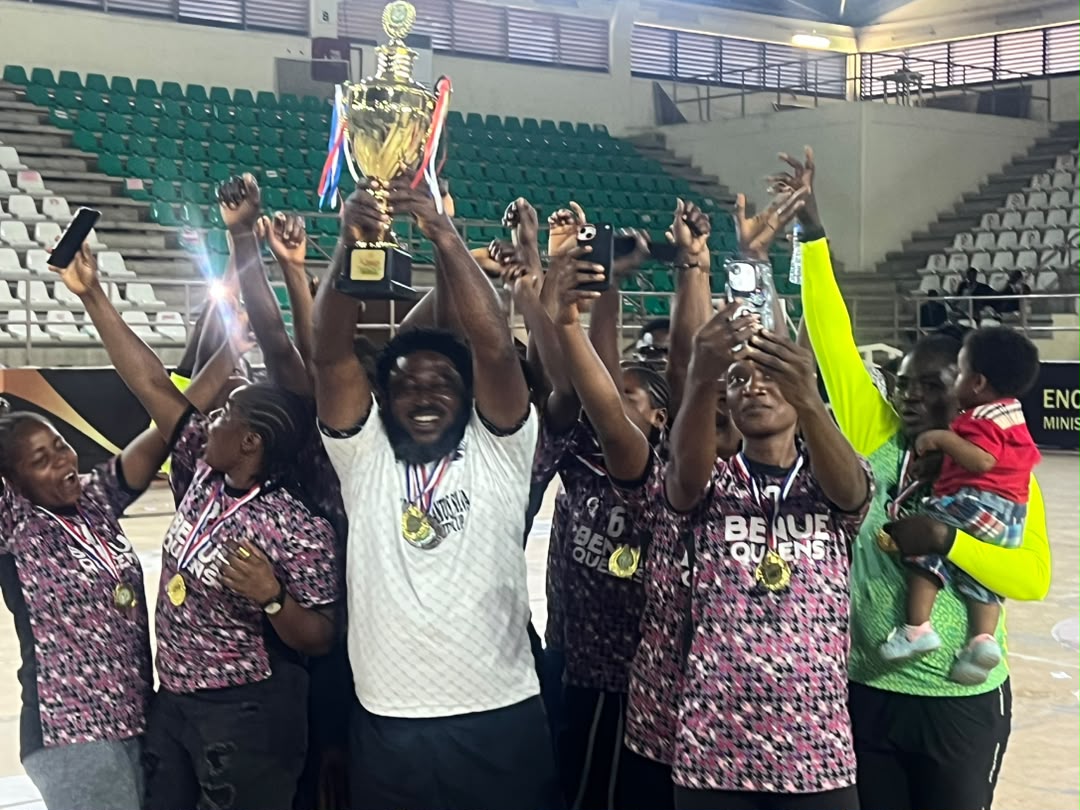
Plateau Vipers, Benue Queens Crowned Champions at HFN North Central Division One Tourney
Joel Ajayi
The President of the Handball Federation of Nigeria (HFN), Jibril Seidu, has said the federation will continue to intensify its grassroots talent development drive through zonal competitions across the country.
Seidu stated this on Saturday in Abuja at the finals of the 2026 North Central Division One Handball Championship, where Plateau Vipers defeated Suleja Shooters 29-24 to emerge champions in the men’s category.
In the women’s final, Benue Queens of Makurdi defeated City Queens of Suleja to claim the title.
The eight-day tournament featured teams from across the North Central Zone, with Plateau Vipers of Jos, Confluence Stars of Lokoja, Unity Boys of Abuja, Suleja Shooters and Nasarawa Ambassadors of Lafia competing in the men’s category.
In the women’s category, Nuela Handball Academy of Ilorin, Inikpi Babes of Idah, Benue Queens of Makurdi and City Queens of Suleja competed for honours.
At the end of the competition, four teams — two male and two female — emerged as the North Central Zone’s representatives for the national Division One league.
According to Seidu, the tournament was organised as part of the federation’s deliberate strategy to take handball development back to the regions and discover talents that might otherwise remain unnoticed.
He said the HFN board, inaugurated on October 25, 2025, resolved that grassroots development was essential to creating a sustainable pipeline of players for national and international competitions.
“All the teams you have seen here are from the North Central Zone of the country, and every state is represented with an academy or state team,” he said.
Seidu explained that the new approach marked a departure from the previous system, where talent identification was largely centred on the federation’s major league competitions.
He said taking competitions to the regions would provide young players with greater opportunities to showcase their abilities while strengthening the foundation of handball across the country.
The HFN president also linked the grassroots initiative to Nigeria’s recent achievements in international handball, stressing the need to develop younger players who can eventually replace members of the current national teams.
He noted that Nigeria had qualified for the 2027 Men’s Junior Handball World Championship in North Macedonia, describing the achievement as evidence of the potential within the country’s handball system.
“How do we replace these players with upcoming players? This is the avenue for us to get players,” he said.
Seidu added that the federation was determined to make handball more visible and accessible, describing it as one of Nigeria’s major sporting disciplines with significant potential for growth.
The North Central tournament is part of a wider zonal programme designed to decentralise handball development across Nigeria.
According to the federation, similar competitions are being organised across other zones, including the South East, North East, North West and South South, with qualifiers from each zone expected to converge at a designated venue for the next stage of the competition.
The federation also appealed for greater support from sponsors, stakeholders and state associations to sustain its grassroots development programme.
It expressed appreciation to the participating states, academies, team sponsors and other stakeholders for their support and commitment to the growth of handball in Nigeria.
The federation said the initiative would provide a platform for discovering the next generation of Nigerian handball stars while expanding the sport’s reach beyond its traditional centres.
While Speaking the elated coach of Benue Queen Godwin Tondo has promised a stronger and more tactical performance after guiding the team to victory at the 2026 North Central Division One Handball Championship in Abuja.
He attributed the success to the team’s long-term youth development programme, noting that the squad was built through a deliberate process of identifying and nurturing young talents.
According to him, the programme began with the selection of 92 girls from secondary schools, who were subsequently trained and developed over a four-year period.
He said the team’s success was a product of sustained hard work and commitment despite the challenges encountered during preparations for the tournament.
“I feel very pleased being a champion today. The road to this stage was very, very hard, but I am very happy that we have got the result from all the toughness of the game,” he said.
-
 Featured7 years ago
Lampard Names New Chelsea Manager
-
 Featured6 years ago
FG To Extends Lockdown In FCT, Lagos Ogun states For 7days
-
 Featured7 years ago
Children Custody: Court Adjourns Mike Ezuruonye, Wife’s Case To April 7
-
 Featured7 years ago
NYSC Dismisses Report Of DG’s Plan To Islamize Benue Orientation Camp
-

 Featured5 years ago
Transfer Saga: How Mikel Obi Refused to compensate me After I Linked Him Worth $4m Deal In Kuwait SC – Okafor
-
Featured7 years ago
Board urges FG to establish one-stop rehabilitation centres in 6 geopolitical zones
-
Sports4 years ago
TINUBU LAMBAST DELE MOMODU
-

 News2 years ago
Zulu to Super Eagles B team, President Tinubu is happy with you













