
Sports
NFF Proposes N13 Billion Budget For 2022
The Nigeria Football Federation (NFF) has proposed the sum of Thirteen Billion, Eighty-nine million, twenty-two thousand, one hundred and eighty nairas (N13,089,022,180:00) as the budget for 2022.
This is revealed in the Communique of the Executive Committee released on Wednesday, 29 December 2021 which reads; “The Executive Committee approved the Financial Statement of the Federation for 2021, as well as the proposed Budget of the sum of N13,089,022,180.00 for the year 2022.
The amount represents over two hundred percent increase with Five billion and five hundred million (N5.5 billion) approved as the budget for 2021.
Meanwhile, the sum of One billion and five hundred million (N1.5 billion) was approved for 2020.



Sports
Nigeria Targets Grassroots Sports Revival as Tinubu’s Aide Adeboye Unveils National Sports Grassroots Summit
Joel Ajayi
The Senior Special Assistant to President Bola Tinubu on Grassroots Sports Development, Adeboye Adeyinka, has called for a comprehensive overhaul of grassroots sports development in Nigeria, urging stakeholders to prioritise youth empowerment, education and national development alongside medals and trophies.
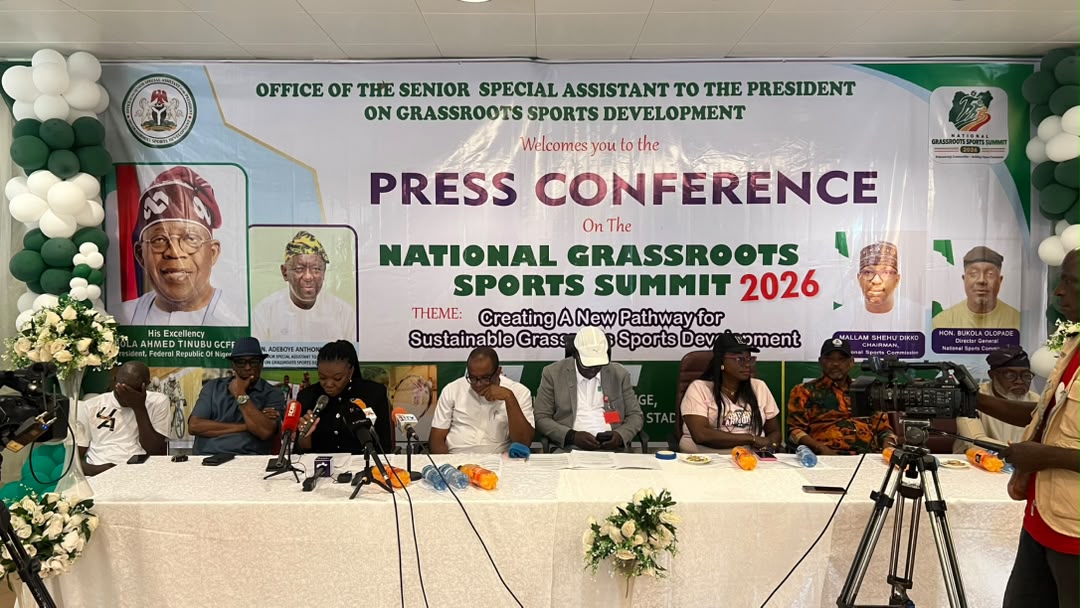
Adeyinka stated this on Thursday in Abuja during a press conference while announcing the 2026 National Grassroots Sports Summit, scheduled for November 18 and 19 at the Banquet Hall of the State House, Presidential Villa, Abuja.
The summit, with the theme, “Creating a New Pathway for Sustainable Grassroots Sports Development,” is expected to bring together government officials, sports administrators, state and local government representatives, private-sector investors, development partners, coaches, athletes and other stakeholders.
The presidential aide stressed that sports development must be measured not only by international achievements but also by the number of young Nigerians whose lives are positively transformed through participation in sports.
He noted that while sporting excellence could lead some athletes to Olympic medals and World Cup glory, sports also offered millions of young people opportunities for education, personal development, employment and social inclusion.
“Sometimes, when we discuss sports development, we speak about stadiums, trophies, medals and international competitions.
“But I want us to remember that at the heart of every sporting achievement is a human being,” Adeyinka said.
He explained that participation in sports could help young Nigerians secure university scholarships, develop discipline, build confidence, acquire life skills and stay away from negative influences.
According to him, sports should be recognised as an important instrument for building character, strengthening communities and creating opportunities for young people, irrespective of their backgrounds.
On talent identification, Adeyinka expressed concern that Nigeria continues to lose potential sporting talents because many children lack access to adequate facilities, qualified coaches, encouragement and organised talent-discovery programmes.
He emphasised the need for an inclusive grassroots sports system that would provide equal opportunities for children in rural communities, public schools, underserved areas and different socioeconomic backgrounds.
The presidential aide maintained that a child’s sporting prospects should not be determined by geographical location, family background or connections to influential individuals.
He warned that without a coordinated approach to identifying and nurturing young talents, the country could continue to miss opportunities to discover future champions.
Adeyinka said the forthcoming summit was designed to develop a sustainable national framework for identifying, nurturing and supporting sporting talents across the 774 local government areas.
He added that the gathering would seek practical solutions to the challenges affecting grassroots sports administration rather than focus solely on speeches and ceremonial activities.
A major objective, he explained, was to move away from fragmented talent-discovery initiatives towards a coordinated national structure connecting school and community competitions with clubs, national competitions and international sporting opportunities.
The two-day summit will deliberate on five key areas: sports participation, talent development, infrastructure, the sports economy and international pathways.
Adeyinka expressed optimism that the recommendations from the summit would provide a roadmap for strengthening grassroots sports development, expanding youth participation and positioning sports as a viable contributor to Nigeria’s economic and social development.
He called on relevant stakeholders to support the initiative and work collectively towards building a sustainable grassroots sports system capable of identifying and developing talents across the country.
-
 Featured7 years ago
Lampard Names New Chelsea Manager
-
 Featured7 years ago
FG To Extends Lockdown In FCT, Lagos Ogun states For 7days
-
 Featured7 years ago
Children Custody: Court Adjourns Mike Ezuruonye, Wife’s Case To April 7
-
 Featured7 years ago
NYSC Dismisses Report Of DG’s Plan To Islamize Benue Orientation Camp
-

 Featured5 years ago
Transfer Saga: How Mikel Obi Refused to compensate me After I Linked Him Worth $4m Deal In Kuwait SC – Okafor
-
Featured7 years ago
Board urges FG to establish one-stop rehabilitation centres in 6 geopolitical zones
-
Sports4 years ago
TINUBU LAMBAST DELE MOMODU
-

 News2 years ago
Zulu to Super Eagles B team, President Tinubu is happy with you













