
Sports
Nigeria/Benin bid in the forefront as CAF picks AFCON 2025 and 2027 host nations

The joint bid by Nigeria and neighbor Republic of Benin has loomed to the forefront in the race for the hosting of the 36th edition of Africa Cup of Nations in 2027, with the Executive Committee of the Confederation of African Football to vote on the bids for both 2025 and 2027 in Cairo on Wednesday. The meeting will take place at the Cairo Marriott Hotel in the Zamalek area of downtown Cairo.
With Morocco virtually guaranteed the honour for the 2025 finals, the joint bid by Nigeria and the Republic of Benin is in the contest with Senegal, Egypt, Botswana, and a tripartite arrangement of Uganda/Kenya/Tanzania for the 2027 event.
Algeria was a strong candidate for the 2027 event until the North African country withdrew from the race on Tuesday morning.
Guinea was originally selected to host the 2025 finals, on the same day that Cameroon and Cote d’Ivoire were given the mandates for the 2021 and 2023 editions respectively. But the Guineans fell behind badly in the preparations with infrastructure and other facilities unattended to. A new military government in place has not helped the country’s case, and CAF simply withdrew the hosting right from that country.
Nigeria has put forward the MKO Abiola Stadium, Abuja; Adokiye Amiesimaka Stadium, Port Harcourt; Godswill Akpabio Stadium, Uyo; Teslim Balogun Stadium, Lagos; Ahmadu Bello Stadium, Kaduna; Stephen Keshi Stadium, Asaba; Samuel Ogbemudia Stadium, Benin City and; Sani Abacha Stadium, Kano. In the Republic of Benin, the Stade Mathieu Kerekou in Cotonou and the Stade Charles de Gaulle in Porto Novo are listed.
Nigeria hosted and won the 12th edition of the AFCON in 1980 and then co-hosted the 22nd finals with Ghana in 2000.
On Tuesday night, Nigeria’s contingent of Minister of Sports Development, John Owan Enoh; Permanent Secretary in the Ministry, Ismaila Abubakar; President of NFF, Ibrahim Musa Gusau; General Secretary of NFF, Mohammed Sanusi and; Project Coordinator, Mainasara Illo arrived in Cairo. They have been joined by Nigeria’s FIFA Council Member and Member of the CAF Executive Committee, Amaju Melvin Pinnick.
In the corridors of CAF’s headquarters in 6th October City, outside Cairo, the Nigeria/Benin Republic bid is being strongly mentioned, with references to two of Africa’s FIFA Council Members and CAF Executive Committee Members, Amaju Melvin Pinnick (former President of NFF) and Mathurin De Chacus, who is the sitting President of Federation Beninoise de Football.
On Wednesday, before the vote is taken by the CAF Executive Committee after it has discussed the report of the Independent Assessment Committee, the bidding nations will have 10 minutes to make a presentation, with the Nigeria/Benin case to be canvassed by veteran broadcaster and experienced bid campaigner, Mainasara Illo. The presentation
Illo, who was deputy chief organizer of the 8th All-Africa Games that Nigeria hosted in 2003, and chief organizer of the FIFA U17 World Cup also hosted by Nigeria in 2009, led a bid coordinating team that has taken two different CAF inspection teams around Nigeria’s stadia infrastructure and other facilities, and will make a case that is a hybrid of strong oratory appeal and multi-media presentation.
The bid’s theme is pegged on how it will spur greater collaboration between both nations in the areas of security and commerce, foster seamless transportation between both nations and by extension the West African region, and be an elixir for the development and improvement of critical infrastructure in the two countries.



Sports
Youth Olympics: AFN TD Hails Home-Based Athletes, Credits NSC for Gold Success
By Joel Ajayi
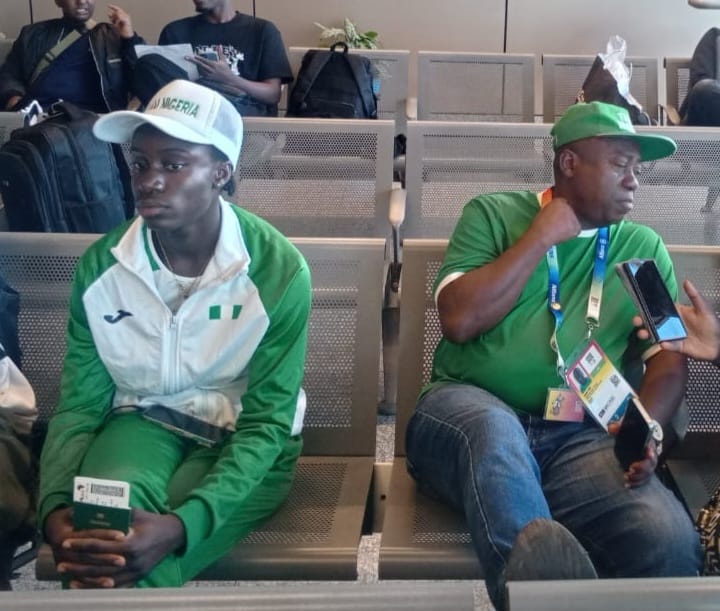
Athletics Federation of Nigeria (AFN) Technical Director, Gabriel Okon, has attributed Nigeria’s impressive performance at the Youth Olympic Games to collective efforts, improved support and the growing potential of home-based athletes.
Okon, who expressed delight at the country’s medal-winning performance, particularly commended the National Sports Commission (NSC), the AFN leadership for their contributions to the achievement.
He said Nigeria’s success in the sprint events, particularly the 100m and 400m, was a product of dedication, professionalism and adequate preparation.
According to him, the financial support provided by the NSC was crucial to ensuring that the athletes and coaching crew had the necessary resources to compete successfully.
“We have to thank God and also appreciate the NSC for its support because without the necessary financial assistance, this achievement would not have been possible.”
Okon also praised the leadership of the AFN under Tony Okowa, noting that collaboration among the federation, coaches and athletes contributed significantly to Nigeria’s success.
He described the performance as evidence that Nigeria has considerable athletics talent at home and does not have to depend exclusively on foreign-based athletes to achieve success at international competitions.
He explained that the federation had been deliberately working towards developing home-based athletes, stressing that the latest achievement was not an isolated development.
According to him, Nigeria had previously demonstrated the competitiveness of its locally based athletes at international competitions, citing the African Athletics Relays in Gaborone, Botswana, where the country competed with an entirely home-based contingent.
He recalled that Nigeria secured qualification for the World Championships through its performances in the relay events, with subsequent qualifications also achieved through competitive times.
Okon said the development showed that Nigerian athletes training within the country were steadily improving and becoming increasingly competitive against their foreign-based counterparts.
He added that the growing confidence among Nigerian athletes, particularly the men, was another encouraging development for the country’s athletics programme.
“It is not something new that our home-based athletes are beginning to perform well. We have been working on this for some time.
“Previously, people focused more on our women, but now the men are also stepping forward and showing that they can compete at the highest level,” he said.
He maintained that the progress was being driven by a structured programme, technical cooperation and the encouragement provided by the NSC and AFN.
The technical director further explained that members of the federation’s technical department and coaching crew regularly interacted and shared ideas, describing their collaboration as an important ingredient in the team’s success.
Looking ahead, he identified relay events, particularly the 4x100m, as another area where Nigeria could have improved its medal prospects if additional opportunities had been available at the competition.
He expressed confidence that the country’s sprinting strength could have produced more impressive results in both the men’s and women’s relay categories, including the mixed relay.
Okon also disclosed that Nigeria’s progress in sprinting had attracted the attention of international athletics personalities, who had sought to understand the country’s approach to developing its athletes.
He recalled a conversation with former British international sprinter John Regis during the Commonwealth Games in Glasgow, Scotland, where they discussed Nigeria’s improving sprint performances.
According to him, the interest shown by international athletics figures indicated that Nigeria’s emerging talents were beginning to command greater respect.
He attributed the improvement partly to the experience Nigerian coaches and athletes had gained through international exposure and professional training systems, which they were now adapting to local conditions.
“We are simply doing what we have always known how to do. Many of us have studied and trained abroad, and we have come back home to replicate what we learnt and do what we know best,” he said.
Reflecting on Nigeria’s performance, Okon described the achievement as a moment of national pride, attributing the success to God’s grace, hard work and the support of stakeholders.
He said the medal haul had exceeded expectations, noting that the team’s initial target was more modest before the athletes delivered their impressive performances.
He expressed happiness that the achievement had brought excitement and renewed confidence among Nigerians, adding that the smiles and celebrations surrounding the athletes’ success were a reward for the collective sacrifices made by everyone involved.
He urged stakeholders to sustain their support and commitment to ensure that Nigeria’s emerging athletics talents continue to develop and win more medals at future international competitions.
-
 Featured7 years ago
Lampard Names New Chelsea Manager
-
 Featured7 years ago
FG To Extends Lockdown In FCT, Lagos Ogun states For 7days
-
 Featured7 years ago
Children Custody: Court Adjourns Mike Ezuruonye, Wife’s Case To April 7
-
 Featured7 years ago
NYSC Dismisses Report Of DG’s Plan To Islamize Benue Orientation Camp
-

 Featured5 years ago
Transfer Saga: How Mikel Obi Refused to compensate me After I Linked Him Worth $4m Deal In Kuwait SC – Okafor
-
Featured7 years ago
Board urges FG to establish one-stop rehabilitation centres in 6 geopolitical zones
-
Sports4 years ago
TINUBU LAMBAST DELE MOMODU
-

 News2 years ago
Zulu to Super Eagles B team, President Tinubu is happy with you













