
News
NTAC Celebrates Seven Returnees, Applauds Contributions to Uganda’s Academic Sector
By Joel Ajayi
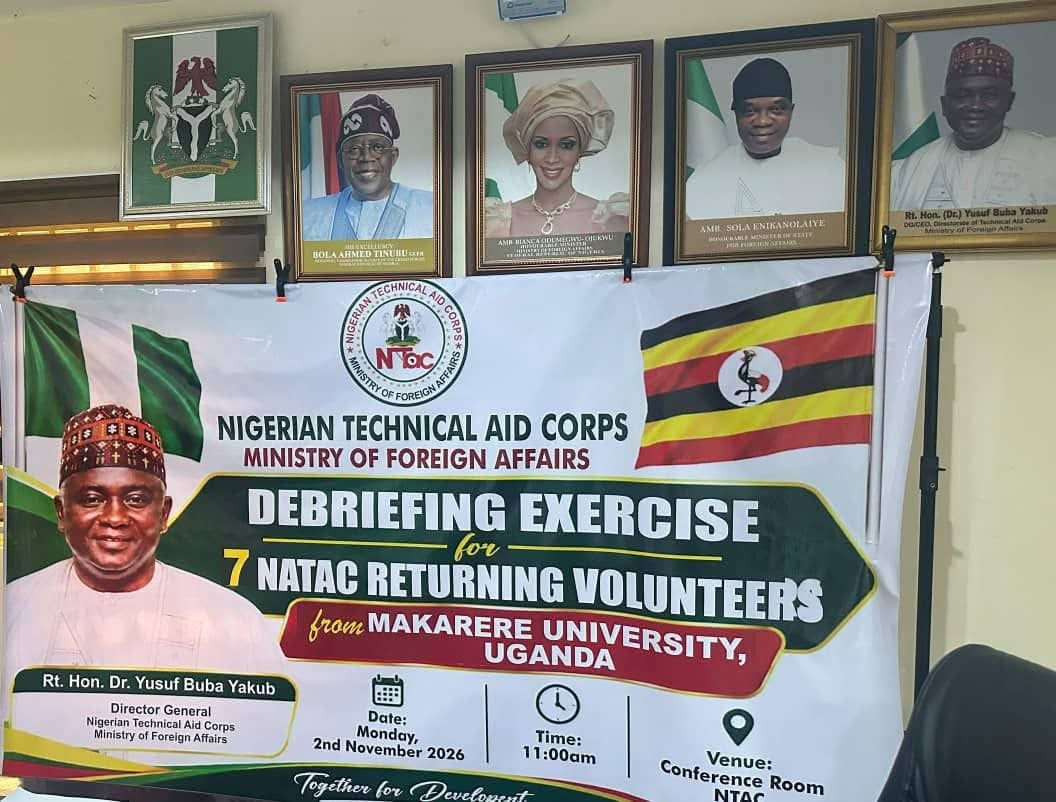
The Nigerian Technical Aid Corps (NTAC) has welcomed seven Nigerian volunteers who successfully completed their two-year assignments at Makerere University, Uganda, commending their dedication, professionalism and contributions to academic development and international cooperation.
The volunteers were received on Monday, November 2, 2026, during a debriefing exercise held at the NTAC Complex in Abuja, where they shared their experiences, achievements and challenges during their service under the Federal Government’s Technical Aid Corps Scheme.
In a statement issued by the Head of Information and Public Relations, NTAC, Ojo Adetoun Olubunmi, the exercise was designed to assess the volunteers’ performance, review their experiences and explore ways of translating the knowledge and expertise acquired abroad into meaningful contributions to their respective institutions and Nigeria.
Speaking on behalf of the Director-General and Chief Executive Officer of NTAC, Rt. Hon. Yusuf Buba Yakub, the Assistant Director, Programme 11, Mr Felix Obidi, congratulated the returnees on the successful completion of their assignments.
Obidi commended their commitment, professional conduct and exemplary service, noting that their contributions had helped project Nigeria positively in the international community.
Describing the returnees as veterans of the Technical Aid Corps Scheme, he urged them to deploy the knowledge, skills and international exposure acquired at Makerere University to improve their institutions and contribute to national development.
He likened their international experience to that of fishes that had explored wider waters, stressing that their exposure should distinguish them professionally and intellectually.
“You are no longer just returning volunteers; you are veterans of the Nigerian Technical Aid Corps. We expect you to bring back the knowledge and experience you have acquired at Makerere University and share them with your respective institutions. You are foreign fishes, and we expect more from you,” he said.
Obidi assured the volunteers that their expertise would continue to be valuable to NTAC and the country, while appreciating President Bola Ahmed Tinubu for his sustained support for the Scheme.
He also acknowledged the contributions of the Minister of Foreign Affairs, Ambassador Bianca Odumegwu-Ojukwu, and the Minister of State for Foreign Affairs, Ambassador Sola Enikanolaiye, towards sustaining the programme.
Similarly, the representative of the Director of Programmes, Senior Counsellor Mrs Hauwa Arabu Mustafa, congratulated the returnees and commended their contributions to academic development and the promotion of South-South cooperation.
Speaking on behalf of the returning volunteers, their team leader, Prof. Abdul Anakobe Isah, expressed gratitude to the Federal Government and NTAC for providing them with the opportunity to serve at Makerere University.
He described the assignment as a rewarding professional experience and praised the university’s management and staff for their hospitality, cooperation, professional support and provision of adequate teaching and learning facilities.
However, he identified some accommodation-related challenges encountered during their two-year assignment.
One of the returning volunteers, Prof. Alo Oluwaseun Olubisi, highlighted her achievements, including securing a Research and Innovation Grant at Makerere University.
She explained that although she initially doubted her eligibility because she was a Nigerian, encouragement from her Head of Department prompted her to apply, eventually leading to a successful grant award.
Olubisi said the assignment significantly improved her teaching methodologies, lecture preparation and delivery while providing opportunities for professional development and research collaboration.
She also disclosed that she facilitated a Memorandum of Understanding between Makerere University and her home institution in Nigeria, noting that the partnership had reached an advanced stage.
The debriefing provided an opportunity for the returning volunteers to present their experiences, achievements, challenges and recommendations, which NTAC said would serve as valuable input towards improving the implementation of the Technical Aid Corps Scheme.
The event also featured the presentation of certificates of service to the returning volunteers in recognition of their successful completion of the assignment.
Established in 1987, the Nigerian Technical Aid Corps is a key instrument of Nigeria’s foreign policy and South-South cooperation, deploying skilled Nigerian professionals to countries across Africa, the Caribbean and the Pacific to provide technical assistance, promote knowledge exchange and strengthen international partnerships.
With more than 10,000 Nigerian professionals deployed to beneficiary countries over the years, the Scheme continues to demonstrate Nigeria’s commitment to human capital development, international cooperation and the use of professional expertise as an instrument of development diplomacy.
The successful completion of the Makerere University assignment by the seven volunteers further underscores the importance of the Scheme in fostering professional exchange, strengthening institutional partnerships and ensuring that international exposure translates into tangible benefits for Nigeria’s development.



News
Civil Society Coalition Kicks Against Proposed 20% Deduction from NCDMB
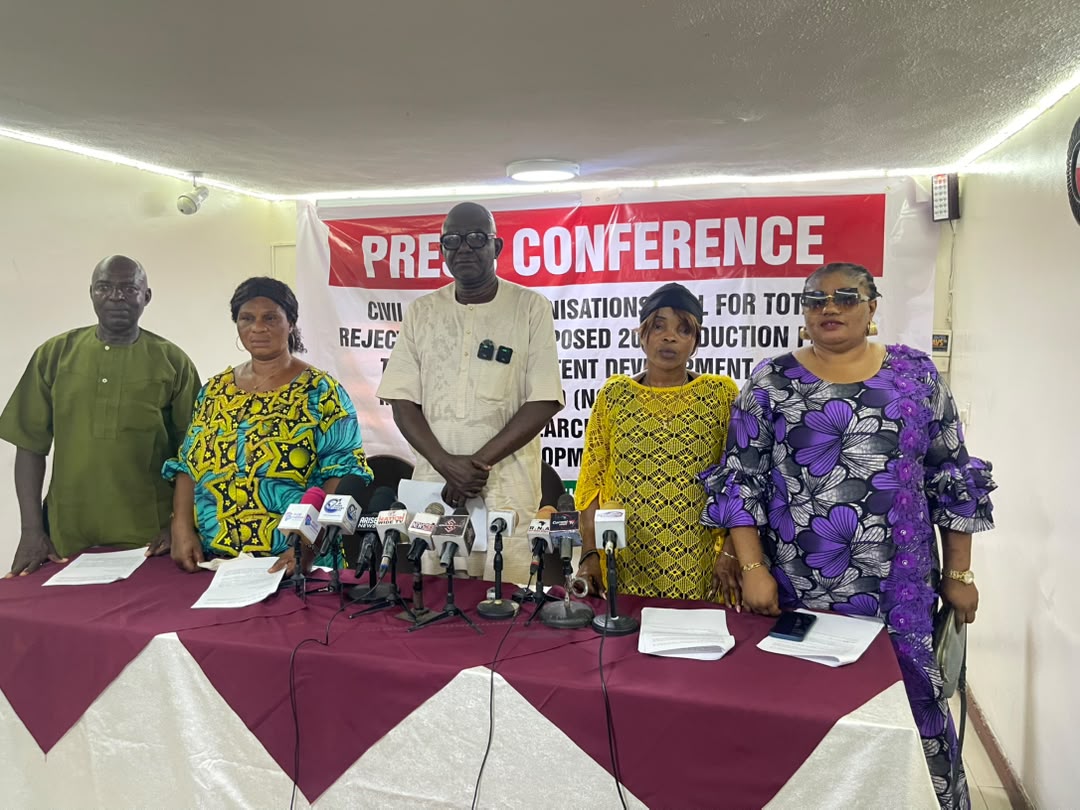
The Coalition of Civil Society Organisations in Nigeria (COCSON) has rejected a proposed 20 per cent deduction from the Nigerian Content Development and Monitoring Board (NCDMB) to finance the proposed National Research and Innovation Development Fund.
The coalition described the proposed funding arrangement as unacceptable, warning that it could undermine the development of indigenous capacity and local value addition in Nigeria’s oil and gas industry.
Speaking at a press conference in Abuja on Thursday, November 26, 2026, COCSON spokesperson, Tabuko Kennedy, said the coalition was not opposed to the establishment of a national research and innovation fund but strongly objected to the proposed funding mechanism.
Kennedy argued that funds allocated to the NCDMB were specifically meant to develop local capacity, support indigenous companies, train Nigerian engineers and promote value addition within the oil and gas sector.
He warned that diverting 20 per cent of the board’s revenue to finance another institution could weaken its ability to fulfil its statutory responsibilities.
According to him, the funds domiciled with the NCDMB are not surplus government revenue but contributions from companies operating in the oil and gas industry, specifically earmarked for local content development.
He maintained that diverting such funds without the consent of industry stakeholders would amount to a breach of trust and undermine the original purpose for which the resources were collected.
The coalition also warned that the proposed deduction could establish a dangerous precedent where financially viable government agencies would have portions of their revenues diverted to fund newly established institutions.
Kennedy questioned what would prevent similar deductions from other specialised intervention funds, including the Tertiary Education Trust Fund, the Universal Service Provision Fund and the Police Trust Fund.
He said such a practice could discourage revenue-generating agencies from improving their financial performance, create inter-agency rivalry and undermine long-term institutional planning.
COCSON further argued that the proposed deduction could violate the Nigerian Oil and Gas Industry Content Development Act, which provides the legal framework for the management and utilisation of funds accruing to the NCDMB.
The coalition maintained that the legislation did not envisage using the board’s resources to finance an unrelated research and innovation institution, describing the proposed diversion as inconsistent with the original statutory purpose of the funds.
Consequently, COCSON called on the leadership of the National Assembly, relevant committees and the Federal Executive Council to reject the proposed 20 per cent deduction.
It also appealed to President Bola Tinubu not to assent to the bill if the controversial funding provision remains in it.
The coalition disclosed that it had mobilised organised labour, pressure groups, religious organisations and other civil society groups to resist the proposed legislation.
It, however, stressed that it was not against research, innovation or the establishment of a national research funding institution, urging the government and lawmakers to explore alternative funding arrangements that would not undermine existing development agencies.
COCSON also called on Nigerians and industry stakeholders to oppose what it described as a legislative overreach, insisting that the country’s local content development programme should not be weakened to finance a new institution.
-
 Featured7 years ago
Lampard Names New Chelsea Manager
-
 Featured7 years ago
FG To Extends Lockdown In FCT, Lagos Ogun states For 7days
-
 Featured7 years ago
Children Custody: Court Adjourns Mike Ezuruonye, Wife’s Case To April 7
-
 Featured7 years ago
NYSC Dismisses Report Of DG’s Plan To Islamize Benue Orientation Camp
-

 Featured5 years ago
Transfer Saga: How Mikel Obi Refused to compensate me After I Linked Him Worth $4m Deal In Kuwait SC – Okafor
-
Featured7 years ago
Board urges FG to establish one-stop rehabilitation centres in 6 geopolitical zones
-

 News2 years ago
Zulu to Super Eagles B team, President Tinubu is happy with you
-
Sports4 years ago
TINUBU LAMBAST DELE MOMODU