
News
NTIFE 2026: Nigeria Intensifies Push for Private Investment in Tourism Development

By Joel Ajayi
The Federal Government has reaffirmed its commitment to transforming Nigeria into Africa’s leading tourism destination through strategic policy reforms, stronger stakeholder collaboration and increased private sector investment.
Minister of Art, Culture, Tourism and the Creative Economy, Hannatu Musa Musawa, made the commitment on Thursday while declaring open the 9th Nigeria Tourism Investment Forum and Exhibition (NTIFE) 2026 in Abuja. She described tourism as a critical pillar of President Bola Ahmed Tinubu’s economic diversification agenda.
Speaking on the theme, “Tourism Transformation Through Collaboration, Policy Alignment and Investment,” Musawa said Nigeria possesses immense tourism assets capable of creating millions of jobs, attracting foreign direct investment, boosting foreign exchange earnings and enhancing the country’s global image.
She said the Federal Government is strengthening the policy and regulatory environment to encourage investment, improve the ease of doing business and deepen collaboration with state governments, development partners and the private sector.
According to the minister, the government is also prioritising domestic tourism, destination branding, heritage conservation, tourism product development and capacity building to position Nigeria as a globally competitive tourism destination.
Musawa stressed that government alone cannot finance the transformation of the tourism sector, urging greater private sector participation.
“Our responsibility as government is to create an enabling environment where investors have confidence, regulations are predictable, partnerships are transparent and innovation is rewarded,” she said.
Delivering the keynote address, former Senator Dr. Ibrahim M. Ida called for urgent and practical measures to reposition tourism as a major contributor to Nigeria’s economy.
He advocated stronger public-private partnerships, harmonised tourism policies, improved infrastructure, long-term financing and the establishment of a National Tourism Marketing Council to promote a unified Nigerian tourism brand globally.
Ida also proposed the creation of a ₦500 billion Nigeria Tourism Development Fund, to be managed by the Bank of Industry in collaboration with state governments, to finance hotels, resorts, conference centres and other tourism infrastructure. He argued that affordable, long-term financing is essential to attracting investment and accelerating growth in the sector.
Highlighting Nigeria’s tourism potential, Ida noted that the country is home to over 250 ethnic groups, globally recognised cultural festivals, historic sites, diverse landscapes and a population exceeding 220 million.
Despite these advantages, he lamented that Nigeria accounts for less than one per cent of global tourism receipts due to inadequate investment and weak policy implementation.
He urged governments, investors, financial institutions and host communities to work together to build a vibrant tourism industry capable of creating five million jobs and generating up to 10 billion dollars annually over the next decade.
The forum attracted policymakers, investors, tourism operators, financial institutions, development partners, state governments and other stakeholders to explore practical strategies for positioning tourism as a major driver of sustainable economic growth.
Delegates from more than 12 West African countries are participating in the two-day event, underscoring Nigeria’s growing role as a regional tourism and investment hub.
In his opening remarks, President of the Federation of Tourism Associations of Nigeria (FTAN), Dr. Aliyu Badaki, said the theme of this year’s forum reflects the urgent need for collective action to transform the sector.
He explained that FTAN’s Tourism Transformation Mandate (TTM), launched a year ago, was designed to unite all segments of Nigeria’s tourism industry under a common vision.
Badaki said the federation had spent the past year strengthening collaboration among member associations, engaging governments at all levels and positioning FTAN as the unified voice of Nigeria’s organised tourism private sector.
He commended the ongoing reforms being implemented by the Federal Ministry of Art, Culture, Tourism and the Creative Economy under Minister Musawa, describing them as bold steps toward creating a more coordinated and investment-friendly tourism ecosystem.
Badaki also urged the Federal Government to review tourism-related laws and regulatory frameworks that create duplication, institutional conflicts and uncertainty for investors, stressing that a predictable regulatory environment is essential for sustainable growth.
He called on private sector operators to uphold integrity, professionalism and collaboration, noting that while competition builds businesses, collaboration builds industries.
“Nigeria has every ingredient required to become one of Africa’s leading tourism destinations. What has been missing is alignment between policy and implementation, between government and business, and among operators.
Together, through collaboration, policy alignment and investment, we can transform our industry and position Nigeria as a destination of choice for Africa and the world,” he said.



News
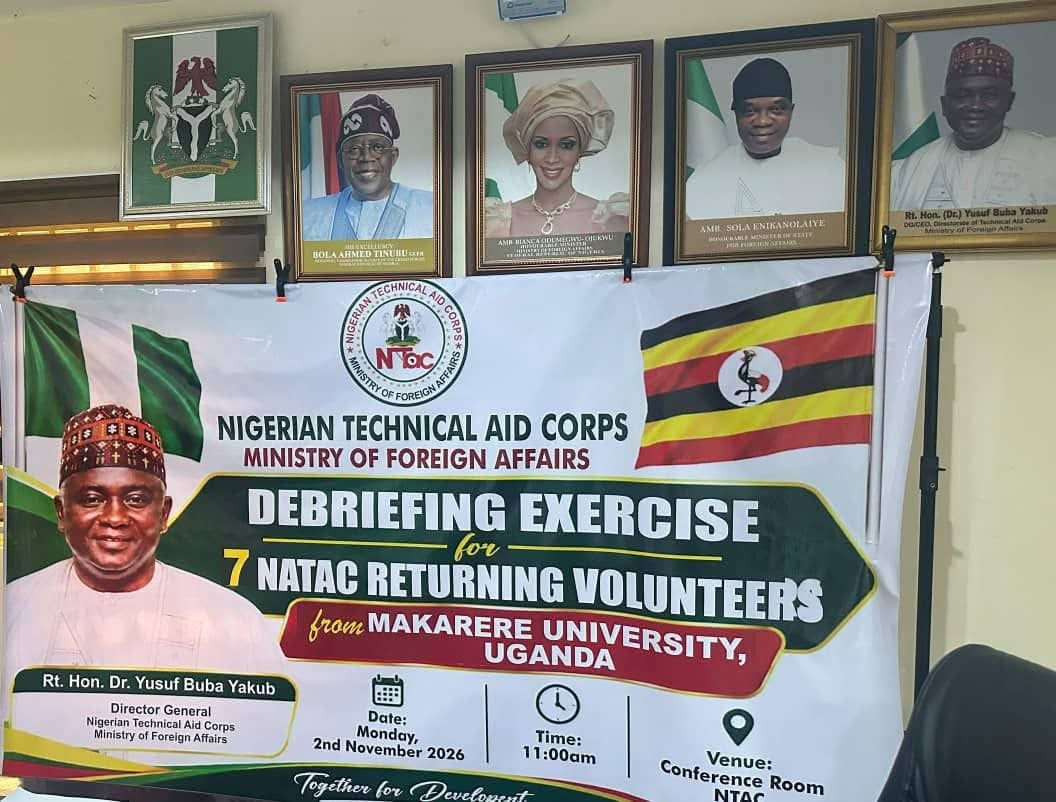
NTAC Celebrates Seven Returnees, Applauds Contributions to Uganda’s Academic Sector
By Joel Ajayi
The Nigerian Technical Aid Corps (NTAC) has welcomed seven Nigerian volunteers who successfully completed their two-year assignments at Makerere University, Uganda, commending their dedication, professionalism and contributions to academic development and international cooperation.
The volunteers were received on Monday, November 2, 2026, during a debriefing exercise held at the NTAC Complex in Abuja, where they shared their experiences, achievements and challenges during their service under the Federal Government’s Technical Aid Corps Scheme.
In a statement issued by the Head of Information and Public Relations, NTAC, Ojo Adetoun Olubunmi, the exercise was designed to assess the volunteers’ performance, review their experiences and explore ways of translating the knowledge and expertise acquired abroad into meaningful contributions to their respective institutions and Nigeria.
Speaking on behalf of the Director-General and Chief Executive Officer of NTAC, Rt. Hon. Yusuf Buba Yakub, the Assistant Director, Programme 11, Mr Felix Obidi, congratulated the returnees on the successful completion of their assignments.
Obidi commended their commitment, professional conduct and exemplary service, noting that their contributions had helped project Nigeria positively in the international community.
Describing the returnees as veterans of the Technical Aid Corps Scheme, he urged them to deploy the knowledge, skills and international exposure acquired at Makerere University to improve their institutions and contribute to national development.
He likened their international experience to that of fishes that had explored wider waters, stressing that their exposure should distinguish them professionally and intellectually.
“You are no longer just returning volunteers; you are veterans of the Nigerian Technical Aid Corps. We expect you to bring back the knowledge and experience you have acquired at Makerere University and share them with your respective institutions. You are foreign fishes, and we expect more from you,” he said.
Obidi assured the volunteers that their expertise would continue to be valuable to NTAC and the country, while appreciating President Bola Ahmed Tinubu for his sustained support for the Scheme.
He also acknowledged the contributions of the Minister of Foreign Affairs, Ambassador Bianca Odumegwu-Ojukwu, and the Minister of State for Foreign Affairs, Ambassador Sola Enikanolaiye, towards sustaining the programme.
Similarly, the representative of the Director of Programmes, Senior Counsellor Mrs Hauwa Arabu Mustafa, congratulated the returnees and commended their contributions to academic development and the promotion of South-South cooperation.
Speaking on behalf of the returning volunteers, their team leader, Prof. Abdul Anakobe Isah, expressed gratitude to the Federal Government and NTAC for providing them with the opportunity to serve at Makerere University.
He described the assignment as a rewarding professional experience and praised the university’s management and staff for their hospitality, cooperation, professional support and provision of adequate teaching and learning facilities.
However, he identified some accommodation-related challenges encountered during their two-year assignment.
One of the returning volunteers, Prof. Alo Oluwaseun Olubisi, highlighted her achievements, including securing a Research and Innovation Grant at Makerere University.
She explained that although she initially doubted her eligibility because she was a Nigerian, encouragement from her Head of Department prompted her to apply, eventually leading to a successful grant award.
Olubisi said the assignment significantly improved her teaching methodologies, lecture preparation and delivery while providing opportunities for professional development and research collaboration.
She also disclosed that she facilitated a Memorandum of Understanding between Makerere University and her home institution in Nigeria, noting that the partnership had reached an advanced stage.
The debriefing provided an opportunity for the returning volunteers to present their experiences, achievements, challenges and recommendations, which NTAC said would serve as valuable input towards improving the implementation of the Technical Aid Corps Scheme.
The event also featured the presentation of certificates of service to the returning volunteers in recognition of their successful completion of the assignment.
Established in 1987, the Nigerian Technical Aid Corps is a key instrument of Nigeria’s foreign policy and South-South cooperation, deploying skilled Nigerian professionals to countries across Africa, the Caribbean and the Pacific to provide technical assistance, promote knowledge exchange and strengthen international partnerships.
With more than 10,000 Nigerian professionals deployed to beneficiary countries over the years, the Scheme continues to demonstrate Nigeria’s commitment to human capital development, international cooperation and the use of professional expertise as an instrument of development diplomacy.
The successful completion of the Makerere University assignment by the seven volunteers further underscores the importance of the Scheme in fostering professional exchange, strengthening institutional partnerships and ensuring that international exposure translates into tangible benefits for Nigeria’s development.
-
 Featured7 years ago
Lampard Names New Chelsea Manager
-
 Featured7 years ago
FG To Extends Lockdown In FCT, Lagos Ogun states For 7days
-
 Featured7 years ago
Children Custody: Court Adjourns Mike Ezuruonye, Wife’s Case To April 7
-
 Featured7 years ago
NYSC Dismisses Report Of DG’s Plan To Islamize Benue Orientation Camp
-

 Featured5 years ago
Transfer Saga: How Mikel Obi Refused to compensate me After I Linked Him Worth $4m Deal In Kuwait SC – Okafor
-
Featured7 years ago
Board urges FG to establish one-stop rehabilitation centres in 6 geopolitical zones
-
Sports4 years ago
TINUBU LAMBAST DELE MOMODU
-

 News2 years ago
Zulu to Super Eagles B team, President Tinubu is happy with you













