
Agriculture
Organic Agriculture combines best traditional practices for modern sustainable farming methods – Don

Dr Jude Obi, Lecturer, Department of Soil Science and Land Resources Management, University of Uyo says Organic Agriculture combines best traditional practices with modern, sustainable farming methods for the health of all.
Obi said this during his online presentation on `Organic Agriculture to the Rescue’ organised by the Journalists Go Organic Initiative.
He said that any agriculture practice that is not rooted, grows and develops on the principles of health, ecology, fairness, and care should be jettisoned.
“These principles express the contributions and the vision that organic agriculture presents to humanity for achieving safe and egalitarian global society.
“It sustains and enhances the health of soil, plant, animal, human and planet as one and indivisible, relies on living ecological systems and cycles, work with them, emulate them and help sustain them.
“Builds on relationships that ensure fairness with regard to the common environment and life opportunities, manages in a precautionary and responsible manner to protect the health and well-being of current and future generations and the environment.
“Any activity, process, practice etc. that does not conform, uphold and fully abide with these principles is clearly not good for the environment and its inhabitants,’’ he stressed.
Obi who is also the Coordinator for the Knowledge Centre for Organic Agriculture (KCOA) in Africa also highlighted the potentials of ecological agriculture.
“Ecological agriculture generates both economic value and sustainable development which should be seriously promoted to enable Africa exploit this niche.
“The continent should adopt organic agriculture practice due to the fragile environment that pervades it, for instance, the best soils are alluvial deposits found in the major river valleys.
“Most of the soils are difficult to cultivate, although soils in the humid tropics can be quite rich due to the forest cover and the rapid decomposition of organic matter.
“However, intense rainfall leads to the leaching of most of the plant nutrients resulting in the formation latosols/ferrosols, luvisols with some undesirable characteristics’’.
According to Obi, towards the deserts, the soils are sandy and deep but low in humus and quite infertile (arenosols) which give way to xerosols that are quite low in humus.
“Confronting these fragile environments is the episode of land degradation ‘worsening’.
“The summary is that these soils are inherently not resilient and management using synthetic resources and heavy equipment is not sustainable in the long run. It has caught up with us earlier than anticipated.
“These explained the failure of all large farms established in Nigeria and will continue to hunt those that will decide not to listen that organic agriculture is the answer’’.
He said that both researches and practical results have shown that in as much as the conventional system continually increases inputs from soil amendments to herbicides, pesticides, insecticides etc. and finally genetical modifications: organic practices increase benefits, profitability and the entire under presented benefits with time.
Enumerating the benefits of organic agriculture, Obi said it has positive effects on the soil by improving soil condition, lower soil pollution, erosion and flooding, ground water purification, energy efficient, greater flavor and nutrition, helps pollinators and sustains biodiversity.
“Organically grown food and agricultural produce have better nutrition, helps us stay healthy, free of poison, organic foods enhance taste and longer shelf–life.
“Has antioxidant content, improves heart condition, antibiotic resistance, pesticide cutback, stronger immune system, products are poison-free, Lower levels of toxic metals etc’’.
Obi concluded that with the crisis that has confronted humanity from strange diseases, to unfriendly environment, natural disaster, communal clashed, war etc. It became obvious that the starting point is environmentally friendly options and the organic agriculture has taken the lead.



Agriculture
ARCN Executive Secretary Dabbán Earns Double Recognition for Excellence
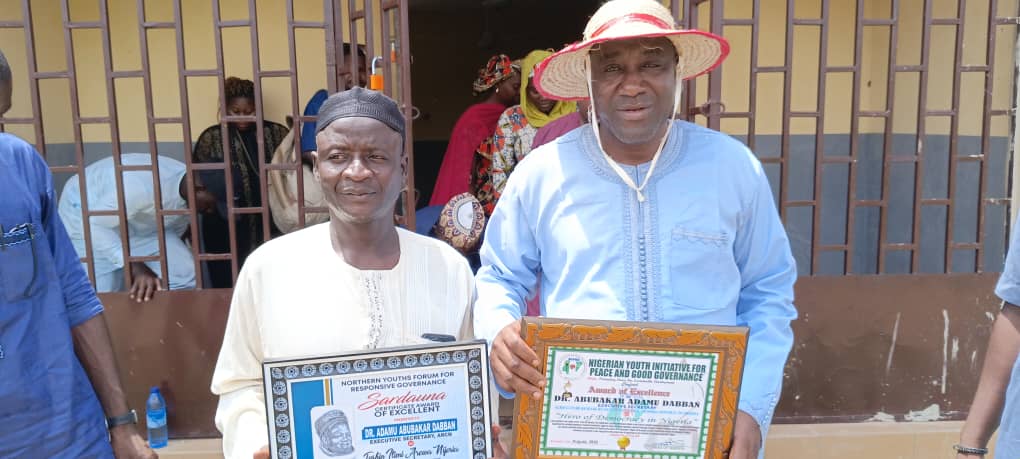
Joel Ajayi
The Executive Secretary of the Agricultural Research Council of Nigeria (ARCN), Dr. Adamu Abubakar Dabban, has been honoured with a Double Award of Excellence by two youth-focused organisations for his leadership, commitment to good governance and contributions to the development of Nigeria’s agricultural sector.
In a statement signed on Tuesday by the ANIPR PRO, Agricultural Research Council of Nigeria Khadijat Ameen in Abuja stated that the honours were conferred on Dr. Dabban by the Nigeria Youth Initiative for Peace and Good Governance and the Northern Youth Forum for Responsive Governance.
The organisations recognised the ARCN Executive Secretary for what they described as his outstanding leadership and dedication to good governance, as well as his efforts toward advancing agricultural development in Nigeria.
The double recognition highlights the growing attention being given to leadership and institutional efforts aimed at strengthening Nigeria’s agricultural research and development ecosystem.
Receiving the honours, Dr. Dabban expressed appreciation to the organisations for the recognition, noting that such awards serve as encouragement to remain committed to the responsibilities entrusted to him and to the broader goal of advancing agricultural development.
The recognition comes as the ARCN continues its mandate of coordinating and promoting agricultural research and development in support of Nigeria’s food and agricultural priorities.
Congratulations to the Executive Secretary, Dr. Adamu Abubakar Dabban, on this distinguished double honour.
-
 Featured7 years ago
Lampard Names New Chelsea Manager
-
 Featured7 years ago
FG To Extends Lockdown In FCT, Lagos Ogun states For 7days
-
 Featured7 years ago
Children Custody: Court Adjourns Mike Ezuruonye, Wife’s Case To April 7
-
 Featured7 years ago
NYSC Dismisses Report Of DG’s Plan To Islamize Benue Orientation Camp
-

 Featured5 years ago
Transfer Saga: How Mikel Obi Refused to compensate me After I Linked Him Worth $4m Deal In Kuwait SC – Okafor
-
Featured7 years ago
Board urges FG to establish one-stop rehabilitation centres in 6 geopolitical zones
-
Sports4 years ago
TINUBU LAMBAST DELE MOMODU
-

 News2 years ago
Zulu to Super Eagles B team, President Tinubu is happy with you