
News
Out-of-School Children Crisis: Nigeria’s Future is bleaking-Group

Federal and state governments have been tasked to urgently address Nigeria’s worrisome spike in out-of-school children crises to save the country’s future.
Experts and citizens made the call during an anti-corruption radio program, PUBLIC CONSCIENCE, produced by the Progressive Impact Organization for Community Development, PRIMORG, in Abuja.
This is coming on the heels of two recent investigative reports published by Premium Times exposing how poverty, shambolic education system, dilapidated infrastructure, tortuous teaching, and learning environment continue to worsen the out-of-school children scourge in Niger and Nasarawa states.
Nigeria currently has the highest number of out-of-school children in the world, with only 63% of primary school children regularly attending schools, according to the United Nations Children’s Fund (UNICEF).
Speaking during the radio program, Chief Executive Officer of Gender Consult Joyce Ahmadu called on President Bola Tinubu and the 36 state governors to take prompt steps in tackling the rising numbers of out-of-school children, admonishing that high priority must be placed on improving basic education.
Ahmadu warned that Nigeria’s future will be bleak if leaders fail to nip the out-of-school children problem in the bud without delay, as primary and secondary school education is the bedrock of every nation’s development”.
She knocked on state governments that have failed to provide matching grants for implementing Universal Basic Education, UBE in their states. Adding that the action ensures the future of the Nigerian child remains in jeopardy, with girls mainly affected.
She noted that corruption is a major issue that must be dealt with if education budgetary allocations at federal and state levels are to be properly put to good use.
Similarly, a board member of the Civil Society Action Coalition on Education for All (CSACEFA), Abdullahi Sale, called out state governments for their inability to prioritize the education of citizens as insecurity, infrastructure, and teachers’ remuneration are still not on the front burner.
Sale, while stressing that Nigeria needs humongous investment in education to catch up with the rest of the world, also lamented the failure of some state governments to access UBE funds as of July 2024. He, however, raised fear that more states will not access the education funds after the federal government increased the matching grant to N3.5 billion.
On her part, data journalist and researcher Kafilat Taiwo urged federal and state governments to collaborate with Non-Governmental Organisations (NGOs) in addressing the myriad of problems bedeviling primary and secondary education, especially in rural areas.
Taiwo, buttressing the findings of the investigation, stated that “poverty, insecurity, dilapidated infrastructure, poor welfare, and others are some of the issues booming the rate of out-of-school children in Niger state and added that the federal government’s discontinuation of the school feeding program has also caused a sharp drop in the number of children that attend school in rural communities.
NMCO DG, Bags CIML Best Civil Servant Leadership Award
Chartered Institute of Management and Leadership, CIML, Commonwealth Kentucky, USA has bestowed its Best Public Servant Leader Award of Excellence in Nigeria on the Director General, DG, of the Nigeria Mining Cadastre Office, NMCO, Engr Obadiah Simon Nkom.
The award presentation took place at a Management and Leadership program organized by the institute, according to a statement signed by the head, of Press and Public Relations, NMCO, Sade Fatoke.
Engr Nkom was also inducted as a Fellow and Member, of the Board of Regents at the event with the theme: ‘Leadership, Strategic Management, and Policy Solutions: Advancing Environmental Sustainability in Nigeria’ held at Nicon Luxury Hotel, Abuja on August 29, 2024, the statement added.
According to the Institute, the Director General is valued for his various reforms in the Mining Cadastre Office, particularly the automation of the Cadastre system to online and real-time Mineral Title Administration and Management in line with best practice.
This, it added, has cascaded to a robust mining sector, impacting positively the economy of the country.
The Institute further noted that Engr Nkom’s passion for human development, youth empowerment, and skill acquisition made him stand out for the leadership award.



Foreign news
Algeria’s Glorious Revolution: Embassy Marks 72nd Anniversary in Abuja
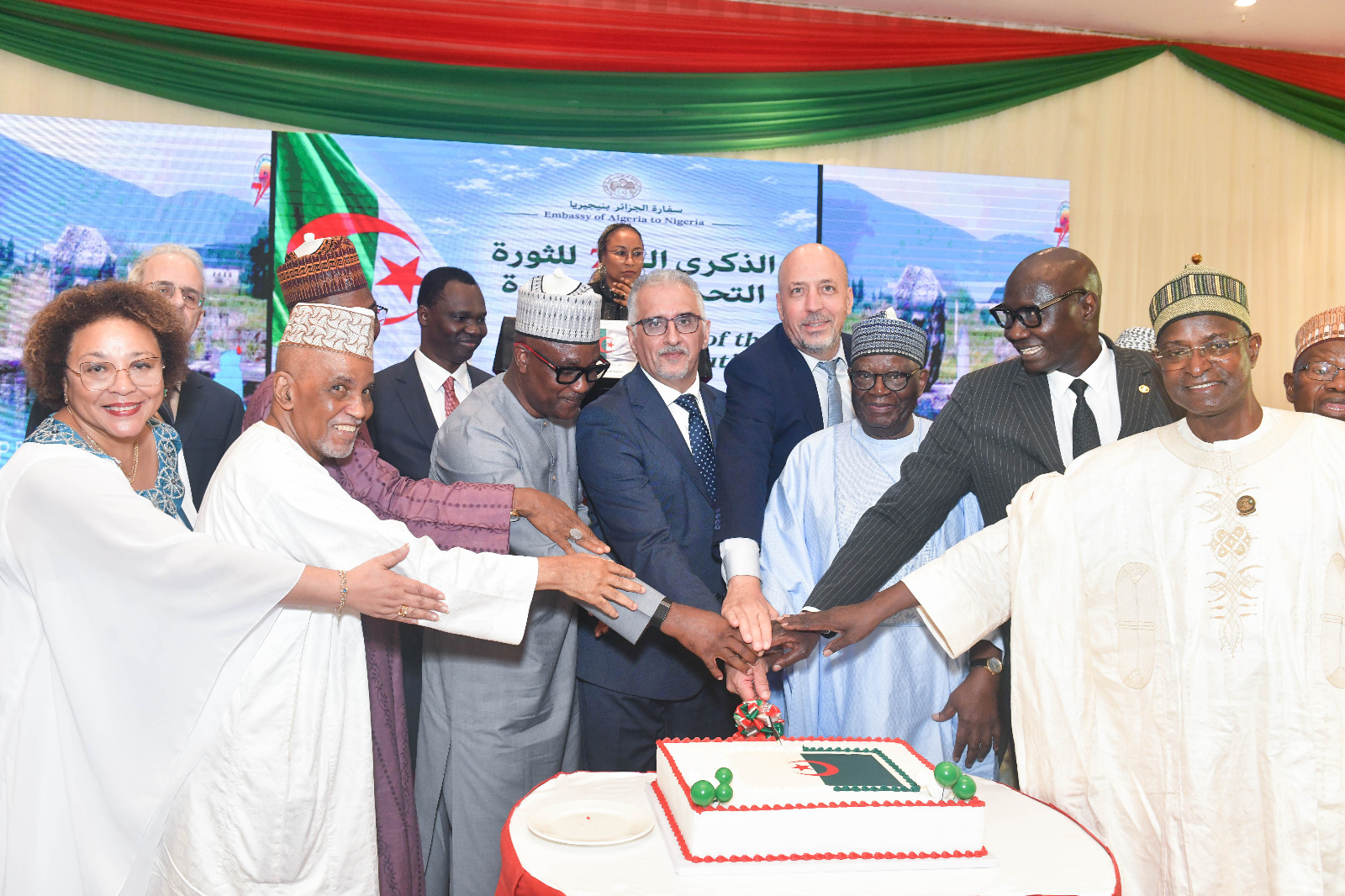
Joel Ajayi
The Embassy of Algeria in Nigeria has commemorated the 72nd anniversary of the country’s Glorious Revolution of November 1, 1954, with a reception in Abuja, highlighting Algeria’s liberation struggle and strengthening diplomatic relations with Nigeria.
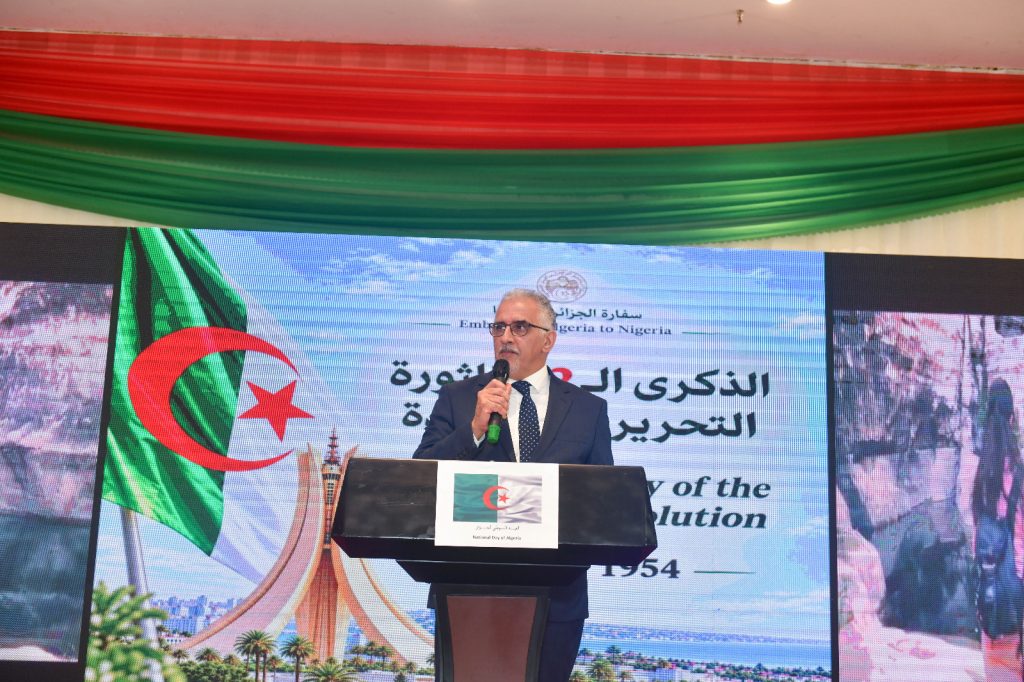
The event, held on November 9, 2026, at Continental Suites Hotel, attracted prominent personalities, including the Speaker of the House of Representatives, Dr Tajudeen Abbas, members of the Federal Government, senior government officials, heads of diplomatic missions and other friends of Algeria.
Speaking at the reception, Algeria’s Ambassador to Nigeria, Hocine Mezoued, welcomed guests and paid tribute to the country’s freedom fighters who sacrificed their lives during the struggle for independence.
He described the November 1, 1954 revolution as the foundation of modern Algeria, noting that the sacrifices of the nation’s martyrs made it possible for the country to reclaim its sovereignty.
On Algeria’s development agenda, Mezoued said President Abdelmadjid Tebboune’s administration had continued to pursue economic reforms, diversification and national development under its New Algeria vision.
He noted that the country was recording progress in non-hydrocarbon exports, while improvements in the business environment had boosted investor confidence and attracted significant foreign investments.
On foreign policy, the ambassador reaffirmed Algeria’s commitment to non-interference, respect for national sovereignty, peaceful conflict resolution and the right of peoples to self-determination.
Addressing security challenges in the Sahel, he stressed that lasting peace could not be achieved through military measures alone, insisting that economic development, inclusive dialogue and peaceful resolution of disputes remained essential.
Turning to Nigeria-Algeria relations, Mezoued described the partnership as one founded on shared values and the commitment of both countries’ leaders to advancing African development.
He identified the Trans-Saharan Highway, Trans-Saharan Gas Pipeline and Trans-Saharan Fibre Optic Backbone as major strategic projects receiving attention from both countries.
The ambassador also disclosed that Algeria had continued to provide scholarships to Nigerian students to strengthen human capital development and capacity building.
He further announced that Air Algérie expanded its Nigerian operations on October 26, 2026, with the introduction of two weekly flights to Lagos, expressing confidence that the service would boost trade and tourism.
Looking ahead, Mezoued said 2027 would offer fresh opportunities to deepen bilateral cooperation, particularly through the fifth Joint High Bi-National Commission scheduled to hold in Abuja.
He expressed optimism that the meeting would provide an opportunity to assess existing partnerships, identify new areas of cooperation and move Nigeria-Algeria relations towards a more practical and results-driven phase.
-
 Featured7 years ago
Lampard Names New Chelsea Manager
-
 Featured7 years ago
FG To Extends Lockdown In FCT, Lagos Ogun states For 7days
-
 Featured7 years ago
Children Custody: Court Adjourns Mike Ezuruonye, Wife’s Case To April 7
-
 Featured7 years ago
NYSC Dismisses Report Of DG’s Plan To Islamize Benue Orientation Camp
-

 Featured5 years ago
Transfer Saga: How Mikel Obi Refused to compensate me After I Linked Him Worth $4m Deal In Kuwait SC – Okafor
-
Featured7 years ago
Board urges FG to establish one-stop rehabilitation centres in 6 geopolitical zones
-
Sports4 years ago
TINUBU LAMBAST DELE MOMODU
-

 News2 years ago
Zulu to Super Eagles B team, President Tinubu is happy with you













