
News
Outcry as Benue govt okays launch of Fulani security outfit in the state

By Abdulateef Bamgbose
There is growing public outcry over the Benue State Government’s commissioning of a security outfit in Makurdi on Saturday June 3, 2023.
The security organization known as Al-Tershak Global Security Ltd was established by Alhaji Aliyu Tershaku, who had in the past been arrested over alleged links with Boko Haram.
An online newspaper, National Record reported that the commissioning of the security organization was performed by the Benue State Deputy Governor, Sam Ode who was represented by his Chief Protocol Officer, Gabriel Igoche.
What was curious during the inauguration of the security outfit and which has sparked concerns among people in the state was the huge number of Fulani personnel with many of them appointed as heads of key units within the organization.
The online newspaper reported, “National Record observed during the inauguration that the membership of the security outfit was dominated by the Fulani based on the names the Director called out and looking at the number of the officers who were physically present.”
This newspaper decided to sample the reactions of residents of Makurdi following the launch of the new security organization. What was more disturbing to those who spoke with us was the fact that the organization is dominated by men of Fulani extraction considering the sour relationship between them and indigenous people of the state in recent years.
Terdue Asongu, a resident of North Bank, Makurdi who was the first to react, described the development as suspicious and cautioned the Benue State Government to retract its steps and stop the Al-Tershak Global Security Ltd from commencing operations. He feared that the presence of men who have questionable backgrounds in the state in charge of security would spell doom for innocent people.
“When I read the news that a security outfit controlled by Fulani men had been approved by the Benue State Government, a cold shiver ran through my spine. Even when Fulanis were not in control of security in the state, our people saw hell. What will happen now that they have formally been asked to take charge of our security?”, Asongu queried.
Another respondent James Gbagir who works at the Tipper Park in Wurukum said “Someone should tell Governor Rev Fr Alia that we will not accept this new security formation. He should not make us regret voting for him. We ignored rumours that Fulani people were sponsoring his election and voted for him. Is he now telling us that we were wrong?”, Gbagir wondered.
A public affairs analyst, elder Peter Shange who has constantly written against attempts by Fulani to occupy Benue lands advised the present government of the state to follow the example of Governor Ortom and come clean on the rumours that it is in cahoots with those who have vowed to displace indigenous people of the state from their ancestral lands and take over.
Shange reminded the Alia government that the state already has a lawfully recognized security outfit known as Community Volunteer Guards who were drawn from each community of the state by the people through traditional rulers. He condemned the launch of an alternative outfit which origin and ownership are suspicious.
“Let me advise Governor Hyacinth Alia to listen to good counsel and resist the pressure from those who might have funded his election, if the story is anything to go by. Allowing Aliyu Tershaku to float a Fulani controlled security organization in the state at this time is as good as sitting on a time bomb. Those guys will wake up one day and ask him (Governor) to vacate the Government House and give them the keys. No one goes to bed with a known enemy”, he stated.
Other respondents who pleaded anonymity alleged that the new government in Benue State has brought Aliyu Tershaku with his security organization to fight their political opponents.
It will be recalled that Tershaku was arrested in 2018 by the Nigerian Army in connection with the killings in Benue State. He had stayed away from the state until last year when he returned and contested for the Makurdi/Guma House of Representatives seat in the 2023 election. Even at that, he was not seen campaigning anywhere until he surfaced at the polling unit on the day of the election. He did not get single vote in the election.
Tershaku, though a Tiv man who went wild and became a Boko Haram kingpin is believed to be a Fulani agent who has been sent on a mission by his sponsors to capture Benue State for them.
His return to the state and endorsement by the Alia administration is surely not going down well with the people of the state.



News
NJC Cannot Dictate Chief Judge Nominee to Imo JSC, Attorney-General Insists
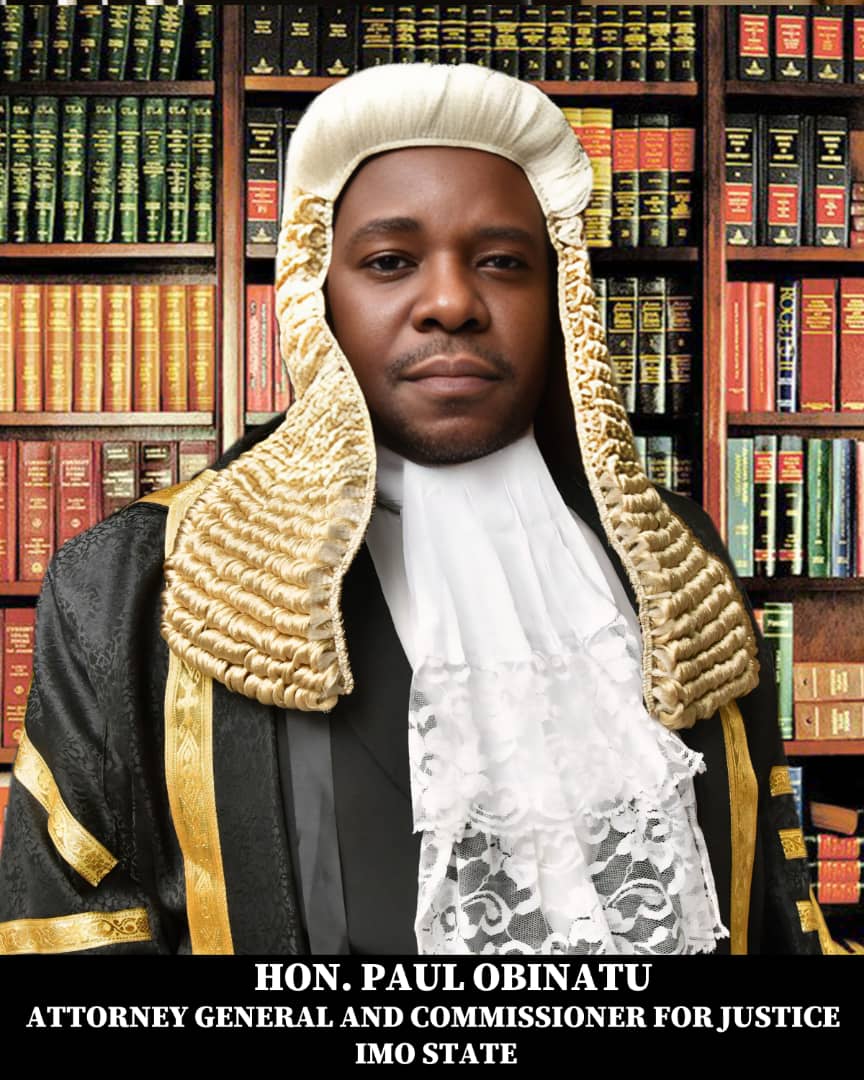
Joel Ajayi
The Imo State Attorney-General and Commissioner for Justice, Hon. Paul Obinatu has challenged the constitutional authority of the National Judicial Council (NJC) to direct the Imo State Judicial Service Commission (JSC) on the candidate whose name it should submit for consideration in the appointment of a substantive Chief Judge of the state, describing such an intervention as an encroachment on the constitutionally guaranteed independence of the State Commission.
In a statement issued on November 6, 2026, the Attorney-General maintained that the NJC lacks the constitutional authority to dictate, control or substitute its preferred candidate for the independent assessment and recommendation process entrusted to the Imo State JSC under the 1999 Constitution, as amended.
The objection follows a directive reportedly issued by the NJC to the Imo State JSC at its 112th meeting held on November 3, 2026, concerning the appointment of a substantive Chief Judge for the state.
The Attorney-General argued that the NJC’s constitutional responsibility to recommend a candidate to the Governor does not confer on it the additional power to determine or dictate the candidate the State Judicial Service Commission must submit to it. He maintained that the directive is constitutionally untenable because it interferes with a responsibility expressly vested in the State Judicial Service Commission.
SECTION 202 GUARANTEES IMO JSC’S INDEPENDENCE
Central to the Attorney-General’s objection is Section 202 of the Constitution, which expressly provides that the State Judicial Service Commission shall not be subject to the direction or control of any other authority or person in exercising its constitutionally assigned powers.
He argued that this provision establishes a clear constitutional safeguard against external interference in the Commission’s responsibilities and cannot be overridden by the NJC through administrative directives or procedural guidelines.
According to him, the NJC cannot invoke its national institutional status or its recommendation powers to exercise control over the Imo State JSC in a manner inconsistent with the Constitution.
Consequently, any directive requiring the State JSC to submit a particular candidate or dictating the outcome of its independent assessment would, in the Attorney-General’s interpretation, amount to unconstitutional interference.
CONSTITUTION ASSIGNS DISTINCT RESPONSIBILITIES TO NJC AND STATE JSC
The Attorney-General anchored his position on Section 271(1) and the relevant provisions of the Third Schedule to the Constitution.
Paragraph 6(a) of Part II of the Third Schedule empowers the State Judicial Service Commission to advise the NJC on suitable persons for nomination as Chief Judge of the state.
Conversely, Paragraph 21(c) of Part I of the Third Schedule empowers the NJC to recommend to the Governor, from among the list of persons submitted by the State JSC, a candidate for appointment as Chief Judge.
Section 271(1) further provides that the appointment shall be made by the Governor on the recommendation of the NJC, subject to confirmation by the State House of Assembly.
According to the Attorney-General, these provisions establish a clear constitutional sequence: the State JSC identifies and advises on suitable candidates, the NJC considers the submitted names and makes its recommendation to the Governor, while the Governor exercises the appointing authority subject to legislative confirmation.
He insisted that the NJC’s recommendation powers cannot be interpreted as authority to dictate which candidate the State JSC must select or submit, as doing so would effectively transfer the Commission’s constitutional responsibility to the NJC and render Section 202 meaningless.
NJC GUIDELINES CANNOT OVERRIDE THE CONSTITUTION
Addressing the NJC’s Guidelines and Procedural Rules for the Appointment of Judicial Officers, the Attorney-General acknowledged the Council’s authority to prescribe and enforce procedural requirements for judicial appointments.
However, he maintained that such guidelines cannot confer powers beyond those granted by the Constitution or be used to compromise the independent functions of the State JSC.
He stressed that the NJC’s responsibility to ensure compliance with appointment procedures must not be extended to usurping the constitutional authority of the Imo State Judicial Service Commission.
COURT DECISIONS REINFORCE ATTORNEY-GENERAL’S POSITION
In support of his argument, the Attorney-General cited several judicial authorities which he said affirm the importance of constitutional boundaries and institutional independence.
They include Elelu-Habeeb & Anor. v. Attorney-General of the Federation & Ors. (2012) LPELR-15515(SC), Kano State Public Complaints and Anti-Corruption Commission & Anor. v. Salisu & Ors. (2019) LPELR-47107(CA), and Bamisile v. National Judicial Council & Ors. (2012) LPELR-8381(CA).
Other authorities referenced are FRN v. Nganjiwa (2022) LPELR-58066(SC), NJC & Ors. v. Senlong & Ors. (2010) LPELR-4582(CA), and Attorney-General of the Federation v. Attorney-General of Abia State & Ors. (2024) LPELR-62576(SC).
The Attorney-General maintained that these authorities reinforce the principle that every constitutional institution must exercise its powers strictly within the limits prescribed by law, irrespective of its institutional standing.
IMO CHIEF JUDGE APPOINTMENT MUST FOLLOW CONSTITUTIONAL PROCEDURE
The Attorney-General warned that allowing the NJC to assume functions constitutionally assigned to the State JSC would undermine the integrity of the judicial appointment process and compromise the independence of the Commission.
He maintained that the issue is not a contest for institutional superiority between the NJC and the State JSC, but the need for each institution to respect the constitutional boundaries of its authority.
He further emphasised that the NJC’s responsibility to recommend a candidate to the Governor must not be confused with the power to control the independent selection and submission process of the State Commission.
The Attorney-General insisted that the ongoing appointment process must be conducted strictly in accordance with the Constitution, without interference that could undermine public confidence in the judiciary.
For the Imo State Attorney-General, the constitutional position is clear: while the NJC has the responsibility to recommend a candidate to the Governor, it has no authority to dictate to the Imo State Judicial Service Commission the candidate whose name it must submit in the exercise of its independent constitutional mandate.
-
 Featured7 years ago
Lampard Names New Chelsea Manager
-
 Featured7 years ago
FG To Extends Lockdown In FCT, Lagos Ogun states For 7days
-
 Featured7 years ago
Children Custody: Court Adjourns Mike Ezuruonye, Wife’s Case To April 7
-
 Featured7 years ago
NYSC Dismisses Report Of DG’s Plan To Islamize Benue Orientation Camp
-

 Featured5 years ago
Transfer Saga: How Mikel Obi Refused to compensate me After I Linked Him Worth $4m Deal In Kuwait SC – Okafor
-
Featured7 years ago
Board urges FG to establish one-stop rehabilitation centres in 6 geopolitical zones
-
Sports4 years ago
TINUBU LAMBAST DELE MOMODU
-

 News2 years ago
Zulu to Super Eagles B team, President Tinubu is happy with you













