
News
RMAFC Advocates Seamless Investment Preocesses

Joel Ajayi
The Revenue Mobilisation Allocation and Fiscal Commission (RMAFC) has called for urgent reforms to streamline investment processes and eliminate bureaucratic bottlenecks as part of efforts to enhance Nigeria’s attractiveness to both domestic and foreign investors.
This position was advanced during a courtesy visit by a delegation led by Hon. Enefe Ekene, Chairman of the Commission’s Investment Monitoring Committee, to the Honourable Minister of Industry, Trade and Investment, Dr. Jumoke Oduwole in her office in Abuja.
In a statement signed by Head, Information and Public Relations UnitRMAFC Maryam Umar Yusuf, mnipr on Monday in Abuja
Speaking during the engagement, Hon. Enefe Ekene emphasised the need for Nigeria to align its investment processes with global best practices, particularly in the area of business registration and investor onboarding. He noted that delays of up to two to three weeks for company registration are no longer competitive in a fast-paced global investment environment.
“Our Committee on Investment Monitoring has been closely tracking investment-related processes, and we felt it necessary to engage directly with the Ministry to address some of the bottlenecks we have observed,” he stated.
He further stressed that inefficiencies in the system discourage potential investors, many of whom operate within tight timelines and may opt for jurisdictions with faster and more predictable processes.
“The world has moved on. Investors expect seamless, one-stop-shop systems where critical processes such as company registration are completed within days, not weeks. If we fail to meet these expectations, we risk losing valuable investment opportunities,” he added.
Hon. Enefe Ekene also underscored the Commission’s evolving role beyond revenue sharing, noting that RMAFC is committed to supporting initiatives that will expand Nigeria’s revenue base through improved investment inflows.
“As a Commission, we must move beyond revenue distribution to actively supporting initiatives that will grow the nation’s revenue. By improving the investment climate, we can significantly enhance national earnings and drive sustainable economic growth,” he said.
In her response, the Honourable Minister, Dr. Jumoke Oduwole acknowledged existing challenges within the investment ecosystem while highlighting ongoing reforms aimed at improving service delivery and institutional coordination.
“We acknowledge that while progress has been made, there are still gaps that need to be addressed. Mr. President has emphasised the need for stronger coordination across government institutions to enhance service delivery, and this is already being implemented,” she said.
The Minister noted that deliberate efforts are being made to strengthen collaboration with key agencies, including the Corporate Affairs Commission, to ensure that business registration processes and related services are more efficient and responsive to investor needs.
“There have been notable strides and measurable achievements; however, much more remains to be done. Our focus is on deepening reforms across the entire investment ecosystem to ensure efficiency, transparency, and improved outcomes,” she added.
Dr. Oduwole reaffirmed the Ministry’s commitment to synergise with RMAFC and other stakeholders in advancing Nigeria’s investment climate, in line with the Renewed Hope Agenda of President Bola Ahmed Tinubu.
“I assure you of our continued collaboration with RMAFC to strengthen investment opportunities and deliver better services for investors and the Nigerian economy,” she stated.
Other members of the RMAFC delegation contributed to the discussions, further enriching the dialogue with diverse perspectives. Hon. Mohammed Kabeer Usman emphasised the importance of strengthening support for domestic investors while commending the Honourable Minister for ongoing efforts in that regard. Hon. Abdulaziz Idris King highlighted the need for clearer identification and operationalisation of Export Free Zones so as to enable investors to adequately benefit from available incentives. In her contribution, Hon. Hauwa Umar Aliyu underscored the importance of improving coordination across relevant institutions to enhance investor experience.
The engagement marks a significant step in fostering inter-agency collaboration aimed at removing structural impediments to investment, enhancing ease of doing business, and ultimately boosting national revenue generation.
The RMAFC delegation comprised Hon. Enefe Ekene, Chairman Investment Monitoring Committee and Federal Commissioner representing Anambra State; Hon. Sa’ad Bello Ibrahim, Federal Commissioner representing Plateau State; Hon. Hauwa Umar Aliyu, Federal Commissioner representing Jigawa State; Hon. Abdulaziz Idris King, Federal Commissioner representing Kogi State; Hon. Modu Ali Juluri, Federal Commissioner representing Yobe State; Hon. Mohammed Kabeer Usman, Federal Commissioner representing Gombe State; and Hon. Aruviere Egharevwa, Federal Commissioner representing Delta State.



News
DNKI President Champions Humanitarian Service, Sustainable Community Development
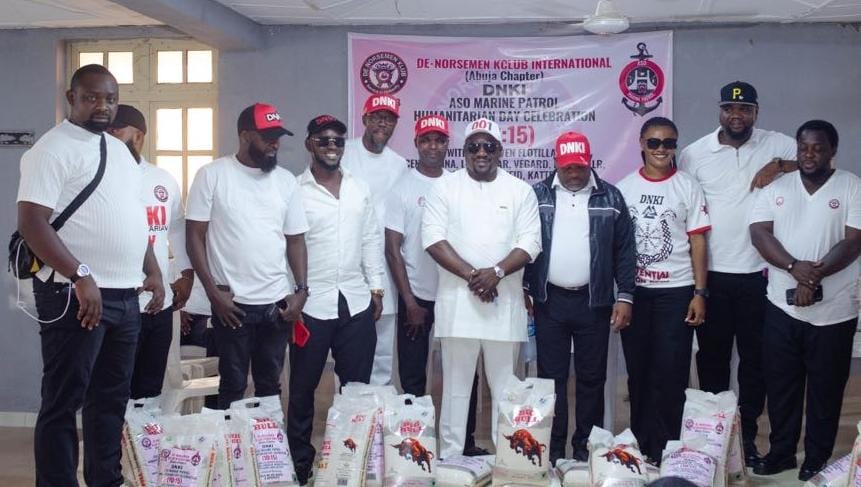
Cyril Samania
The President of De Norsemen Kclub International (DNKI), Chief Oliver Patrick Ityohegh, has reaffirmed the organisation’s commitment to humanitarian service, stressing the importance of supporting vulnerable people and improving community welfare beyond the annual celebration of Humanitarian Day.
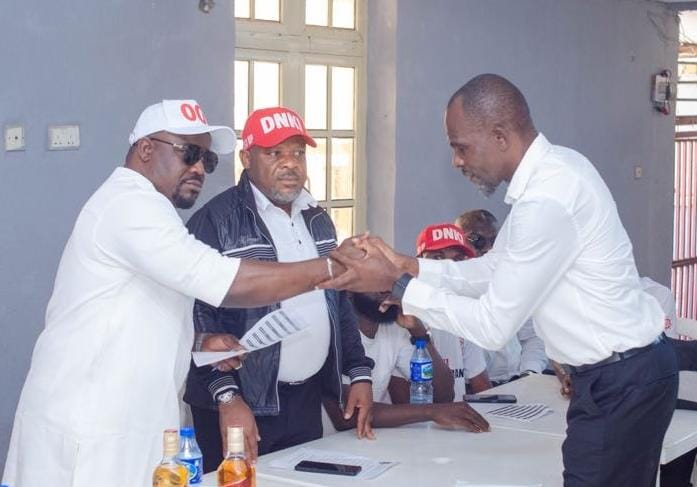
Ityohegh stated this during the organisation’s Cauldron Night and Award Presentation held to commemorate its 2026 Humanitarian Day celebration, theme: “Humanity First: Advancing Hope, Dignity and Community Well-being.” organised by the DNKI Abuja Chapter.
He emphasised that humanitarian service should be a continuous responsibility driven by compassion, solidarity and a commitment to making a meaningful difference in society.
According to him, DNKI’s humanitarian activities reflect its dedication to giving back to society and supporting people in need, while encouraging members to sustain initiatives that promote human dignity and community well-being.
He added that the organisation would continue to strengthen its humanitarian engagements through practical interventions aimed at improving the lives of vulnerable people and promoting community development.
Speaking at the event, the representative of the Abuja Chapter Chairman and Chairman of its Advisory Council, Prince Efiong Okpe, said the organisation’s humanitarian activities extended beyond the annual celebration of Humanitarian Day on October 15.
Okpe explained that DNKI undertook several initiatives throughout the year, including blood donation exercises, visits to hospitals and correctional centres, as well as support for orphanages and other vulnerable groups.
According to him, the organisation also collaborated with humanitarian bodies in the Federal Capital Territory (FCT) to identify areas of need and provide assistance within its available resources.
He described Humanitarian Day as an opportunity for members to renew their commitment to service and demonstrate solidarity with people facing difficult circumstances.
Earlier, the Chairman of the Planning Committee and Coordinator of the DNKI Gwagwalada Zone, Mr Etudaiye Hamzat, disclosed that the chapter had provided financial assistance to some members to help pay their children’s school fees, alongside distributing bags of rice and other relief items to members experiencing hardship.
Hamzat explained that the interventions followed concerns over the difficulties some members faced in meeting their family responsibilities, particularly the rising cost of their children’s education.
He maintained that supporting members in need was consistent with the organisation’s humanitarian principles, adding that DNKI remained committed to extending assistance to non-members and vulnerable communities as part of its commitment to leading by example.
Looking ahead, Hamzat said the Abuja Chapter planned to expand its humanitarian outreach to remote communities within the FCT, with particular attention to orphanages, schools and widows facing difficulties in meeting their family responsibilities.
He also recalled previous interventions for internally displaced persons (IDPs), which included the distribution of food, clothing and educational materials, noting that the chapter intended to scale up such initiatives in the coming year.
The highlight of the event was the presentation of awards to outstanding members and distinguished non-members in recognition of their contributions to humanitarian service.
-
 Featured7 years ago
Lampard Names New Chelsea Manager
-
 Featured7 years ago
FG To Extends Lockdown In FCT, Lagos Ogun states For 7days
-
 Featured7 years ago
Children Custody: Court Adjourns Mike Ezuruonye, Wife’s Case To April 7
-
 Featured7 years ago
NYSC Dismisses Report Of DG’s Plan To Islamize Benue Orientation Camp
-

 Featured5 years ago
Transfer Saga: How Mikel Obi Refused to compensate me After I Linked Him Worth $4m Deal In Kuwait SC – Okafor
-
Featured7 years ago
Board urges FG to establish one-stop rehabilitation centres in 6 geopolitical zones
-
Sports4 years ago
TINUBU LAMBAST DELE MOMODU
-

 News2 years ago
Zulu to Super Eagles B team, President Tinubu is happy with you













