
Business
RMAFC Honours Distinguished Director at Retirement Send-Off

Joel Ajayi
Staff of the Revenue Mobilisation Allocation and Fiscal Commission (RMAFC) held a retirement send-forth ceremony in honour of the Director, Chairman’s Office, Mr. Paul Adefusi, celebrating his decades of dedicated service and outstanding contributions to the Commission.
Speaking at the event held at the Old Boardroom of the Commission’s headquarters on Tuesday 20th January, 2026, the Honourable Chairman of Commission, Dr. Mohammed Bello Shehu, OFR, described Mr. Adefusi as an intellectual who is disciplined and deeply committed to duty.
He added that his impact on the Commission will be enduring. Dr Bello commended his humility, professionalism, and exemplary conduct, noting that his contributions have added in no small measure to the institution’s growth.
The Chairman encouraged him to explore new opportunities in consultancy, training, and advisory services, stressing that retirement marks a transition rather than an end.
Earlier, delivering the opening remarks on behalf of the Secretary to the Commission, Engr. Joseph Okechukwu Nwaze, the Director, Fiscal Efficiency Department, Dr. Tanimu Adamu Aliyu described Mr. Adefusi as a quiet achiever whose integrity and outstanding commitment to duty greatly strengthened the operations of the Chairman’s Office and the Commission at large.
Goodwill messages were showered on Mr. Adefusi by Directors of Customs Services, Gas Investments, Solid Minerals, and other senior officials, who spoke glowingly of his intelligence, humility, sincerity, and commitment to service.
Speakers described him as a dependable colleague, a listening leader whose legacy will endure within the Commission.
In his response, Mr. Adefusi expressed deep appreciation to the leadership, management, and staff of the Commission for the support and cooperation he enjoyed throughout his career.
He described his years at RMAFC as fulfilling and pledged to remain an ambassador of the values of integrity, professionalism, and service that defined his time in public office.
The ceremony marked a fitting tribute to a distinguished public servant whose legacy will remain firmly etched in the history of RMAFC.



Business
UNIUYO MFB Launches WashLoan For Safe Water, Hygiene
Cyril Ogar
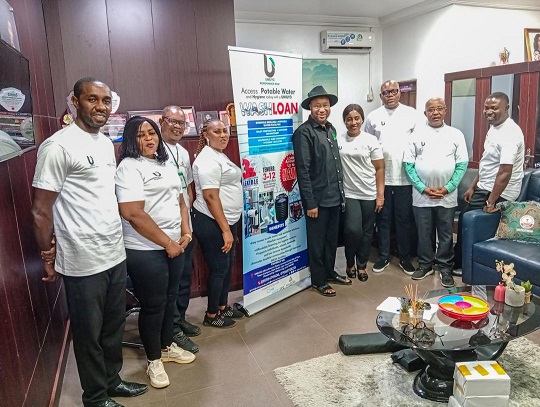
Uniuyo Microfinance Bank (MfB) has launched a loan facility – WashLoan – as part of its commitment to improved water, sanitation and hygiene for residents in the university community and its immediate environs.
The launch of the loan facility by the MFB, in partnership with Water-org, a leading civil advocacy group committed to improved water access globally, and the National Association of Microfinance Banks (NAMB), the umbrella body of all MFBs in Nigeria, was held last Thursday at the university in Uyo, Akwa Ibom State.
Speaking at the event, the Managing Director of the MFB, Dr. Millicent Idiong, said that access to clean water and proper sanitation is not a luxury as it is a basic human right but lamented that in many households, schools, and small businesses in our communities, this right remained out of reach.
She explained that through the Washloan initiative Uniuyo MFB is saying clearly that no family should struggle for safe water, no child should learn in an unsafe environment, and that no community should be left behind because of lack of sanitation.
While thanking Water.org and NAMB for partnering with the microfinance bank to expand access to safe water and sanitation in the tertiary institution, Dr. Idiong explained that the partnership aligned with Uniuyo MFB’s mission as a development focused financial institution – to use finance as a tool for transformation, not just profit.
She clarified: “The WashLoan has been carefully designed to be affordable, flexible and accessible, supporting individuals, households, schools, landlords and water related businesses to invest in sustainable water and sanitation solutions. By providing this financing, we are not just supporting infrastructure – We are supporting health, dignity, productivity, and community resilience.”
In his remarks, the Senior Relationship Account Manager at Water.org, Gilbert Okpono, said: “The launch of this WSS loan product by Uniuyo MFB provides a beacon of hope of universal access to safe water and sanitation for the state and country. Through this innovative finance solution, households and SMEs would be supported in a sustainable manner.”
Commenting on the benefits of the initiative to millions of people in the university and its environs, the National President of NAMB, Alhaji Abubakar Ahmad, described the WashLoan product launch “as a testament of the spirit of collaboration in improving hygiene and health for our teeming clients and communities.”
He maintained that NAMB was “seeking more partnerships to deliver more sustainable, life impacting practices to its customers and communities.”
-
 Featured7 years ago
Lampard Names New Chelsea Manager
-
 Featured6 years ago
FG To Extends Lockdown In FCT, Lagos Ogun states For 7days
-
 Featured6 years ago
Children Custody: Court Adjourns Mike Ezuruonye, Wife’s Case To April 7
-
 Featured7 years ago
NYSC Dismisses Report Of DG’s Plan To Islamize Benue Orientation Camp
-

 Featured5 years ago
Transfer Saga: How Mikel Obi Refused to compensate me After I Linked Him Worth $4m Deal In Kuwait SC – Okafor
-
Sports3 years ago
TINUBU LAMBAST DELE MOMODU
-

 News1 year ago
Zulu to Super Eagles B team, President Tinubu is happy with you
-
Featured7 years ago
Board urges FG to establish one-stop rehabilitation centres in 6 geopolitical zones