
Uncategorized
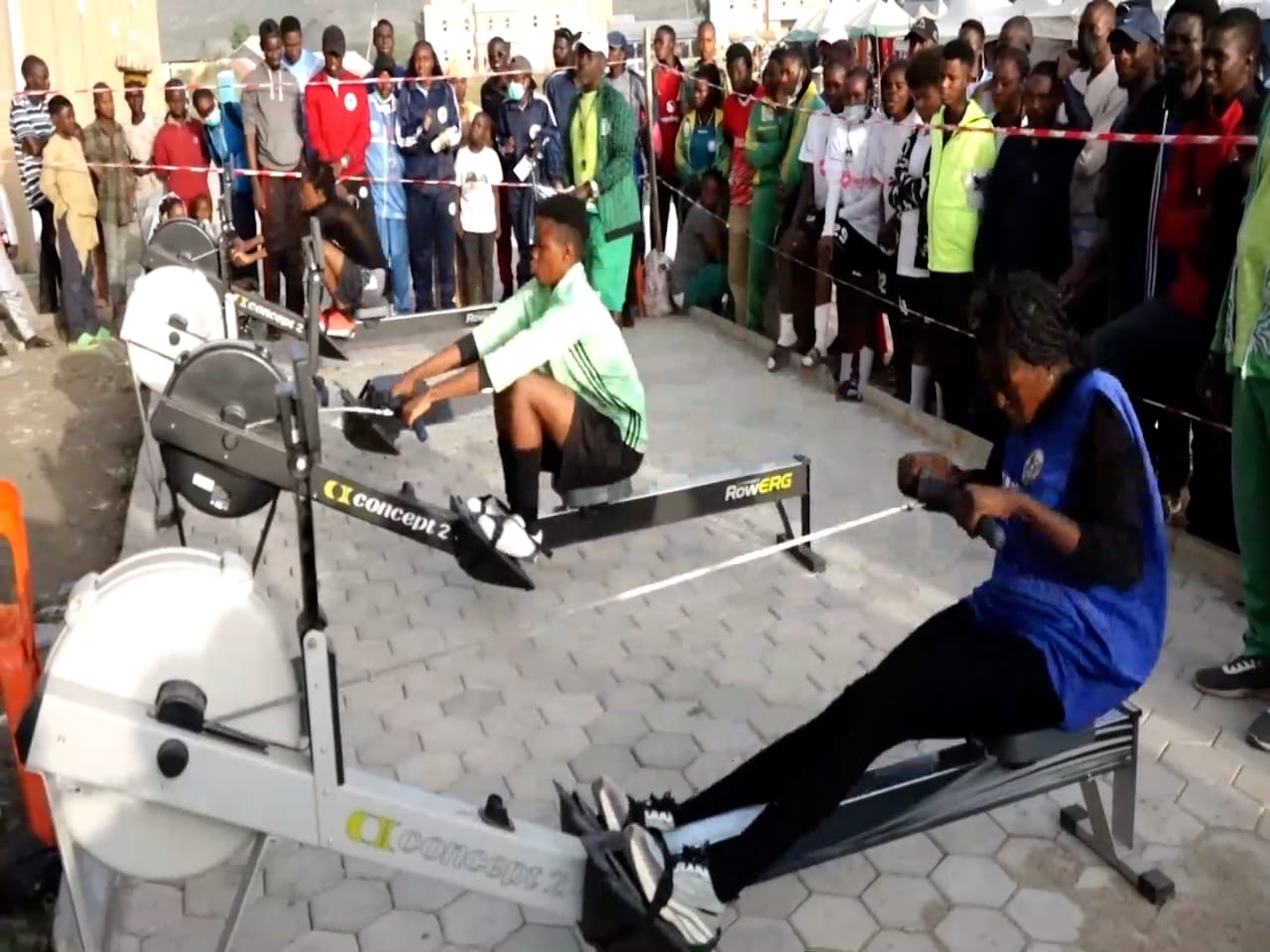
Rowing Ergometer Makes Historic Debut at 27th NUGA Games in Jos
Joel Ajayi
The 27th Nigeria University Games (NUGA), hosted by the University of Jos, delivered a landmark moment in Nigerian collegiate sports with the debut of the Rowing Ergometer event.
For the first time in the history of the Games, student-athletes competed in this intensity-packed discipline, showcasing extraordinary power, fitness and mental resilience.
Athletes from 14 universities contested across lightweight and heavyweight divisions in the 2000m, 1000m and 500m races for both men and women. The competition quickly became one of the most exciting spectacles of the Games.
Medal Highlights 2000m Results: Men’s Heavyweight: Ikechukwu Victor (ESUT) – 7:20. Men’s Lightweight: Tyonkaa Ebenezer (JOSTUM) – 7:56.
Women’s Heavyweight: Deborah Omowuyi Kareem (ABU Zaria) – 8:40. Women’s Lightweight: Lucy Yago (ABU Zaria) – 9:05
1000m Results: Men’s Heavyweight: Ikechukwu Victor (ESUT) – 3:20Men’s Lightweight: Sani Umar (FUDMA) – 3:43Women’s Heavyweight: Edeh Elora (ESUT) – 4:03Women’s Lightweight: Aderonke Adelakun (Ekiti State University) – 4:20.
500m Results: Men’s Heavyweight: Ikechukwu Victor (ESUT) – 1:32Men’s Lightweight: Tyonkaa Ebenezer (JOSTUM) – 1:40Women’s Heavyweight: Edeh Elora (ESUT) – 1:51Women’s Lightweight: Kasham Katherine (NAUB) – 1:53.
The rowing arena became one of the busiest venues of the Games as students and sports enthusiasts flocked to watch the thrilling showdowns. Spectators cheered loudly as competitors battled the clock and their own endurance, producing an atmosphere charged with excitement and anticipation.
Fubara Owonaro, Chairman of the Rowing, Yachting and Canoeing Committee for the Games, celebrated the successful debut of the sport:
“Rowing is a medal-winning sport, and we are excited that this is the first time it is being featured at NUGA. Talents discovered here will be groomed to represent Nigeria nationally and internationally.”
Coach Jimoh Amidu Babatunde of the Nigeria Rowing, Canoe and Sailing Federation also commended the smooth organization and the commitment of the University of Jos:
“These Games are not just about medals. They build disciplined, skilled and resilient young athletes who will one day represent Nigeria internationally and foster national pride among our youths.”
Special recognition was extended to Dr. Akin Ogunbiyi, President of the Nigeria Rowing, Canoe and Sailing Federation, and Bunmi Oluode, the Secretary-General, whose leadership and dedication paved the way for the sport’s historic introduction to NUGA.
With the next NUGA Games scheduled to take place in Calabar, officials are optimistic that even more universities will field athletes in the Rowing Ergometer events, building on the momentum and success recorded in Jos.



Uncategorized
Eight Athletes, 11 Medals: Applauding Asagba’s Sports Leadership At DELSU
By Godspower Odedede
Delta State University (DELSU), Abraka, has recorded an impressive outing at the 15th West Africa University Games (WAUG) 2026, winning 11 medals with just eight athletes who represented the university in only three sporting events.
The university won seven gold, two silver and two bronze medals to occupy seventh position on the medal table, an achievement that underscores the potential of its athletes and the importance of purposeful investment in university sports.
DELSU participated in the men’s 100-metre sprint with two athletes, women’s judo with two athletes, and swimming with four male athletes. Despite the limited number of athletes and sporting events, the university’s medal haul was a commendable performance and a source of pride for the institution.
The achievement deserves particular recognition given the restricted scope of DELSU’s participation. With representation in only three sports, the university demonstrated that focused preparation, adequate support and the effective deployment of available talent can produce encouraging results at major university competitions.
A major highlight of DELSU’s preparation for WAUG 2026 was the approval by the Vice-Chancellor, Professor Samuel Ogheneovo Asagba, for a quality two-week training programme for the university’s athletes in Asaba.
The camp provided the athletes with an opportunity to prepare using the excellent and up-to-date training facilities available in the state capital.
The initiative is particularly noteworthy as it represents a significant commitment to structured preparation for university sports. Rather than relying solely on athletes’ natural abilities, the training programme recognised the importance of preparation, access to appropriate facilities and institutional investment in performance.
Professor Asagba deserves commendation for this intervention and for demonstrating a willingness to provide practical support for sports development at DELSU. The university’s WAUG performance offers an encouraging indication of what can be achieved when athletes receive purposeful preparation and administrative backing.
The Vice-Chancellor’s broader vision for sports infrastructure is also encouraging. Plans are understood to be underway for the construction of an ultra-modern sports complex for the university in the near future. If delivered as anticipated, the facility could significantly strengthen DELSU’s capacity for athlete development, training, competitions and sports science activities.
Such infrastructure would also support the university’s ambitions to improve its performance at national and international university games. A modern sports complex could provide a foundation for more systematic talent identification, performance monitoring, coaching development and the preparation of athletes across a wider range of sporting events.
Special recognition must also go to Mrs Epebi-Ebi Noah, the swimming coach, who was physically present at Obafemi Awolowo University (OAU), Ile-Ife, with the DELSU swimming team during the competition. Her presence and involvement underline the importance of coaching support, technical guidance and close supervision of athletes during major sporting events.
The performance also calls for commendation of the Chairman of the University Sports Committee, Professor Ochuko Nabofa, whose leadership has brought renewed attention and energy to sports development at DELSU. His role in supporting the university’s sports administration and helping to strengthen the sporting environment deserves recognition.
Similarly, the Acting Director of Sports, Peter Omojuwa, deserves commendation for his administrative responsibilities and contribution to the university’s sporting programme. The Chief Coach, Lucky Ajaino, should also be recognised for his role in the technical preparation and development of DELSU athletes.
The combined efforts of the university management, sports committee, sports administrators and coaches are essential to sustaining progress. While medals provide a visible measure of success, the systems established to prepare athletes and support their development are equally important to the long-term growth of university sports.
DELSU’s WAUG achievement follows another notable outing at the last Nigeria University Games Association (NUGA) Games, where the university finished fourth. That result was regarded as one of the finest performances in the institution’s sporting history and strengthened expectations that DELSU could become an even more formidable force in university sports.
The latest WAUG performance provides another reason for optimism. However, the university’s participation in only three events also reveals an opportunity for further growth. Expanding participation across more sports, identifying talented students and improving access to specialised training could help DELSU compete for a higher position on future medal tables.
The proposed sports complex, if realised, could play a central role in this expansion. It should ideally be supported by sustained funding, modern equipment, qualified coaches, athlete welfare programmes and collaboration with relevant sports science professionals. These measures would help ensure that infrastructure investment translates into measurable improvements in performance.
The university could also consider strengthening performance analysis, sports medicine, strength and conditioning, talent identification and systematic monitoring of athletes’ progress. Such an approach would help transform individual successes into a sustainable university-wide sports development programme.
DELSU’s performance at WAUG 2026 is worthy of celebration. Eight athletes competed in just three sporting events and returned with 11 medals, including seven gold. The result reflects the potential within the university and provides a strong basis for building a more ambitious sports programme.
Professor Asagba’s approval of the two-week training camp and the prospect of an ultra-modern sports complex offer reasons to look forward to the next phase of DELSU sports development. The challenge now is to sustain the momentum, broaden participation and ensure that the university’s sporting ambitions are matched by consistent investment and effective implementation.
With continued support from the Vice-Chancellor, the University Sports Committee, the Directorate of Sports, coaches and other stakeholders, DELSU can build on its recent achievements and strengthen its position among Nigeria’s leading sporting universities.
The message from WAUG 2026 is clear: DELSU has demonstrated what a small but well-supported contingent can achieve. With broader participation, sustained preparation and modern sporting infrastructure, the university has the potential to accomplish even greater things.
-
 Featured7 years ago
Lampard Names New Chelsea Manager
-
 Featured7 years ago
FG To Extends Lockdown In FCT, Lagos Ogun states For 7days
-
 Featured7 years ago
Children Custody: Court Adjourns Mike Ezuruonye, Wife’s Case To April 7
-
 Featured7 years ago
NYSC Dismisses Report Of DG’s Plan To Islamize Benue Orientation Camp
-

 Featured5 years ago
Transfer Saga: How Mikel Obi Refused to compensate me After I Linked Him Worth $4m Deal In Kuwait SC – Okafor
-
Featured7 years ago
Board urges FG to establish one-stop rehabilitation centres in 6 geopolitical zones
-
Sports4 years ago
TINUBU LAMBAST DELE MOMODU
-

 News2 years ago
Zulu to Super Eagles B team, President Tinubu is happy with you













