
News
Southwest Security Alarm: DNKI Chieftain Urges FG to Convene Emergency Stakeholders’ Summit Amid Rising Terror Threats

By Cyril Ogar
A prominent Southwest leader and Special Assistant on Southwest Affairs to the International President of De Norsemen Kclub International (DNKI), Chief Victory Ngumas, has called on the Federal Government to urgently convene a Southwest Emergency Security Stakeholders’ Meeting to tackle the growing wave of kidnappings, terrorism, and violent crimes spreading across the region.
Ngumas said the call had become necessary following a series of disturbing security incidents and intelligence reports suggesting that criminal and terrorist elements are increasingly extending their operations into the Southwest.
According to him, the recent mass abduction of pupils and teachers in Oyo State signals a dangerous escalation that requires immediate and coordinated intervention from all levels of government and security agencies.
He recalled that on May 15, 2026, armed gunmen invaded three schools in Oriire Local Government Area of Oyo State, abducting dozens of pupils, students, and teachers. He described the attack as one of the most alarming security breaches in the region in recent times.
The DNKI chieftain also referenced the reported killing of Mr. Michael Oyedokun, a Mathematics teacher at Community High School, Ahoro-Esinle, allegedly by his abductors, describing the act as barbaric, inhumane, and a direct assault on education and humanity.
Ngumas further cited the June 3 abduction of Mrs. Olaide Busayo Adegoke John-Paul, sister of former Minister of Power, Chief Adebayo Adelabu, alongside her 12-year-old twin sons in Ibadan, noting that although the victims were eventually rescued through security operations, the incident highlighted the growing boldness of criminal gangs operating in the region.
He expressed concern over reports that the attackers involved in the school abductions operated with military-style sophistication, reportedly wearing camouflage uniforms, riding motorcycles, communicating in multiple languages, and deploying Improvised Explosive Devices (IEDs) during confrontations with security personnel.
According to him, intelligence gathered from rescue efforts suggests the involvement of organised criminal networks with access to sophisticated weapons, explosives, and logistics support.
While commending President Bola Ahmed Tinubu for approving the recruitment of approximately 1,000 forest guards for Oyo State following the attacks, Ngumus said the initiative should be complemented with broader and more proactive security measures.
“The deployment of forest guards is commendable, but lasting security requires a comprehensive strategy built around intelligence gathering, stakeholder collaboration, technology-driven surveillance, and effective inter-agency coordination,” he stated.
Ngumas stressed the need for greater collaboration between security agencies and responsible civil society organisations, noting that community-based groups possess valuable grassroots intelligence that could strengthen early warning systems and crime prevention efforts.
He explained that De Norsemen Kclub International, with active chapters across all six Southwest states and 27 states nationwide, stands ready to support intelligence gathering and community engagement initiatives under the supervision of relevant security authorities.
“With proper training, vetting, and oversight, members of responsible civil society organisations can contribute significantly to intelligence gathering, surveillance, and early warning systems, particularly within vulnerable rural communities and forest corridors,” he said.
The Southwest leader warned that worsening insecurity could negatively affect economic activities, educational development, investment opportunities, and public confidence in government.
“The Oyo school abductions represent a dangerous shift in the security landscape. If urgent steps are not taken, the Southwest could face security challenges similar to those witnessed in other parts of the country,” he cautioned.
He added that security would remain a critical issue as the country approaches the 2027 general elections, stressing that citizens would assess political leaders based largely on their ability to protect lives and property.
To address the growing threat, Ngumas proposed the immediate convening of a Southwest Security Stakeholders’ Conference involving the Federal Government, state governments, security agencies, traditional rulers, the Amotekun Corps, community leaders, civil society organisations, and other relevant stakeholders.
He also advocated the establishment of a regional intelligence fusion centre to improve information sharing among security agencies and local stakeholders, alongside coordinated technology-driven operations to dismantle criminal networks operating within forest reserves and other vulnerable areas.
Other recommendations include intensified investigations into the sources of illegal arms and explosives entering the region, as well as the structured deployment of vetted civil society actors to support intelligence gathering and early warning functions.
He, however, emphasized that all armed and kinetic security operations must remain the exclusive responsibility of constitutionally recognised security agencies.
Reaffirming DNKI’s commitment to national peace, security, and community development, Ngumas said the organisation would continue to support initiatives aimed at promoting public safety, unity, and humanitarian service across Nigeria.
“Security is a collective responsibility. We must act now to prevent these threats from taking deeper roots in the Southwest and to safeguard the future of our communities,” he said.This version is structured in a professional newspaper style suitable for publication.



Foreign news
Algeria’s Glorious Revolution: Embassy Marks 72nd Anniversary in Abuja
Joel Ajayi
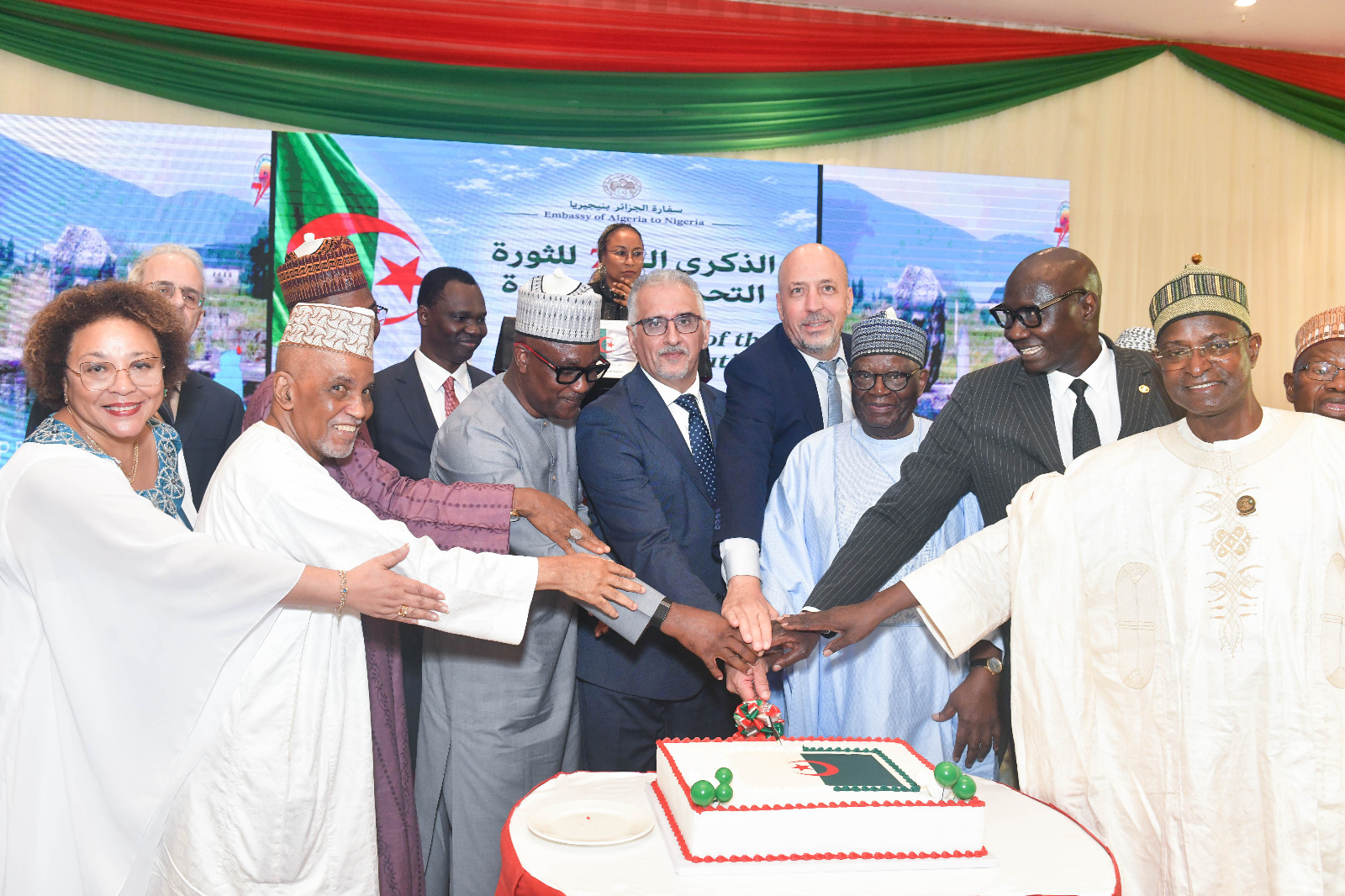
The Embassy of Algeria in Nigeria has commemorated the 72nd anniversary of the country’s Glorious Revolution of November 1, 1954, with a reception in Abuja, highlighting Algeria’s liberation struggle and strengthening diplomatic relations with Nigeria.
The event, held on November 9, 2026, at Continental Suites Hotel, attracted prominent personalities, including the Speaker of the House of Representatives, Dr Tajudeen Abbas, members of the Federal Government, senior government officials, heads of diplomatic missions and other friends of Algeria.
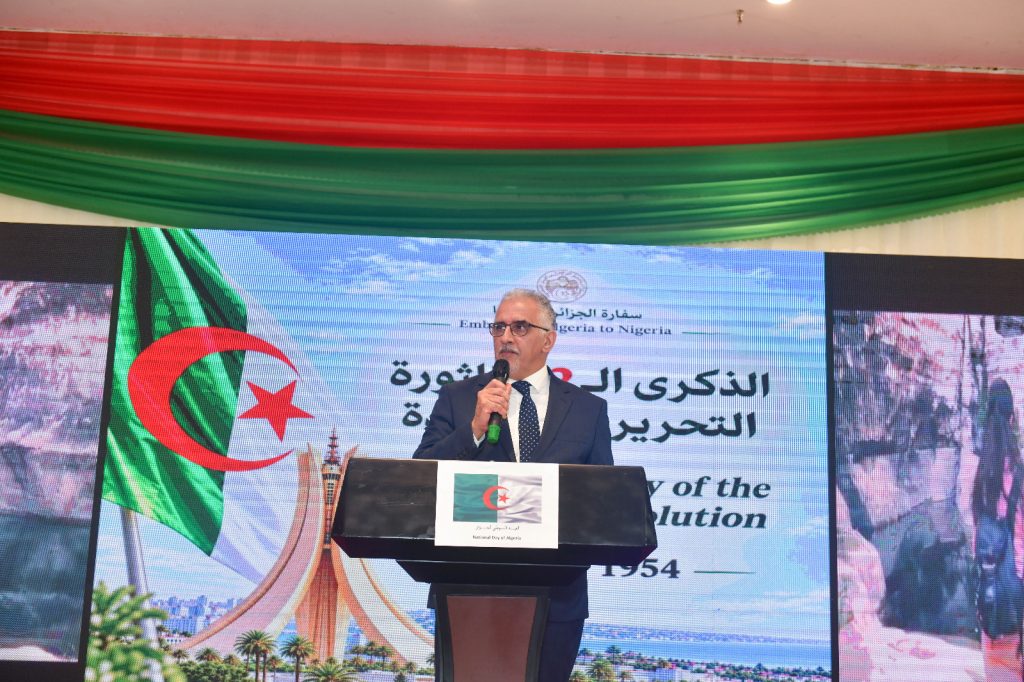
Speaking at the reception, Algeria’s Ambassador to Nigeria, Hocine Mezoued, welcomed guests and paid tribute to the country’s freedom fighters who sacrificed their lives during the struggle for independence.
He described the November 1, 1954 revolution as the foundation of modern Algeria, noting that the sacrifices of the nation’s martyrs made it possible for the country to reclaim its sovereignty.
On Algeria’s development agenda, Mezoued said President Abdelmadjid Tebboune’s administration had continued to pursue economic reforms, diversification and national development under its New Algeria vision.
He noted that the country was recording progress in non-hydrocarbon exports, while improvements in the business environment had boosted investor confidence and attracted significant foreign investments.
On foreign policy, the ambassador reaffirmed Algeria’s commitment to non-interference, respect for national sovereignty, peaceful conflict resolution and the right of peoples to self-determination.
Addressing security challenges in the Sahel, he stressed that lasting peace could not be achieved through military measures alone, insisting that economic development, inclusive dialogue and peaceful resolution of disputes remained essential.
Turning to Nigeria-Algeria relations, Mezoued described the partnership as one founded on shared values and the commitment of both countries’ leaders to advancing African development.
He identified the Trans-Saharan Highway, Trans-Saharan Gas Pipeline and Trans-Saharan Fibre Optic Backbone as major strategic projects receiving attention from both countries.
The ambassador also disclosed that Algeria had continued to provide scholarships to Nigerian students to strengthen human capital development and capacity building.
He further announced that Air Algérie expanded its Nigerian operations on October 26, 2026, with the introduction of two weekly flights to Lagos, expressing confidence that the service would boost trade and tourism.
Looking ahead, Mezoued said 2027 would offer fresh opportunities to deepen bilateral cooperation, particularly through the fifth Joint High Bi-National Commission scheduled to hold in Abuja.
He expressed optimism that the meeting would provide an opportunity to assess existing partnerships, identify new areas of cooperation and move Nigeria-Algeria relations towards a more practical and results-driven phase.
-
 Featured7 years ago
Lampard Names New Chelsea Manager
-
 Featured7 years ago
FG To Extends Lockdown In FCT, Lagos Ogun states For 7days
-
 Featured7 years ago
Children Custody: Court Adjourns Mike Ezuruonye, Wife’s Case To April 7
-
 Featured7 years ago
NYSC Dismisses Report Of DG’s Plan To Islamize Benue Orientation Camp
-

 Featured5 years ago
Transfer Saga: How Mikel Obi Refused to compensate me After I Linked Him Worth $4m Deal In Kuwait SC – Okafor
-
Featured7 years ago
Board urges FG to establish one-stop rehabilitation centres in 6 geopolitical zones
-
Sports4 years ago
TINUBU LAMBAST DELE MOMODU
-

 News2 years ago
Zulu to Super Eagles B team, President Tinubu is happy with you













