
Business
TAJBank opens new branch to deepen financial inclusion
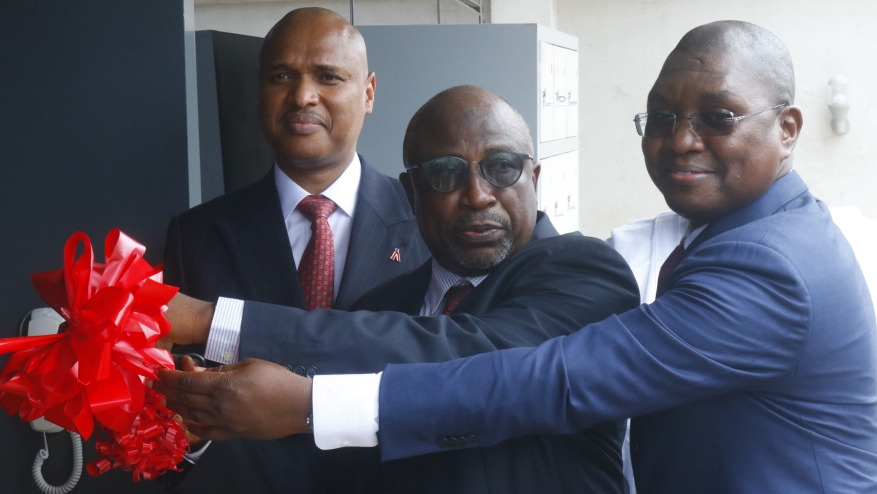
…..As excited traders jostle to open account
Joel Ajayi
TAJBank Ltd, a leading non-interest hank, has continued its service and financial inclusion drive with the opening of a new, technology-powered branch in Wuse 2, Abuja.
The opening of the new branch brings the lender’s growing branch network to 22 within its first two years of operation.
Speaking during the event, which was witnessed by scores of traders and small business owners eager to do business with the non-interest financial services provider, the Managing Director/CEO; Mr. Hamid Joda, said the opening of the Wuse 2 branch aligned with the management’s strategy of deepening financial inclusion by taking banking products and services to millions of unbanked and undeserved populace in the grassroots.
Joda explained: “The opening of the new branch is to continue with our strategy of ensuring that we take the TAJBank brand to all the nooks and crannies of the Country with the aim of addressing the service needs of our teeming customers.
“We understand that Customers want to do business and sometimes someone to give them that advisory service they yearn for which in turn will help to address their financial challenges”, he added.
In his remarks, the bank’s board Chairman, Alhaji Tanko Gwamma, stressed that one of TAJBank’s goals was to increase its visibility at the grassroots in demonstration of its commitment to continuously add socio-economic value to ordinary Nigerians.
According to him, Wuse 2 zone is one of the promising locations in the FCT where businesses are thriving every day and the idea of opening a branch there “is to ensure that customers don’t suffer in their banking transactions as TAJBank will not only give them real time service but also give them advice on how to grow their businesses.”
It would be recalled that TAJBank recently reported a 433% growth in PBT for the 2021 financial year and significant growth in gross revenue, balance sheet and other performance assessment indicators.
The non-interest bank is also set to launch Nigeria’s first private sector Sukuk offering under a N100 billion programme.



Business
38 Years On, RMRDC Continues to Drive Industrial Growth and Sustainable Prosperity
Joel Ajayi
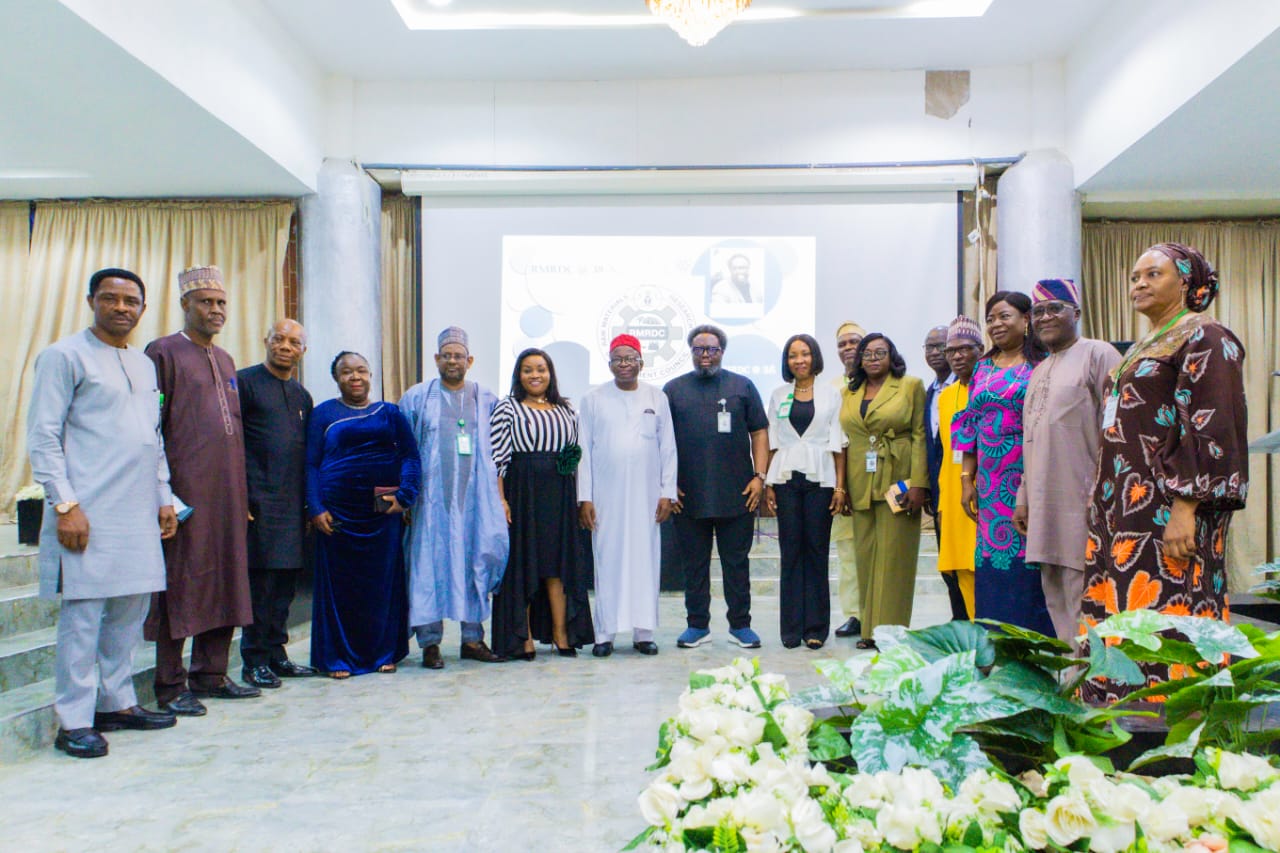
It was a grand celebration of resilience, innovation, and the advancement of industrial growth for generations to come, highlighting sustainable prosperity, nationwide industrial development, and future-focused progress, as the Raw Materials Research and Development Council (RMRDC) marked its 38th anniversary on Tuesday in Abuja. The event was themed “RMRDC @ 38 – Celebrating the Journey and Defining the Frontier.”
The occasion brought together staff, partners, and stakeholders who have contributed immensely to the Council’s achievements over nearly four decades. In his address, the Director General/CEO of RMRDC, Professor Nnanyelugo Ike-Muonso, reflected on the Council’s journey and its pivotal role in charting a sustainable future for Nigeria’s industrial sector.
“Our story began on February 10, 1988, in Lagos, not as a typical government agency, but as a strategic response to a national challenge,” Professor Ike-Muonso said. At the time, Nigeria’s industries were heavily dependent on imported raw materials—a vulnerability exposed by the global oil price crash of the mid-1980s.
“The Council’s establishment followed a landmark workshop organized by the Manufacturers Association of Nigeria (MAN), the Federal Ministry of Industries, and the Nigerian Institute of Social and Economic Research (NISER). This led to the 1983 conference “The Raw Materials Question” and the enactment of Decree No. 39 of December 17, 1987 (now RMRDC Act Cap R3 LFN). Since then, RMRDC has spearheaded initiatives in raw materials import substitution, backward integration, and industrial development.
“From its early days in Lagos to its headquarters in Maitama, Abuja, and offices across all 36 states, RMRDC has transformed the “raw materials question” into a driving force for industrial growth.
“The Council has evolved from resource mapping to pioneering technological breakthroughs, positioning itself as Nigeria’s central hub for industrial resource utilization.” he said.
Acknowledging the contributions of past leaders, staff, partners, and stakeholders, Professor Ike-Muonso emphasized: “As we celebrate 38 years of impactful service, we reaffirm our commitment to unlocking Nigeria’s raw materials potential, driving industrial growth, and securing a prosperous future for generations to come.”
Since assuming leadership in 2024, Professor Ike-Muonso has embarked on a bold reform agenda, including a bill to amend the RMRDC Act. The legislation mandates a minimum of 30% value addition to all raw materials before export and discourages imports of locally abundant materials. “We are choosing ‘Nigeria First’ and ending the era of exporting our prosperity,” he stated.
Technological advancement is at the heart of RMRDC’s transformation. The Council has fully digitalized its operations through an Enterprise Resource Planning (ERP) system and developed the National Raw Materials and Products Statistical Information System (NRMPSIS) to provide global access to technical and investment data on Nigerian raw materials. Specialized centers, including the Centre for Circularity and Repurposing and the Centre of Excellence in Nanotechnology, are driving innovation in resource recovery, advanced materials, and sustainable manufacturing.
RMRDC has invested heavily in capacity building, establishing a training school and partnering with universities to offer MSc and PhD programs in raw materials science. Forty-six commercializable technologies have been patented, and pilot plants in agro and mineral raw materials are operational, supporting industrial development and job creation.
The Council’s strategic roadmap for 2025–2034, developed with the African Development Bank, aims to achieve 30–95% value addition to raw materials and deliver 10,000 laboratory certifications. These initiatives are designed to reduce import dependence, improve industrial resilience, and diversify Nigeria’s economy.
Despite these achievements, challenges remain, including financing gaps for research and industrial innovation, skills mismatches, difficulties in implementing import substitution policies, ineffective tariff regimes, and insecurity.
RMRDC’s mandates remain central to Nigeria’s industrial strategy: developing policy guidelines for raw materials acquisition and utilization, advising the Federal Government on strategic implications, promoting efficient machinery and processes, conducting research, and publicizing data to encourage local sourcing.
In his anniversary lecture, former RMRDC Director General and current Vice-Chancellor of the African University of Science and Technology (AUST), Professor Azikiwe Peter Onwualu, praised the Council’s achievements and emphasized the importance of continued reforms. RMRDC is being repositioned to define Nigeria’s next industrial frontier—a knowledge and technology-driven, sustainable, and self-reliant industrial sector, with at least 30% local value addition to raw materials before export.
With a renewed focus on knowledge-driven, sustainable, and self-reliant industrial growth, RMRDC is positioning Nigeria to define the next frontier in industrialization where local raw materials drive value addition, large-scale industries source locally, and economic prosperity benefits all Nigerians.
-
 Featured7 years ago
Lampard Names New Chelsea Manager
-
 Featured6 years ago
FG To Extends Lockdown In FCT, Lagos Ogun states For 7days
-
 Featured6 years ago
Children Custody: Court Adjourns Mike Ezuruonye, Wife’s Case To April 7
-
 Featured7 years ago
NYSC Dismisses Report Of DG’s Plan To Islamize Benue Orientation Camp
-

 Featured4 years ago
Transfer Saga: How Mikel Obi Refused to compensate me After I Linked Him Worth $4m Deal In Kuwait SC – Okafor
-
Sports3 years ago
TINUBU LAMBAST DELE MOMODU
-

 News1 year ago
Zulu to Super Eagles B team, President Tinubu is happy with you
-
Featured6 years ago
Board urges FG to establish one-stop rehabilitation centres in 6 geopolitical zones













