
News
The whys of a university of education in Kwara
Rafiu Ajakaye
In one of his many writings on leadership which he titled ‘Six Studies in World Strategy’, America’s all-time diplomatic czar and statesman Henry Kissinger said ‘leaders think and act at the intersection of two axes: the first, between the past and the future; the second, between the abiding values and aspirations of those they lead. Their first challenge is analysis, which begins with a realistic assessment of their society based on its history, mores, and capacities. Then they must balance what they know, which is necessarily drawn from the past, with what they intuit about the future, which is inherently conjectural and uncertain. It is this intuitive grasp of direction that enables leaders to set objectives and lay down a strategy’.
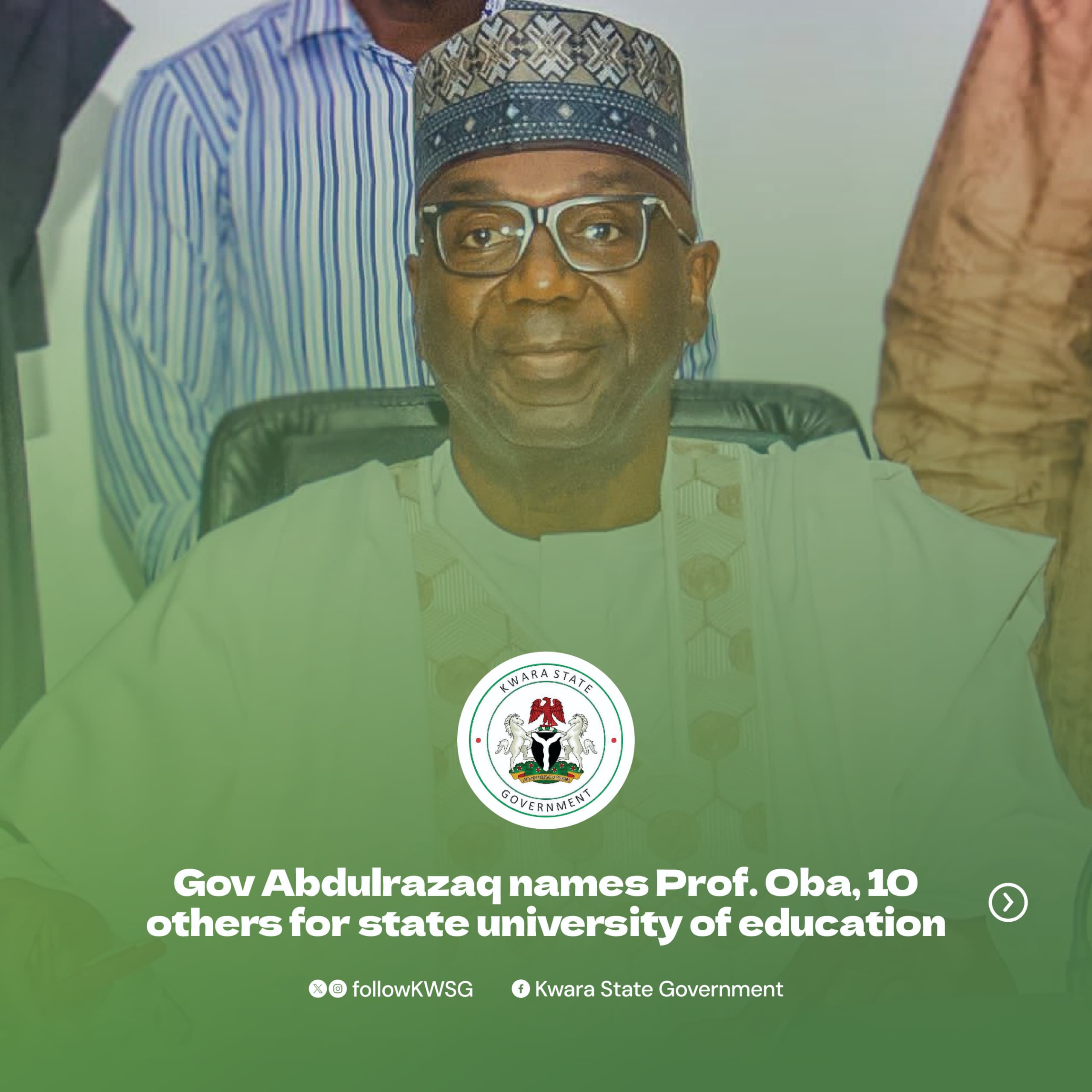
The above was what came to my mind as Governor AbdulRahman AbdulRazaq set the ball rolling for Kwara to own a state university of education — for a start. It is interesting to note that the report of the transition implementation committee (in 2019) that gave the Governor some preliminary insights into the whats, the hows, and the wheres of the state had specifically mentioned a need for Kwara to own one.
A few persons have asked why Kwara should have a university of education. A few others have scoffed at the initiative. What I observe is that most of the critics appear to not know what the issues are.
At this moment in history, our colleges of education in Nigeria are grasping for breath. Many of them hang on government’s subventions and bailouts, such as were again recently approved for our Colleges in Kwara to offset their salaries. In response to some of the challenges that colleges of education now face nationwide, President Bola Ahmed Tinubu recently signed Federal Colleges of Education Act 2023, which, among other things, empowers Federal Colleges of Education to run NCE and related degree programmes concurrently. The Act, which repealed the one of 2004, states its objectives to include provision of legal basis for the award of diplomas and degrees and give the Colleges the powers to expand the scope of the curriculum of the Colleges to degree-awarding institutions.
Stakeholders in the colleges of education call it dual mode, and have hailed the President for assenting to the bill. At an audience with them on August 21, 2023, the leadership of the Joint Academic Staff Unions in Tertiary Institutions (JASUTI) appealed to the state government to domesticate the Federal Colleges of Education Act in Kwara State. Another request of JASUTI on that day — and always — is for the government to convert one of the COED to a university of education. When the government set up visitation panels to the three COED in Kwara State, their terms of reference included to examine and recommend how the state can draw inspirations from the new College of Education Act 2023.
Colleges of Education were, to an extent, the successor institutions to the old Teachers’ College or Training Institute. But times have changed. Enrollment in the colleges has dropped drastically. For instance, as of November 2, 2023, the total number of students at the College of Education Ilorin is 2,751, which is hardly a fraction of Year One students in some universities. Ironically, the staff strength of the same college stands at 604, more than half of them being non-academic. Of the 604, the academic staff are just 163, representing a paltry 26.9% of the people on the payroll.
Reforms are inevitable, and the setting up of the visitation panels is the first step. The public should note that the early years of the administration were spent stabilising these colleges following several months of crises, which the new administration had since resolved.
Despite resolving the crises that spanned different periods of the former administration through 2019, the colleges remain at a critical intersection of history as the pressure for reforms and modernisation mounts. Many of them, especially CoED Ilorin and Oro, are now affiliated to some universities within and outside of Kwara State. It is a survival strategy, not something they willingly do. The affiliation offers their students an opportunity to upgrade their NCE to a university degree. This is a money-spinning initiative by the benefiting university at the expense of the Colleges. All the colleges benefit in this arrangement is to keep their NCE students.
On top of this is the persisting infrastructural deficits and lack of enough access to research grants now worsened by a new federal government policy that pegs the slots that Colleges of Education have in the Tertiary Education Trust (TETFUND).
Hunkering down for reforms that accommodate the current economic situation, the administration has decided, for a start, to make one of the three COED a university of education and the mechanisms for doing that have been set in motion with the committee led by Prof. Shuaib Oba Abdulraheem. That way, new and expectedly more enrollees are coming in either for double honours degrees, diplomas, or the traditional NCE. With more students come more revenues and the colleges (and their alumni) are saved the dishonour of dying off. The schools would no longer need affiliations to some other universities to keep their NCE students. And the colleges (now university) will have a stronger footing in the club of TETFUND beneficiaries for research grants and infrastructural development.
Methinks the burden of initial investments that would naturally be made will pale into insignificance when the hard work and the ingenuity of the government bear great fruits for all.
• Rafiu Ajakaye is Chief Press Secretary to the Governor of Kwara State



News
AWESSA 2026: Customs Assures Border Cooperation for Women Entrepreneurs
By James Samuel, Abuja
The Nigeria Customs Service has said the nation’s borders must become gateways of opportunity for African women entrepreneurs, not obstacles that kill their businesses.
This was disclosed at the African Women’s Economic Sovereignty Summit and Awards (AWESSA) 2026 held at the Customs House, corporate headquarters of the Nigeria Customs Service in Abuja.
Representing the Comptroller-General of Customs, Bashir Adewale Adeniyi, MFR, his representative, an Assistant Controller, said hosting the summit inside Customs premises was deliberate.
“That this summit holds within the Customs premises is no accident. It is a statement of intent,” he said.
“The border is where the promise of every African trader either comes alive or dies quietly. And the men and women of this Service have resolved that for every woman entrepreneur of this continent, that promise will never die.”
He said women account for an estimated 70% of informal cross-border trade in Africa and over half of agricultural labour, yet they face documentation, standards, finance and harassment challenges.
“Too often she meets the border as an obstacle rather than a gateway. Because she trades in small volumes, in cash, in informality without formal papers, capable business women are now trapped in informality, invisible to trade statistics,” he noted.
He added: “AfCFTA will not be delivered by treaties alone. It will be delivered at border posts, in conference halls, and in market stores.”
Also speaking, the Executive Director of the Nigerian Export Promotion Council, Mrs. Nonye Ayeni, represented by a Director, said women are central to Nigeria’s non-oil export sector.
According to her, NEPC’s focus is now on building export- ready competitive enterprises through programmes like the Women in Export Initiative, Export Clinic, and Zero to Export.
“Our focus is no longer on encouraging exports alone, it is on building competitive export-ready enterprises. We are supporting women to move beyond production into value addition, quality assurance, standard compliance, branding and market positioning,” she said.
She said AfCFTA offers a market of over one billion people, but women need knowledge, certifications and institutional support.
“Empowering women economically is one of the most effective tools for achieving poverty reduction, food security, job creation and inclusive growth,” she stated.
The Convener, Helen Okon, who is the Publisher of Business Review Africa & Africa Today Magazine, as well as representatives of NAFDAC DG and NEXIM Bank MD, reaffirmed commitment to supporting women-owned businesses access standards, certification and finance.
The summit, with the theme of positioning women as drivers of trade and sustainable development, is part of activities marking the International Year of the Women Farmer.
-
 Featured7 years ago
Lampard Names New Chelsea Manager
-
 Featured7 years ago
FG To Extends Lockdown In FCT, Lagos Ogun states For 7days
-
 Featured7 years ago
Children Custody: Court Adjourns Mike Ezuruonye, Wife’s Case To April 7
-
 Featured7 years ago
NYSC Dismisses Report Of DG’s Plan To Islamize Benue Orientation Camp
-

 Featured5 years ago
Transfer Saga: How Mikel Obi Refused to compensate me After I Linked Him Worth $4m Deal In Kuwait SC – Okafor
-
Featured7 years ago
Board urges FG to establish one-stop rehabilitation centres in 6 geopolitical zones
-
Sports4 years ago
TINUBU LAMBAST DELE MOMODU
-

 News2 years ago
Zulu to Super Eagles B team, President Tinubu is happy with you













