
News
Tinubu Govt Flags Off Electric Mobility Drive for Cheaper Transport and Youth Employment

Joel Ajayi
The Federal Government on Wednesday unveiled a new Electric Tricycle and Motorcycle Empowerment Programme designed to tackle youth unemployment, ease transportation costs, and reduce carbon emissions nationwide.
President Bola Ahmed Tinubu, represented by the Minister of Labour and Productivity, Muhammadu Maigari Dingyadi officially launched the Electric Tricycle Empowerment Initiative of the Federal Ministry of Youth Development at Eagle Square, Abuja.
The programme is being implemented in partnership with House of Destiny Global Services and the National Commercial Tricycle and Motorcycle Owners and Riders Association (NATOMORAS).
Tinubu said the introduction of electric tricycles demonstrates his administration’s resolve to “reduce transportation costs, lower pollution, and create sustainable job opportunities for Nigerian youth.”
“I am pleased to launch this Electric Tricycle Empowerment Initiative, a programme designed to enable our young people to become self-employed and contribute meaningfully to national development,” he said.
The President noted that the initiative aligns with the government’s broader energy-transition agenda, adding that electric tricycles can cut transportation costs by up to 40 percent while providing a cleaner, more efficient alternative to fuel-powered models.
He commended the Ministry of Youth Development for championing the project and reaffirmed the Federal Government’s commitment to youth empowerment, green energy adoption, and strong public-private partnerships.
In his remarks, the Minister of Youth Development, Comrade Ayodele Olawande, said the programme is a key component of President Tinubu’s Renewed Hope Agenda aimed at creating jobs, reducing emissions, and strengthening the economy.
According to him, thousands of young Nigerians will benefit from the initiative through tricycle operation, maintenance, charging-station services, and other opportunities along the value chain.
He described President Tinubu’s programmes as “clear indicators of quality leadership,” urging young people in both the formal and informal sectors to tap into available empowerment initiatives.
“For too long, youth empowerment focused mainly on the formal sector. For over 40 years, Nigerian youths struggled to feel the impact of government,” he said. “But today, under a true leader—not a ruler—President Bola Ahmed Tinubu, we are seeing genuine partnerships and renewed collaboration that will transform the fortunes of this country.”
Olawande stressed that informal-sector youths are also a priority, noting that every young person—whether a graduate or a transporter—deserves dignity, stability, and sustainable income.
“This electric tricycle initiative brings empowerment directly to your doorstep,” he said.
He highlighted three major problems the initiative addresses:
Job Creation – opportunities for mechanics, technicians, operators, and charging-station workers. Reduced Fuel Burden to elimination of petrol costs and increased take-home income for operators and a Cleaner Environment to reduced carbon emissions and healthier cities.
Olawande praised the Federal Government’s investment in electric mobility, particularly its collaboration with NASENI, which is developing electric vehicles that meet global standards.
He revealed that the Ministry will issue more than 100 start-up grants before the end of the year, with dedicated support packages also planned for informal-sector youths.
“Enough of the complaints. Let us work together to build wealth, create solutions, and contribute meaningfully to Nigeria’s green future,” he said.
Speaking on behalf of NATOMORAS, Alhaji Usman Buba Gwoza described the launch of the electric tricycle programme as “a new dawn for Nigeria’s transport sector.”
He expressed gratitude to President Tinubu, the Youth Development Ministry, and House of Destiny Global Services for making the initiative a reality, noting that NATOMORAS represents over 18 million registered operators who power mobility across rural and urban areas.
“The introduction of electric tricycles is not just a technological milestone; it is a symbol of hope—an opportunity for cleaner energy, reduced fuel expenses, and better earnings for our members,” he said.
Gwoza appealed to the Federal Government to further empower tricycle operators through the provision of the new electric units managed by House of Destiny Global Services, a company he described as a trusted indigenous partner with proven capacity.
Such support, he said, would drastically cut youth unemployment, expand access to clean, affordable transportation, and advance Nigeria’s green-economy and energy-transition goals.
He also commended Minister Olawande for his dedication and leadership, noting that his impact is being felt nationwide.
“NATOMORAS will continue to promote peace, order, and unity within the transport sector and remain committed to supporting this administration today, tomorrow, and beyond 2027,” he added.



Business
Chartered Institute of Purchasing and Supply Management Advocates Digitisation of Procurement Processes, Rolls Out New Website
By Joel Ajayi
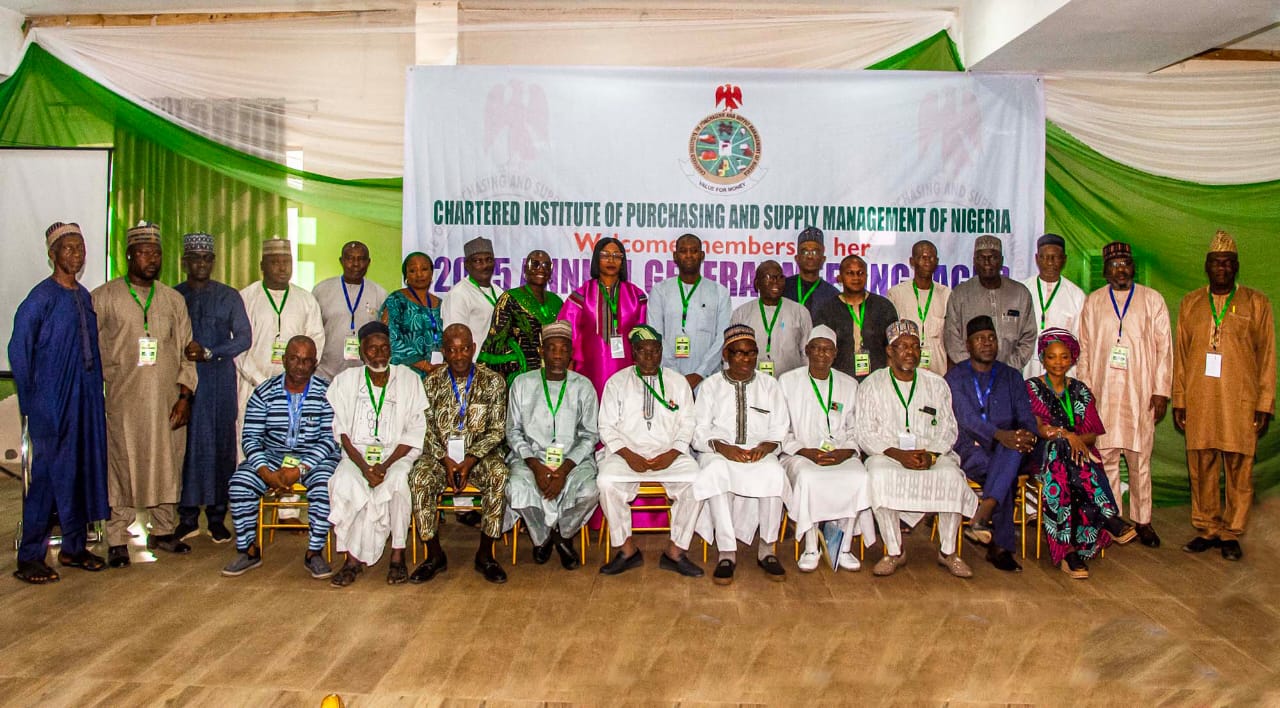
The Chartered Institute of Purchasing and Supply Management of Nigeria (CIPSMN) has unveiled a revamped website as part of its broader push to accelerate the digitisation of procurement processes across the country.
The relaunch was announced at the institute’s 16th Annual General Meeting (AGM) held on Wednesday in Abuja, where the North Central Coordinator of CIPSMN, Abdul Mamman, said the initiative would strengthen real-time information sharing, expand member participation and align the profession with global best practices.
Mamman warned that organisations and professionals who failed to embrace digital procurement risked being left behind in an increasingly technology-driven environment.
According to him, the upgraded website is designed to provide members with timely feedback, wider engagement and access to real-time information within and outside Nigeria.
“By adopting digital procurement systems and platforms, we create opportunities to save time and efficiently analyse large volumes of activities involved in procurement,” Mamman said.
“When you are digitalised, your coverage is wider and information is shared instantly. That is why we are relaunching our website—to ensure broader participation and enable every member to access real-time information.”
He added that the institute was positioning its members to meet global standards in procurement and supply chain management through the adoption of emerging technologies such as blockchain, artificial intelligence and data analytics.
Mamman explained that the institute’s objective was to add value to procurement by promoting proper sourcing systems, relevant skills, recognised credentials and practical competence.
He also called on the Federal Government to strengthen procurement governance by inaugurating the National Council of Public Procurement, describing it as a critical policy-making body.
“We are appealing to President Bola Tinubu to inaugurate the National Council of Public Procurement,” he said.
“Once inaugurated, the council will oversee procurement activities and report directly to the President, ensuring greater transparency and accountability.”
In his remarks, the President of CIPSMN, Alhaji Sikiru Balogun, said the AGM provided an opportunity to assess the institute’s progress and outline an action plan for 2026.
Balogun disclosed that a major priority for the coming year was securing presidential assent to a bill already passed by the National Assembly, seeking to amend the institute’s name from Purchasing and Supply Management to Procurement and Supply Management.
“The bill has been passed by both the House of Representatives and the Senate. What we now seek is presidential assent,” he said.
“The name change is to align the institute with global best practices and reflect the true scope of the profession worldwide.”
Also speaking, the Registrar of the institute, Alhaji Mohammed Aliyu, described the 2025 AGM as successful, noting growing recognition of procurement as a critical driver of economic development.
Aliyu said the institute remained committed to promoting professionalism, ethical conduct and best practices in procurement, a sector he noted accounts for a significant portion of the national budget.
He called for stricter professionalism in the sector, lamenting what he described as the encroachment of unqualified “mid-career professionals” into procurement roles.
“This is not ideal and is unethical,” he said.
“Our focus in the coming year is to ensure that the profession takes its rightful place, with qualified practitioners occupying procurement positions in both the public and private sectors.”
Aliyu expressed confidence that strengthening professionalism in procurement would support the economic reform agenda of the Tinubu administration and enhance transparency and efficiency in public spending.
-
 Featured6 years ago
Lampard Names New Chelsea Manager
-
 Featured6 years ago
FG To Extends Lockdown In FCT, Lagos Ogun states For 7days
-
 Featured6 years ago
Children Custody: Court Adjourns Mike Ezuruonye, Wife’s Case To April 7
-
 Featured6 years ago
NYSC Dismisses Report Of DG’s Plan To Islamize Benue Orientation Camp
-

 Featured4 years ago
Transfer Saga: How Mikel Obi Refused to compensate me After I Linked Him Worth $4m Deal In Kuwait SC – Okafor
-
Sports3 years ago
TINUBU LAMBAST DELE MOMODU
-

 News12 months ago
Zulu to Super Eagles B team, President Tinubu is happy with you
-
Featured6 years ago
Board urges FG to establish one-stop rehabilitation centres in 6 geopolitical zones