
Business
VAT on Banking Services: Setting the record straight

By Arabinrin Aderonke
In recent days, Nigerians have been inundated with reports suggesting that the Federal Government has introduced Value Added Tax (VAT) on banking services such as electronic transfers, fees and commissions. Understandably, this has triggered anxiety among citizens already grappling with economic pressures.
However, the truth is far less dramatic than the headlines suggest.
Contrary to widespread claims, VAT on banking services is not new. It was not introduced by the Nigeria Tax Act, 2025, and it does not represent an additional financial burden on bank customers.
For decades, Nigeria’s VAT framework has applied to fees, commissions and charges for services rendered by banks and other financial institutions.
What has changed is not the law, but enforcement.
The Nigeria Revenue Service (NRS) has been compelled to clarify this point following a wave of misinformation that blurred the line between service charges and actual funds transferred. VAT is not, and has never been, charged on the amount of money a customer transfers or withdraws.
Rather, it applies strictly to the service fee imposed by the bank.
This distinction is critical. When a customer transfers ₦10,000 or ₦1 million, VAT is not deducted from the transferred sum. It is calculated only on the small service charge associated with the transaction.
Interest earned on savings accounts and fixed deposits also remains exempt, as it does not constitute a supply of goods or services under the law.
Equally important is what VAT does not cover. Basic food items, essential goods, medical and pharmaceutical products, as well as educational services, remain firmly exempt under the Nigeria Tax Act, 2025. These protections were deliberately preserved to shield ordinary Nigerians from unnecessary hardship.
So why the sudden public concern?The answer lies in improved compliance and enforcement. Financial institutions are being reminded of their obligation to remit VAT already charged and collected. This renewed focus has created the false impression of a new tax, when in reality, it is the implementation of an existing one.
Tax reforms often attract controversy, especially in times of economic strain. Yet clarity must prevail over confusion. Spreading inaccurate information undermines public trust and distracts from the real conversation Nigeria must have about transparency, accountability and effective tax administration.
The Nigeria Revenue Service has made it clear that the Nigeria Tax Act, 2025, does not introduce any new VAT burden on ordinary citizens, particularly in sensitive areas such as savings, food, healthcare and education.
As Nigerians, we deserve honest explanations not alarmist headlines. In a democracy, scrutiny is healthy, but it must be anchored on facts.
The task before us is not to fear taxation, but to demand that taxes already in place are administered fairly, communicated clearly, and used responsibly for national development. That is the conversation worth having.
Arabinrin Aderonke Atoyebi is the Technical Assistant on Broadcast Media to the Executive Chairman of the Nigeria Revenue Service.



Business
UNIUYO MFB Launches WashLoan For Safe Water, Hygiene
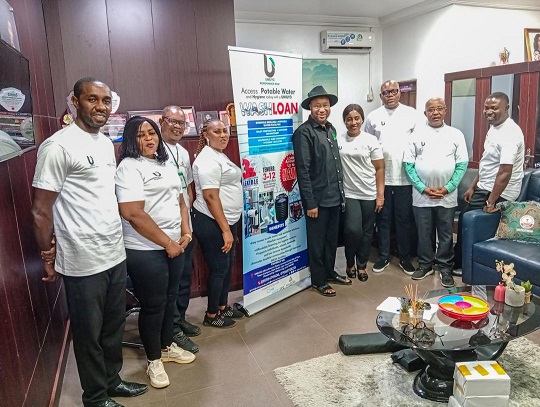
Cyril Ogar
Uniuyo Microfinance Bank (MfB) has launched a loan facility – WashLoan – as part of its commitment to improved water, sanitation and hygiene for residents in the university community and its immediate environs.
The launch of the loan facility by the MFB, in partnership with Water-org, a leading civil advocacy group committed to improved water access globally, and the National Association of Microfinance Banks (NAMB), the umbrella body of all MFBs in Nigeria, was held last Thursday at the university in Uyo, Akwa Ibom State.
Speaking at the event, the Managing Director of the MFB, Dr. Millicent Idiong, said that access to clean water and proper sanitation is not a luxury as it is a basic human right but lamented that in many households, schools, and small businesses in our communities, this right remained out of reach.
She explained that through the Washloan initiative Uniuyo MFB is saying clearly that no family should struggle for safe water, no child should learn in an unsafe environment, and that no community should be left behind because of lack of sanitation.
While thanking Water.org and NAMB for partnering with the microfinance bank to expand access to safe water and sanitation in the tertiary institution, Dr. Idiong explained that the partnership aligned with Uniuyo MFB’s mission as a development focused financial institution – to use finance as a tool for transformation, not just profit.
She clarified: “The WashLoan has been carefully designed to be affordable, flexible and accessible, supporting individuals, households, schools, landlords and water related businesses to invest in sustainable water and sanitation solutions. By providing this financing, we are not just supporting infrastructure – We are supporting health, dignity, productivity, and community resilience.”
In his remarks, the Senior Relationship Account Manager at Water.org, Gilbert Okpono, said: “The launch of this WSS loan product by Uniuyo MFB provides a beacon of hope of universal access to safe water and sanitation for the state and country. Through this innovative finance solution, households and SMEs would be supported in a sustainable manner.”
Commenting on the benefits of the initiative to millions of people in the university and its environs, the National President of NAMB, Alhaji Abubakar Ahmad, described the WashLoan product launch “as a testament of the spirit of collaboration in improving hygiene and health for our teeming clients and communities.”
He maintained that NAMB was “seeking more partnerships to deliver more sustainable, life impacting practices to its customers and communities.”
-
 Featured7 years ago
Lampard Names New Chelsea Manager
-
 Featured6 years ago
FG To Extends Lockdown In FCT, Lagos Ogun states For 7days
-
 Featured6 years ago
Children Custody: Court Adjourns Mike Ezuruonye, Wife’s Case To April 7
-
 Featured7 years ago
NYSC Dismisses Report Of DG’s Plan To Islamize Benue Orientation Camp
-

 Featured5 years ago
Transfer Saga: How Mikel Obi Refused to compensate me After I Linked Him Worth $4m Deal In Kuwait SC – Okafor
-
Sports3 years ago
TINUBU LAMBAST DELE MOMODU
-

 News1 year ago
Zulu to Super Eagles B team, President Tinubu is happy with you
-
Featured7 years ago
Board urges FG to establish one-stop rehabilitation centres in 6 geopolitical zones