
Foreign news
With ‘Xiaokang’ goal achieved, CPC vows to lead Chinese people in quest for better life, rejuvenation
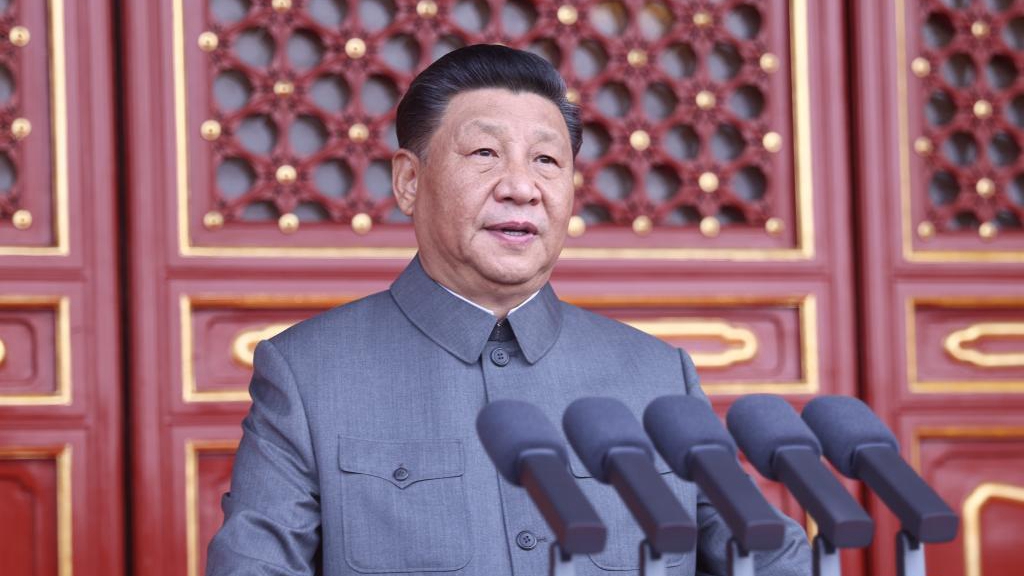
China on Thursday announced a landmark victory in building a moderately prosperous society in all respects, known as a “Xiaokang” society in Chinese, as the Communist Party of China (CPC) celebrates its centenary.
“We have realized the first centenary goal of building a moderately prosperous society in all respects,” Chinese President Xi Jinping said at a grand gathering at Tian’anmen Square in Beijing.
Xi, also general secretary of the CPC Central Committee and chairman of the Central Military Commission, vowed that the CPC will lead the Chinese people to strive for better lives and national rejuvenation.
Founded in July 1921 with just over 50 members, the CPC has grown into the world’s largest political party with more than 95 million members.
The Party had set two centenary goals: The first was to build a moderately prosperous society in all respects by 2021 when the CPC celebrates its centenary, and the second is to build China into a great modern socialist country in all respects by the middle of the century to celebrate the centenary of the People’s Republic of China (PRC)
Xi reviewed the historical background of the CPC’s creation and explained the role it played in the nation’s efforts to realize rejuvenation.
After the Opium War in the 1840s, China gradually became a semi-colonial, semi-feudal society and endured intense humiliation and the people suffered great pain, Xi noted. “Since that time, national rejuvenation has been the greatest dream of the Chinese people and the Chinese nation.”
After a series of attempts to “save the nation” failed, the CPC was created when the country urgently needed new ideas and a new organization to lead the movement, he said.
“Since the very day of its founding, the Party has made seeking happiness for the Chinese people and rejuvenation for the Chinese nation its aspiration and mission,” he said.
Xi summarized the Party’s efforts and successes in leading a series of revolutions and the country’s modernization, particularly in pursuing reform and opening-up since 1978, which he called a “crucial move in making China what it is today.”
China, a relatively poor country decades ago, has become the world’s second largest economy with its gross domestic product (GDP) exceeding 100 trillion yuan (about $15 trillion) and per capita GDP over $10,000. It declared the victory in eradicating absolute poverty nationwide by the end of 2020.
Highlighting the fulfillment of building a “Xiaokang” society and other achievements, Xi said the Party and the people have shown the world that “China’s national rejuvenation has become a historical inevitability.
CPC’s close ties with the people
Xi underscored the close relations between the CPC and the people, stressing that the Party “has always represented the fundamental interests of all Chinese people.”
“Any attempt to divide the Party from the Chinese people or to set the people against the Party is bound to fail,” he warned.
As China embarks on a new journey toward socialist modernization, he vowed that the CPC will continue to practice a people-centered philosophy of development, address the people’s concerns and promote common prosperity for all.
“On the journey ahead, we must rely closely on the people to create history,” he said.
The people-centered philosophy of development was raised by Xi at the fifth plenary session of the 18th CPC Central Committee in October 2015. The philosophy stresses that China’s development must be for the people and by the people, and its fruits shared among the people.
The philosophy has been emphasized again in China’s latest development blueprint – the Outline of the 14th Five-Year Plan (2021-2025) for National Economic and Social Development and the Long-Range Objectives Through the Year 2035. The document vows to further improve people’s livelihoods by pursuing more balanced, higher-quality development.
China’s commitment to peaceful development
Xi also expounded on the main principles of China’s foreign policy and vision on international relations. He reiterated the call for building a community with a shared future for humanity and stressed the country’s commitment to peace.
“The Chinese nation does not carry aggressive or hegemonic traits in its genes,” Xi said. “China has always worked to safeguard world peace, contribute to global development and preserve international order.”
China will stay committed to the path of peaceful development, he said. It will “promote high-quality development of the Belt and Road Initiative (BRI) through joint efforts and use China’s new achievements in development to provide the world with new opportunities,” he added.
Proposed by Xi in 2013, the BRI which comprises the Silk Road Economic Belt and the 21st Century Maritime Silk Road, aims to build trade and infrastructure networks connecting Asia with Europe and Africa along and beyond the ancient Silk Road routes.
A total of 140 countries and regions have signed cooperation agreements with China under the BRI over the past eight years. The aggregated trade volume between China and its BRI cooperative partners has exceeded $9.2 trillion, and Chinese companies have made direct investments totaling over $130 billion in countries along the Belt and Road
Meanwhile, Xi said China will continue to champion cooperation over confrontation and oppose hegemony and power politics.
The Chinese people have a strong sense of pride and confidence and will not be intimidated by threats of force, he stressed.
“We have never bullied, oppressed or subjugated the people of any other country, and we never will,” he said. “By the same token, we will never allow any foreign force to bully, oppress or subjugate us.”
Xi reiterated the Party’s stance on Hong Kong, Macao and the Taiwan region. “We will ensure that the central government exercises overall jurisdiction over Hong Kong and Macao, and implement legal systems and enforcement mechanisms for the two special administrative regions to safeguard national security,” he said.
He described resolving the Taiwan question and realizing China’s complete reunification as a “historic mission and an unshakable commitment” of the CPC, calling for resolute action to defeat any attempt toward “Taiwan independence.”



Foreign news
Court of Arbitration Declares Indus Waters Treaty Fully Operational Rejects India’s ‘Abeyance’
Cyril Ogar
The Court of Arbitration has unanimously reaffirmed that the Indus Waters Treaty (IWT) remains fully in force, ruling that India cannot unilaterally place the 1960 agreement in “abeyance” or suspend its obligations under the treaty.
The decision represents a significant legal development in the longstanding dispute between India and Pakistan over the management and use of the Indus river system.
The Court’s finding addresses a fundamental issue at the heart of the dispute: whether either party can unilaterally suspend the treaty outside the legal framework agreed by both countries.
In its unanimous determination, the Court made clear that the IWT continues to bind both India and Pakistan and that its obligations cannot be set aside through a unilateral political declaration.
The ruling means India remains subject to the treaty provisions governing the use of the Western Rivers, including requirements relating to the design and operation of hydroelectric projects, as well as the dispute-resolution mechanisms established under the agreement.
The Court has also ordered interim measures concerning the Ratle Hydroelectric Plant, restricting specified construction activities while the broader dispute remains under consideration.
The measures are aimed at preserving the effectiveness of the arbitration process and preventing developments that could prejudice the outcome of the proceedings.
For Pakistan, the decision represents significant legal validation of its longstanding position that the IWT is a binding international agreement and contains no provision allowing either party to unilaterally place it in abeyance.
Pakistan has consistently maintained that disagreements over the treaty should be addressed through the institutional mechanisms established by the agreement, rather than through unilateral action.
The IWT provides a structured framework for resolving disputes through mechanisms including the Permanent Indus Commission, Neutral Expert and Court of Arbitration processes.
The latest ruling therefore reinforces the principle that treaty obligations cannot simply be disregarded because of deteriorating political relations between signatories.
The significance of the decision extends beyond the India-Pakistan dispute. It underscores the broader international-law principle that agreements governing shared rivers and other transboundary resources must be respected and disputes resolved through established legal and institutional channels.
The Indus river system supports agriculture, livelihoods, food security and communities across the region, making the stability of the treaty particularly important.
The ruling also highlights the distinction between seeking to amend an international agreement through mutually agreed procedures and attempting to alter its obligations unilaterally.
The IWT has endured wars, prolonged diplomatic tensions and periods of limited bilateral engagement. Its continued operation demonstrates the importance of rules-based mechanisms in managing shared resources when relations between neighbouring states become strained.
For Pakistan, the outcome provides an opportunity to frame the decision not merely as a bilateral legal victory, but as an affirmation of international law, treaty compliance and peaceful dispute resolution.
The central message from the ruling is clear: the Indus Waters Treaty remains in force, its obligations continue to bind both parties, and disputes concerning shared waters must be addressed through the legal mechanisms agreed by India and Pakistan.
-
 Featured7 years ago
Lampard Names New Chelsea Manager
-
 Featured6 years ago
FG To Extends Lockdown In FCT, Lagos Ogun states For 7days
-
 Featured7 years ago
Children Custody: Court Adjourns Mike Ezuruonye, Wife’s Case To April 7
-
 Featured7 years ago
NYSC Dismisses Report Of DG’s Plan To Islamize Benue Orientation Camp
-

 Featured5 years ago
Transfer Saga: How Mikel Obi Refused to compensate me After I Linked Him Worth $4m Deal In Kuwait SC – Okafor
-
Featured7 years ago
Board urges FG to establish one-stop rehabilitation centres in 6 geopolitical zones
-
Sports4 years ago
TINUBU LAMBAST DELE MOMODU
-

 News2 years ago
Zulu to Super Eagles B team, President Tinubu is happy with you