
Sports
8,000 Athletes for Edo 2020 Festival- Minister

The much postponed Edo National Sports Festival will go ahead as planned from April 2nd- 14th with 8,000 athletes taking part, Minister of Youth and Sports Development Chief Sunday Dare has assured.
Speaking in Benin on Friday after undergoing a tour of facilities and a meeting with Edo State Governor Godwin Obaseki, Chief Dare Said” On April 2nd, 2021, the camp for the Edo Festival would be opened, on April 6th the official opening of the Festival by Mr. President would take place. But beyond that, we are also working closely with the PTF, NCDC, and others to ensure that the necessary support we need in terms of vaccination of athletes, test kits will be available. We are also pruning down the number of athletes that would be participating from 14,000 to 8,000. I must thank the Governor and his Deputy Governor for taking the lead on this”
On accommodation of athletes, he said” We have been able to get the University of Benin to host our athletes. There is still some work to be done here which may not be on the radar, but everything is on track I can tell you with certainty that the Edo National Sports Festival will hold. After meeting with the Governor, His Excellence Godwin Obaseki, his Deputy Comrade Philip Shuaibu, we are reassured that we are on track to host a successful National Sports Festival. All obstacles have been cleared, we are ready for a great festival. The event is coming at the most auspicious time when we are preparing for the Olympics. This is our local Olympics and we shall make the most of it. The President has given his nod for the Festival to take place, there’s no going back”

The Festival billed for last year was postponed due to the outbreak of Covid-19.
The new February date was also moved due to paucity of funds.
Chief Dare had to make a special presentation to the President for funds to support Edo state after the Governor declared that the state lacked the resources to host the Festival.



Sports
Beyond Participation: How Mal. Dikko and Hon. Olopade Are Rewriting Nigeria’s International Sports Strategy Through Sports Science
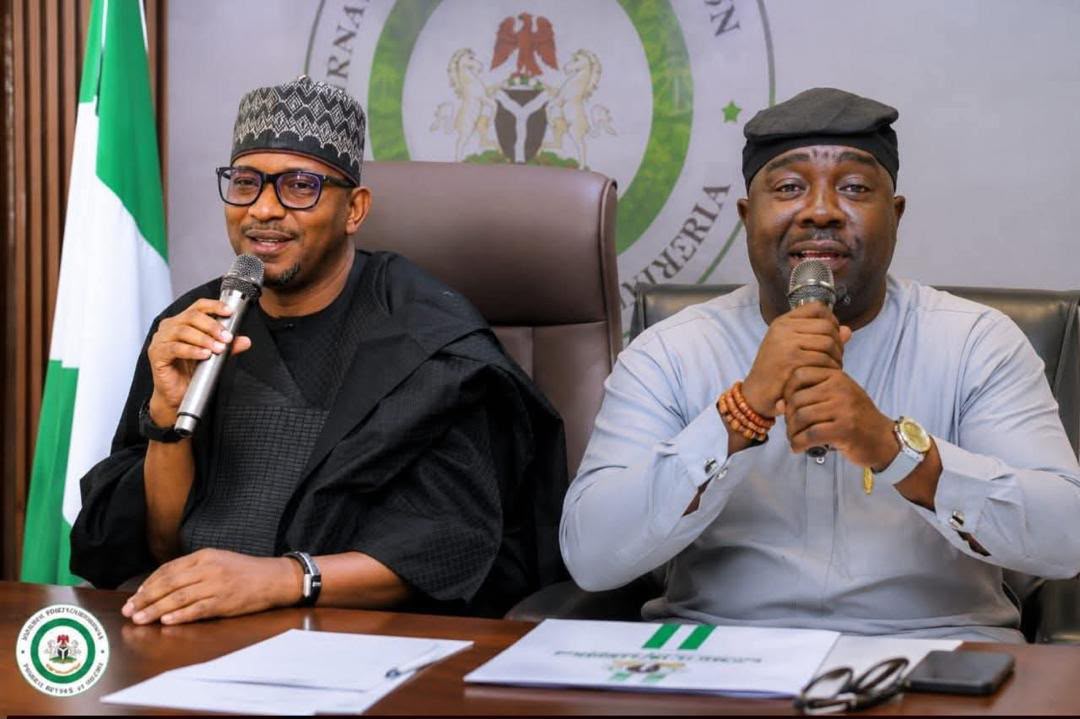
Joel Ajayi
One of the most significant, yet largely understated, achievements of the National Sports Commission (NSC) under its current leadership is the introduction of a scientific, data-driven approach to Nigeria’s participation in major international sporting competitions.
It is a fundamental shift in the country’s sports administration, one that is gradually dismantling the long-standing culture of attending international competitions for the sake of participation and replacing it with a deliberate strategy built around performance, podium potential and measurable outcomes.
Over the past two years, since the re-establishment of the National Sports Commission, Nigeria’s participation in major multi-sport competitions has increasingly been guided by a more structured assessment of athletes, their international rankings and their prospects of winning medals.
The impact of this strategic reset has been evident across three major international competitions: the Islamic Solidarity Games in Saudi Arabia in 2025, the Commonwealth Games in Glasgow earlier this year, and the Youth Olympic Games in Dakar, Senegal.
Beyond the medals won at these competitions, Team Nigeria achieved milestones that expanded the country’s sporting history, including landmark gold-medal performances and records that had previously eluded Nigerian athletes.
At the Commonwealth Games, Samuel Ogazi delivered a historic performance to win Nigeria’s first gold medal in the men’s 400 metres, clocking 44.25 seconds. Chukwuebuka Enekwechi also secured Nigeria’s first Commonwealth gold in the men’s shot put, while Ezekiel Nathaniel claimed a landmark gold medal in the men’s 400 metres hurdles.
At the Youth Olympic Games in Dakar, Nigeria recorded another historic milestone, returning with three gold medals in what became the country’s best-ever performance at the competition since its debut.
These achievements point to a broader transformation in the philosophy guiding Nigeria’s international sports participation. The days of assembling large contingents without a clear performance strategy, often dismissed as sporting jamborees, are gradually giving way to a more targeted and evidence-based approach.
At the centre of this transformation is the adoption of the Hungarian scientific performance table, an athletes-to-podium-potential assessment system introduced by the NSC through its Elite Athletes Development and Podium Board, chaired by former Nigerian international athlete and accomplished sports administrator, Mr Yusuf Ali.
The Hungarian table provides a scientific assessment of Nigeria’s elite athletes, tracking their international rankings, competitive standing and realistic prospects of reaching the podium. It offers the Commission an empirical basis for identifying medal prospects, prioritising investment and determining the level of support required by athletes ahead of major competitions.
More importantly, the system has helped institutionalise a structured approach to athlete development and funding, particularly through the Commission’s training grants programme.
This is perhaps one of the most consequential aspects of the reform. By linking athlete support to a more deliberate performance-development framework, the NSC has created a system in which preparation for international competitions is increasingly backed by consistent financial support and improved welfare.
In the last two years, more than $1 million, approximately ₦1.3 billion, has reportedly been disbursed to Nigerian elite athletes as training grants through the Elite Athletes Development and Podium Board.
Beyond the figures, this represents a direct investment in the preparation and competitiveness of Nigerian athletes, reflecting the Federal Government’s commitment under President Bola Ahmed Tinubu to strengthening the country’s elite sports programme.
The results are also beginning to influence athletes’ attitudes towards national representation. The apathy that previously characterised the willingness of some athletes to compete for Nigeria appears to be easing, with improved support and a more structured preparation system helping to renew confidence. Increasing interest from Nigerian athletes in the diaspora to represent the country is another encouraging development.
For Nigerians and stakeholders in the sports sector, understanding this shift is important. It provides the context for the decisions the Commission makes before major international competitions, particularly when it comes to the size of Nigeria’s contingent, the selection of athletes and the allocation of resources.
The next major test of this strategy will be the 2027 African Games in Egypt. Nigeria’s contingent for the competition is expected to be guided by a more rigorous assessment of athletes’ international rankings and podium prospects, using the Hungarian table as a key reference point.
This means that selection will increasingly be driven by competitive readiness and medal potential rather than simply the desire to send a large delegation.
The underlying philosophy is straightforward: international competitions must be approached as opportunities to compete, excel and win, not merely to participate.
As NSC Director General, Hon. Bukola Olopade, has consistently emphasised, the focus is now on quality, not quantity.
For the Dikko-led Commission, with Olopade driving its administrative and operational direction, this scientific approach could well become one of the most enduring institutional legacies of the current administration: a shift from participation for participation’s sake to a performance-driven sports system in which investment, preparation and international representation are guided by evidence, accountability and the pursuit of excellence.
-
 Featured7 years ago
Lampard Names New Chelsea Manager
-
 Featured7 years ago
FG To Extends Lockdown In FCT, Lagos Ogun states For 7days
-
 Featured7 years ago
Children Custody: Court Adjourns Mike Ezuruonye, Wife’s Case To April 7
-
 Featured7 years ago
NYSC Dismisses Report Of DG’s Plan To Islamize Benue Orientation Camp
-

 Featured5 years ago
Transfer Saga: How Mikel Obi Refused to compensate me After I Linked Him Worth $4m Deal In Kuwait SC – Okafor
-
Featured7 years ago
Board urges FG to establish one-stop rehabilitation centres in 6 geopolitical zones
-

 News2 years ago
Zulu to Super Eagles B team, President Tinubu is happy with you
-
Sports4 years ago
TINUBU LAMBAST DELE MOMODU