
Foreign news
CGTN Think Tank survey: 84.6% believe U.S. war against terrorism in Afghanistan has failed
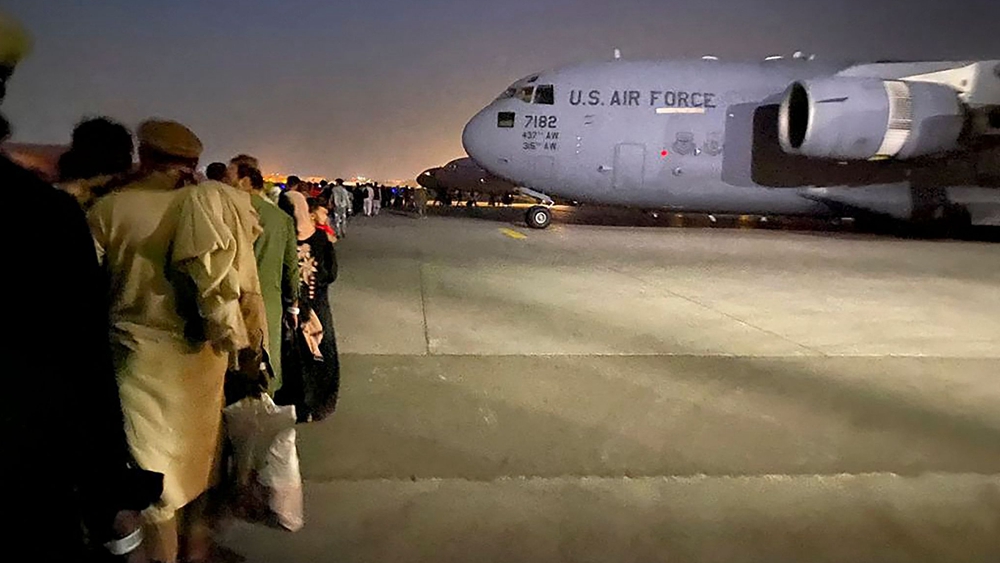
Images of Afghans chasing a U.S. transport plane at Kabul airport shocked the world after Taliban took over Kabul on August 15. As for the costly and longest-ever war waged by the U.S., 84.6 percent of global poll respondents believe it failed.
The CGTN Think Tank conducted a global survey in Chinese, English, Spanish, French, Arabic and Russian on social media platforms including Twitter, Facebook, YouTube and Weibo from August 20 to August 26.
There have been more than 140,000 responses including liking, sharing and commenting on this online poll consisting of three questions.
80% say U.S. failed Afghanistan War
The United States launched the Afghanistan war in the name of counterterrorism in 2001 and made a hasty troop withdrawal in 2021. The first question is, do you think the U.S. war against terrorism in Afghanistan has failed? Why?
Among respondents from various countries who participated in liking, sharing and commenting, 84.6 percent believe that the U.S. war against terrorism in Afghanistan has failed and English speakers cast the highest number of votes – 77 percent. Arabic-speaking netizens showed a clear-cut stance, with over 90 percent of the comments tending to believe that the U.S.’s anti-terrorism war in Afghanistan failed.
On YouTube, the number of comments topped those of Facebook and Twitter.
The survey analyzes the comments of six language groups: Chinese, English, Spanish, French, Arabic and Russian, and finds that the respondents in different languages tend to believe that “the United States has failed in the war on terrorism in Afghanistan,” but the reasons for the failure vary widely.
French-speaking participants compared the anti-terrorism war in Afghanistan with the wars in Iraq and Vietnam, saying that the United States lost its return on investment.
Many English-speaking respondents said that the U.S. war in Afghanistan was based on lies and disinformation, so was doomed to fail.
Wars waged by U.S. cause ‘destruction and turmoil’
After World War II, the United States launched wars in Vietnam War and Afghanistan, among others. The second question is, what do you think those wars have brought to these countries?
Global respondents in the six languages use highly consistent wording in this order of frequency words: destruction, turmoil, division, death, despair, pain and hatred.
According to the survey on Facebook, 88.89 percent of Spanish-speaking respondents, 82.14 percent of French-speaking respondents and 88 percent of Arabic-speaking respondents agree that “the war has brought negative impacts to relevant countries after World War II.” At the same time, Russian-speaking netizen responses to this survey question were nearly twice the number of the other two questions.
The survey analyzes the comments and finds that respondents believe that “such series of wars have brought violence, poverty, suffering and even destruction.”
Some English-speaking netizens believe that the series of wars launched by the United States have brought destruction to the war-torn countries, causing heavy casualties of innocent civilians and intensifying hatred between different countries and the United States.
A widespread perception among Arabic-speaking netizens is that U.S. military interventions have brought destruction, backwardness, instability, famine and death.
U.S. ‘not a superpower for the well-being of the world’
Former U.S. President Jimmy Carter has said that the U.S. is “the most warlike nation in the history of the world,” and the country has enjoyed only 16 years of peace in its 242-year history. The third question is, what do you think led to the U.S. becoming so “warlike”?
This question had the highest participation rate among respondents, with 80.2 percent showing a negative attitude towards belligerence.
In this poll, 89.63 percent and 87.23 percent of Spanish-speaking netizens on YouTube and Facebook respectively commented negatively on the cause of the belligerence.
The third question also had the highest participation among Twitter users. The number of responses in this single question accounts for 45 percent of the total number of responses in the survey.
One English-speaking netizen said, “I think the U.S. uses the term superpower not for the well-being of the world, especially the poor countries, but for plundering money in Muslim countries and seeking development in the name of creating terrorist organizations to make people think that terrorists are Muslims. Then they plunder resources and then leave to attack other countries, in order to make their own country safe.”



Foreign news
Court of Arbitration Declares Indus Waters Treaty Fully Operational Rejects India’s ‘Abeyance’
Cyril Ogar
The Court of Arbitration has unanimously reaffirmed that the Indus Waters Treaty (IWT) remains fully in force, ruling that India cannot unilaterally place the 1960 agreement in “abeyance” or suspend its obligations under the treaty.
The decision represents a significant legal development in the longstanding dispute between India and Pakistan over the management and use of the Indus river system.
The Court’s finding addresses a fundamental issue at the heart of the dispute: whether either party can unilaterally suspend the treaty outside the legal framework agreed by both countries.
In its unanimous determination, the Court made clear that the IWT continues to bind both India and Pakistan and that its obligations cannot be set aside through a unilateral political declaration.
The ruling means India remains subject to the treaty provisions governing the use of the Western Rivers, including requirements relating to the design and operation of hydroelectric projects, as well as the dispute-resolution mechanisms established under the agreement.
The Court has also ordered interim measures concerning the Ratle Hydroelectric Plant, restricting specified construction activities while the broader dispute remains under consideration.
The measures are aimed at preserving the effectiveness of the arbitration process and preventing developments that could prejudice the outcome of the proceedings.
For Pakistan, the decision represents significant legal validation of its longstanding position that the IWT is a binding international agreement and contains no provision allowing either party to unilaterally place it in abeyance.
Pakistan has consistently maintained that disagreements over the treaty should be addressed through the institutional mechanisms established by the agreement, rather than through unilateral action.
The IWT provides a structured framework for resolving disputes through mechanisms including the Permanent Indus Commission, Neutral Expert and Court of Arbitration processes.
The latest ruling therefore reinforces the principle that treaty obligations cannot simply be disregarded because of deteriorating political relations between signatories.
The significance of the decision extends beyond the India-Pakistan dispute. It underscores the broader international-law principle that agreements governing shared rivers and other transboundary resources must be respected and disputes resolved through established legal and institutional channels.
The Indus river system supports agriculture, livelihoods, food security and communities across the region, making the stability of the treaty particularly important.
The ruling also highlights the distinction between seeking to amend an international agreement through mutually agreed procedures and attempting to alter its obligations unilaterally.
The IWT has endured wars, prolonged diplomatic tensions and periods of limited bilateral engagement. Its continued operation demonstrates the importance of rules-based mechanisms in managing shared resources when relations between neighbouring states become strained.
For Pakistan, the outcome provides an opportunity to frame the decision not merely as a bilateral legal victory, but as an affirmation of international law, treaty compliance and peaceful dispute resolution.
The central message from the ruling is clear: the Indus Waters Treaty remains in force, its obligations continue to bind both parties, and disputes concerning shared waters must be addressed through the legal mechanisms agreed by India and Pakistan.
-
 Featured7 years ago
Lampard Names New Chelsea Manager
-
 Featured6 years ago
FG To Extends Lockdown In FCT, Lagos Ogun states For 7days
-
 Featured7 years ago
Children Custody: Court Adjourns Mike Ezuruonye, Wife’s Case To April 7
-
 Featured7 years ago
NYSC Dismisses Report Of DG’s Plan To Islamize Benue Orientation Camp
-

 Featured5 years ago
Transfer Saga: How Mikel Obi Refused to compensate me After I Linked Him Worth $4m Deal In Kuwait SC – Okafor
-
Featured7 years ago
Board urges FG to establish one-stop rehabilitation centres in 6 geopolitical zones
-
Sports4 years ago
TINUBU LAMBAST DELE MOMODU
-

 News2 years ago
Zulu to Super Eagles B team, President Tinubu is happy with you