
Agriculture
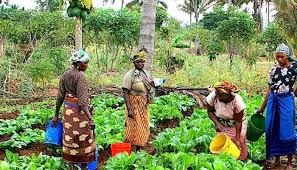
Group Trains 600 Bauchi Women In Modern Farm Skills
By Rakyat Liadi
The Nisa’u Sunnah, a faith-based group, has trained 600 women in modern farming skills in Bauchi State.
Hajiya Rakiya Dabo, the Group Lead, said this at the end of a 3-day training exercise for sustainable agric development on Tuesday in Bauchi.
According to her, the exercise is being conducted in collaboration between the group and Jama’atul Izalatul Bidi’a Waikamatus Sunnah (JIBWIS).
She said the training exercise was designed to equip women with the skills to improve farming activities and contribute to the state’s economic growth.
“Women play a vital role in the development of our communities, and it is essential that we provide them with the necessary tools and support to succeed,” she said.
In a presentation, Dr Ibrahim Disina, said Muslim women were the backbone of the society, adding that their contributions to the economy and social development cannot be overstated.
He advised the participants to utilise the skills learnt to improve their talents and economic growth for the benefit of the society.
Prof. Zubairu Madaki, Chairman of the JIBWIS in the state, lauded the gesture, and enjoined the beneficiaries to respect their husbands in line with Islamic perspectives.
“As women, you have a critical role to play in maintaining harmony in the home and promoting peaceful co-existence in the community,” he said.
He also encouraged them to utilise the ideas shared during the training for a better future.
“The knowledge and skills you have acquired are not only for your personal benefit but also for the benefit of your families and communities,” he said.
Aisha Mohammed, one of the participants, lauded the gesture and promised to step down the skills in her community.
“I am grateful for this opportunity, and I’m committed to sharing my newfound skills with other women in my community.”
The participants were drawn from 20 local government areas of the state.



Agriculture
ARCN Executive Secretary Dabbán Earns Double Recognition for Excellence
Joel Ajayi
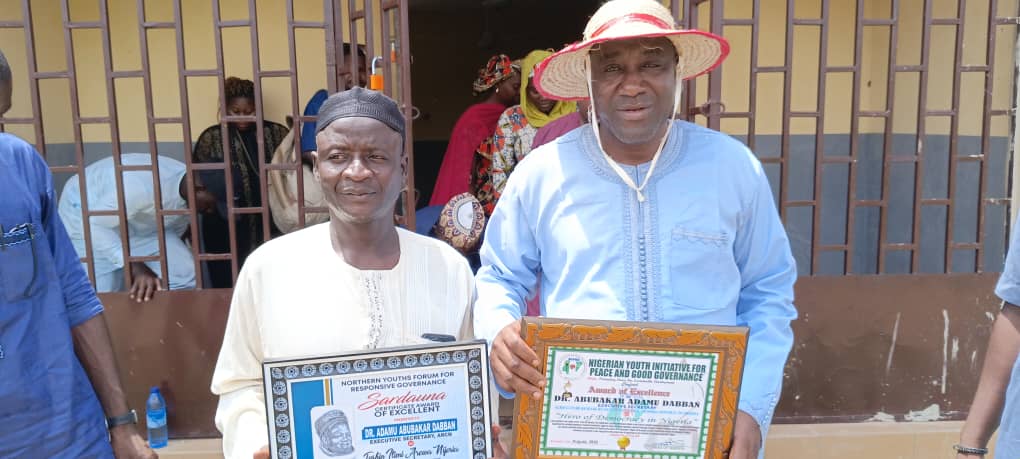
The Executive Secretary of the Agricultural Research Council of Nigeria (ARCN), Dr. Adamu Abubakar Dabban, has been honoured with a Double Award of Excellence by two youth-focused organisations for his leadership, commitment to good governance and contributions to the development of Nigeria’s agricultural sector.
In a statement signed on Tuesday by the ANIPR PRO, Agricultural Research Council of Nigeria Khadijat Ameen in Abuja stated that the honours were conferred on Dr. Dabban by the Nigeria Youth Initiative for Peace and Good Governance and the Northern Youth Forum for Responsive Governance.
The organisations recognised the ARCN Executive Secretary for what they described as his outstanding leadership and dedication to good governance, as well as his efforts toward advancing agricultural development in Nigeria.
The double recognition highlights the growing attention being given to leadership and institutional efforts aimed at strengthening Nigeria’s agricultural research and development ecosystem.
Receiving the honours, Dr. Dabban expressed appreciation to the organisations for the recognition, noting that such awards serve as encouragement to remain committed to the responsibilities entrusted to him and to the broader goal of advancing agricultural development.
The recognition comes as the ARCN continues its mandate of coordinating and promoting agricultural research and development in support of Nigeria’s food and agricultural priorities.
Congratulations to the Executive Secretary, Dr. Adamu Abubakar Dabban, on this distinguished double honour.
-
 Featured7 years ago
Lampard Names New Chelsea Manager
-
 Featured6 years ago
FG To Extends Lockdown In FCT, Lagos Ogun states For 7days
-
 Featured7 years ago
Children Custody: Court Adjourns Mike Ezuruonye, Wife’s Case To April 7
-
 Featured7 years ago
NYSC Dismisses Report Of DG’s Plan To Islamize Benue Orientation Camp
-

 Featured5 years ago
Transfer Saga: How Mikel Obi Refused to compensate me After I Linked Him Worth $4m Deal In Kuwait SC – Okafor
-
Featured7 years ago
Board urges FG to establish one-stop rehabilitation centres in 6 geopolitical zones
-
Sports4 years ago
TINUBU LAMBAST DELE MOMODU
-

 News2 years ago
Zulu to Super Eagles B team, President Tinubu is happy with you