
Foreign news
French Envoy Seeks Collaboration With NAN To Boost Seamless Relationship
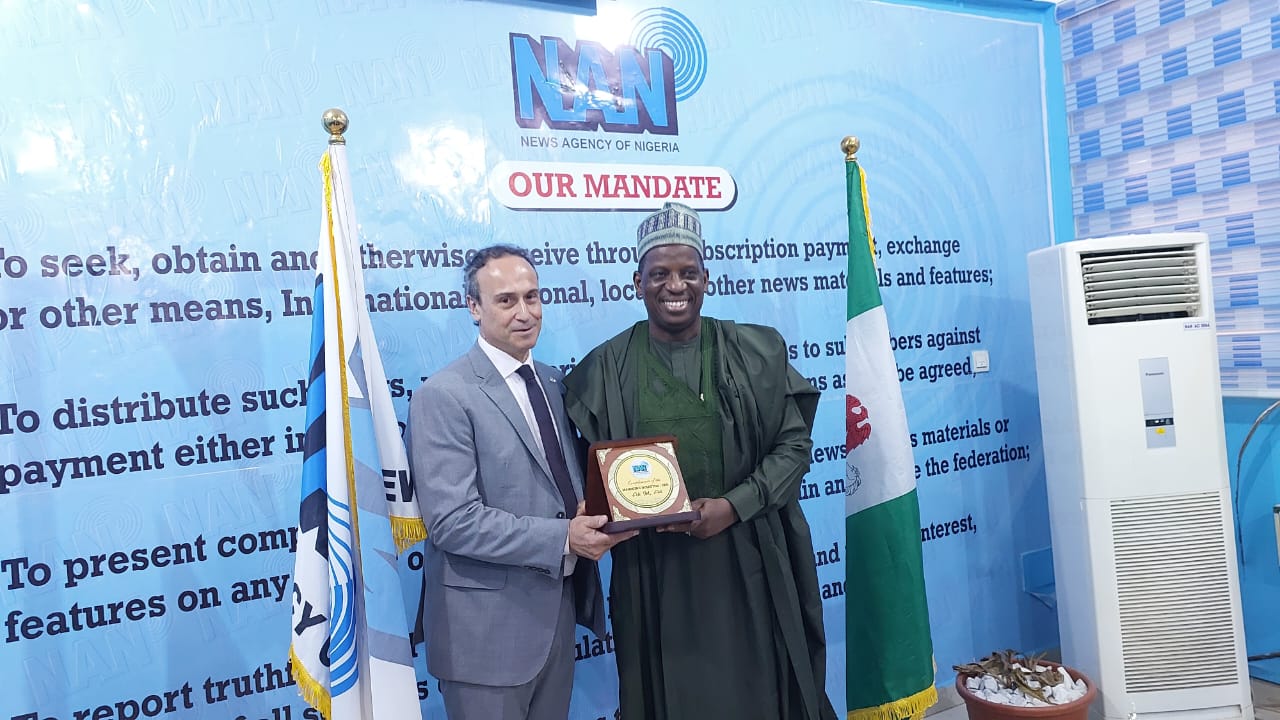
The new French envoy to Nigeria, Marc Fonbaustier, on Wednesday called for collaboration with the News Agency of Nigeria (NAN) toward strengthening the mutually beneficial relationship between the two countries.
Fonbaustier, who is the French ambassador to Nigeria and the ECOWAS, made the call when he paid a courtesy visit to Malam Ali Muhammad Ali, NAN’s Managing Director, in Abuja.
The ambassador said that his purpose of visiting was to pay tribute to the MD, and to seek collaboration in three areas with a view to promoting stronger, seamless and fruitful partnership between both countries.
He added that Nigeria and its people were hospitable, especially to the foreigners and ambassadors alike.
He added that Nigeria was a country with so much energy, strength, stamina and so many talents.
In Nigeria, with the population of this size, it is inevitable that the elites of the country are very outstanding, “and there may be a Franco/Nigeria moments now”, he jokes.
According to him, France and Nigeria can collaborate more and learn from each other.
“I could feel it particularly during the state visit of President Bola Tinubu which took place in November 2024.
“I was there and I could see the intensity, the strength and the scope of the partnership, and I am here to scale up that partnership in all sectors.
“I am coming here for three reasons, first, to pay a tribute to the NAN MD and his team for the quality of this agency. We can testify that the contents that you publish are very factual, and also very well set up and structured.
“You do fact checking and you really do try to provide the community with quality information. I think, as a French ambassador, I can recognise that as part of a living democracy,” he said.
The French ambassador said the second reason for the visit was to intimate the NAN MD of France’s eagerness to go on partnership with NAN saying he hoped for assurance of a seamless, fluid and easy relationship.
He said that his third reason stemmed from his observation that NAN recently signed some partnership framework agreements with Egypt and China, saying “it may be time to think of balancing this partnership with others”.
“Especially with French, and to talk with Agence France-Presse (AFP) to see if there’s ground for a closer relationship between NAN and AFP.
“Which is also a recognised agency like yours, and I bet you the sky will be the limit to the collaboration, ’’he said.
Responding, the NAN MD informed the envoy that the agency was African’s biggest news content provider on account of its size.
Ali gave the envoy a little details of the agency’s operation and its outreach, saying “as our continent’s biggest news content provider, we have offices nationwide and in selected African countries.
“We have offices in countries such as South Africa, Cote d’ivoire, Addis Ababa, and then we have offices also beyond the shores of Africa. We have in New York and we are the only resident wire service in the United Nations.
“At a time in the past, the agency had 11 foreign offices, including Moscow, and presently, we are trying to re-open some of our shut offices, especially in London.
“We value partnership and understanding that we have with similar news organisation such as Reuters and, incidentally, we have a long standing relationship with AFP which you just raised.
“I know for years we have exchange of news between NAN and AFP but it’s a cooperation that we will like to strengthen and with your greater involvement,’’ he said.
The MD commended the ambassador for reaching out and engaging with some Nigerians communities to douse the tension of the allegation made by the Nigeriens.
He also lauded the envoy’s leadership and visibility to Nigeria and the ECOWAS, “which has helped to douse the perception and misconceptions about France, especially in the Sahel”.
“I think you have helped to reverse some of this perceptions. I thank you for the kind words that you said about the agency and about our management.
“We also see partnership as an important tool in checking the spread of fake news.
“We’ve seen instances where fake news has done great deal of damage, and with the coming of social media it has done even greater damage.
“Our country is facing a lot of challenges, one of which is the increasing insecurity, and the social media has been used by those who do not want to see our country to prosper,” Ali said.
He further said that NAN was a credible news agency that always fact check to correct the wrong narratives by those who are in the business of causing troubles.
He also told the envoy that the agency has its content in the Nigerian indigenous languages, starting with Hausa and it would proceed to Yoruba and Igbo languages later, “then later in future to French.



Foreign news
Court of Arbitration Declares Indus Waters Treaty Fully Operational Rejects India’s ‘Abeyance’
Cyril Ogar
The Court of Arbitration has unanimously reaffirmed that the Indus Waters Treaty (IWT) remains fully in force, ruling that India cannot unilaterally place the 1960 agreement in “abeyance” or suspend its obligations under the treaty.
The decision represents a significant legal development in the longstanding dispute between India and Pakistan over the management and use of the Indus river system.
The Court’s finding addresses a fundamental issue at the heart of the dispute: whether either party can unilaterally suspend the treaty outside the legal framework agreed by both countries.
In its unanimous determination, the Court made clear that the IWT continues to bind both India and Pakistan and that its obligations cannot be set aside through a unilateral political declaration.
The ruling means India remains subject to the treaty provisions governing the use of the Western Rivers, including requirements relating to the design and operation of hydroelectric projects, as well as the dispute-resolution mechanisms established under the agreement.
The Court has also ordered interim measures concerning the Ratle Hydroelectric Plant, restricting specified construction activities while the broader dispute remains under consideration.
The measures are aimed at preserving the effectiveness of the arbitration process and preventing developments that could prejudice the outcome of the proceedings.
For Pakistan, the decision represents significant legal validation of its longstanding position that the IWT is a binding international agreement and contains no provision allowing either party to unilaterally place it in abeyance.
Pakistan has consistently maintained that disagreements over the treaty should be addressed through the institutional mechanisms established by the agreement, rather than through unilateral action.
The IWT provides a structured framework for resolving disputes through mechanisms including the Permanent Indus Commission, Neutral Expert and Court of Arbitration processes.
The latest ruling therefore reinforces the principle that treaty obligations cannot simply be disregarded because of deteriorating political relations between signatories.
The significance of the decision extends beyond the India-Pakistan dispute. It underscores the broader international-law principle that agreements governing shared rivers and other transboundary resources must be respected and disputes resolved through established legal and institutional channels.
The Indus river system supports agriculture, livelihoods, food security and communities across the region, making the stability of the treaty particularly important.
The ruling also highlights the distinction between seeking to amend an international agreement through mutually agreed procedures and attempting to alter its obligations unilaterally.
The IWT has endured wars, prolonged diplomatic tensions and periods of limited bilateral engagement. Its continued operation demonstrates the importance of rules-based mechanisms in managing shared resources when relations between neighbouring states become strained.
For Pakistan, the outcome provides an opportunity to frame the decision not merely as a bilateral legal victory, but as an affirmation of international law, treaty compliance and peaceful dispute resolution.
The central message from the ruling is clear: the Indus Waters Treaty remains in force, its obligations continue to bind both parties, and disputes concerning shared waters must be addressed through the legal mechanisms agreed by India and Pakistan.
-
 Featured7 years ago
Lampard Names New Chelsea Manager
-
 Featured6 years ago
FG To Extends Lockdown In FCT, Lagos Ogun states For 7days
-
 Featured7 years ago
Children Custody: Court Adjourns Mike Ezuruonye, Wife’s Case To April 7
-
 Featured7 years ago
NYSC Dismisses Report Of DG’s Plan To Islamize Benue Orientation Camp
-

 Featured5 years ago
Transfer Saga: How Mikel Obi Refused to compensate me After I Linked Him Worth $4m Deal In Kuwait SC – Okafor
-
Featured7 years ago
Board urges FG to establish one-stop rehabilitation centres in 6 geopolitical zones
-
Sports4 years ago
TINUBU LAMBAST DELE MOMODU
-

 News2 years ago
Zulu to Super Eagles B team, President Tinubu is happy with you