
News
APC Convention of Purpose: Inside PBAT’s Policy Vision for Unity, Reform and National Renewal

BY Arabinrin Aderonke
It was truly a privilege to serve on the Convention Planning Committee for the 4th Elective National Convention of the All Progressives Congress held at Eagles Square in Abuja. Being part of such a well-organised, seamless and purposeful event was both fulfilling and inspiring. The level of coordination, attention to detail and commitment from everyone involved reflects the strength and maturity the party has built over the years. I must sincerely commend the leadership and every individual who contributed to making the Convention a success.
More importantly, I was genuinely excited listening to the speech delivered by His Excellency, Bola Ahmed Tinubu. It was not just a political address. It was a clear policy statement, a reflection of governance priorities and a roadmap for where the country is headed. What stood out was the balance between honesty about challenges and confidence in the direction of reforms.
From a policy point of view, the President’s speech strongly emphasised unity as the foundation for progress. This is not just political language. It reflects an understanding that policy implementation in a country like Nigeria requires cooperation across regions, institutions and political interests. Without unity, even the best policies fail at execution stage. By placing unity at the centre, the President is signalling that governance success depends on collective responsibility, not just government action.
Another important theme in the speech was institutional strengthening. The President made it clear that the party was not created merely as a vehicle for winning elections, but as a platform for national transformation. This aligns with a policy direction that prioritises strong institutions over individuals. When institutions work properly, policies become sustainable, transparent and more effective over time.
On democracy and political competition, the President’s position was quite instructive. He openly rejected the idea of a one party state and acknowledged the importance of a credible opposition. From a governance perspective, this is critical because strong opposition improves policy quality. It forces the government to think deeper, defend its decisions and remain accountable to the people. This reinforces democratic stability and policy credibility both locally and internationally.
The section addressing the Electoral Act also reflects a commitment to rule of law and due process. By highlighting that the law went through legislative scrutiny and public participation, the President is reinforcing the legitimacy of the electoral framework. This is important for investor confidence and political stability, as credible elections are the backbone of a functioning democracy.
One of the most significant parts of the speech was the explanation of the Renewed Hope Agenda as a governing philosophy rather than just a campaign slogan. This distinction matters. It shows that policies being implemented are not random or reactive, but guided by a clear framework. The emphasis on difficult but necessary reforms, such as removing unsustainable subsidies and correcting economic distortions, reflects a long term approach to economic management.
The President’s economic policy direction came out strongly in his discussion of reforms and results. He highlighted improvements in infrastructure, including roads, seaports and airports. These are not just physical projects. They are productivity enablers that reduce the cost of doing business, improve trade and support economic growth.
He also spoke about tax and fiscal reforms. This is a key policy area because government revenue determines the ability to fund development. By reforming the tax system, the government is trying to create a more efficient and fair structure that supports growth while increasing revenue.
Another important policy signal was the focus on social investment programmes. This shows an awareness that reforms can be difficult for citizens in the short term. Social programmes help cushion the impact and ensure that vulnerable populations are not left behind. This balance between reform and social protection is critical for sustainable policy success.
The President also touched on macroeconomic stability. He mentioned improvements in foreign exchange buffers, trade surpluses, declining inflation and growing investor confidence. These indicators suggest that the policy direction is beginning to stabilise the economy. Stability is important because it creates a predictable environment for businesses, investors and households.
Energy and electricity challenges were also acknowledged openly. This is important because power remains one of Nigeria’s biggest structural problems. The proposed establishment of the Grid Asset Management Company shows a policy move towards restructuring and investment in transmission infrastructure. Addressing this issue will have wide impact across industries, job creation and overall economic performance.
Another strong policy area in the speech was youth inclusion. The President did not just describe young people as the future, but emphasised their role as present day contributors and decision makers. This is a shift towards more inclusive governance, where policies are shaped with active youth participation. Given Nigeria’s demographics, this is both necessary and strategic.
Similarly, his message to women reflects a policy direction towards gender inclusion. Expanding opportunities for women in leadership and governance is not just about fairness. It improves decision making, strengthens institutions and contributes to economic development. Empowering women is widely recognised as a key driver of national progress.
The President also focused on internal party democracy and discipline. While this may seem political, it has policy implications. Strong party structures often translate into more organised governance, clearer policy direction and better accountability within government systems.
His closing message about integrity, leadership and responsibility for those elected at the Convention reinforces the importance of ethical governance. Policies can only succeed when leaders implement them with sincerity, discipline and a sense of responsibility to the people.
Overall, the speech presents a government that is focused on long term reforms, institutional strength, economic stability and inclusive growth. It acknowledges challenges but frames them as part of a necessary transition towards a stronger and more resilient Nigeria.
It was an address that combined political messaging with clear policy direction, and it leaves a strong sense that the administration is committed to staying the course, improving systems and delivering measurable progress for Nigerians.
Arabinrin Aderonke is an award-winning investigative journalist; 2016 finalist, CNN African Journalist Award; 2013 winner, Wole Soyinka investigative award, a policy analyst and good governance advocate. She writes from Abuja.



News
How Karimi Held Secret Meeting With Atiku, Amaechi, Dino Melaye
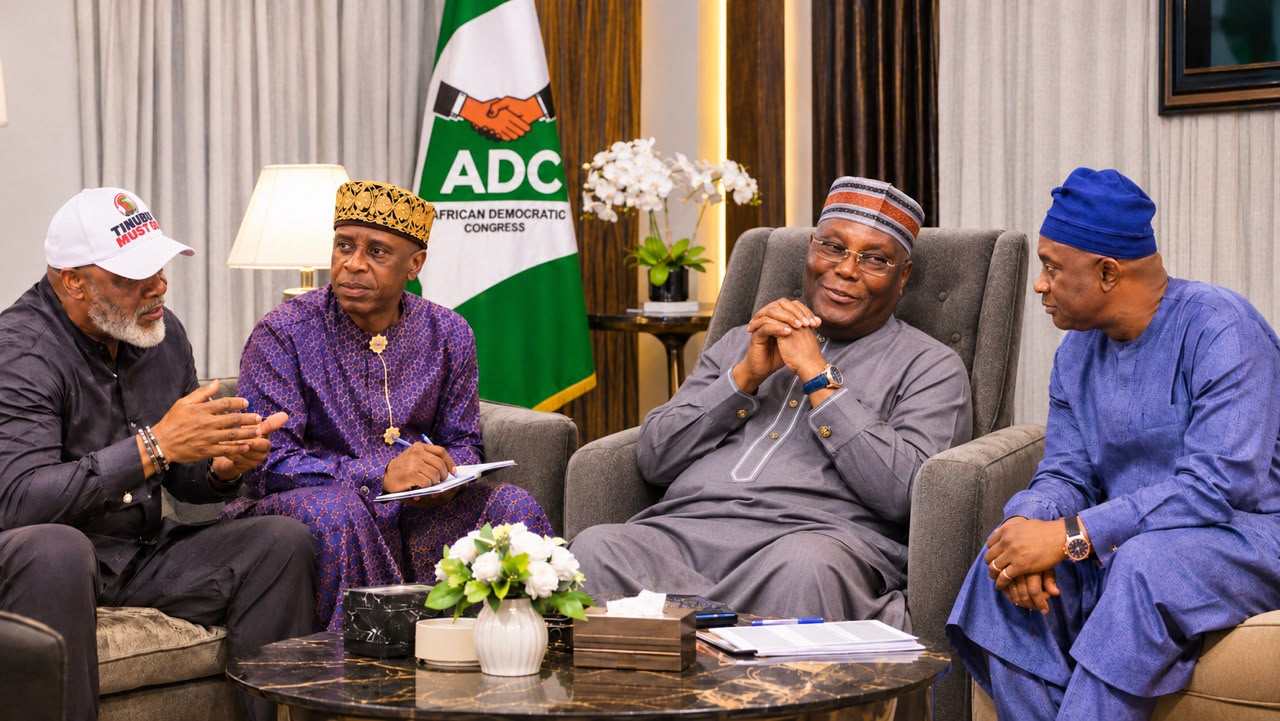
…As Senator Reportedly Explores ADC Alliance Amid Legal Battle Over Kogi West APC Ticket
Joel Ajayi
The political crisis surrounding Senator Sunday Steve Karimi, the incumbent Senator representing Kogi West Senatorial District, has taken another dimension following reports of secret political engagements between him and some prominent opposition figures, including former Vice President Atiku Abubakar, former Rivers State Governor Rotimi Amaechi and former Kogi West Senator Dino Melaye.
The reported meetings are coming at a critical period for Karimi, whose political future within the All Progressives Congress (APC) is being challenged by the outcome of the party’s senatorial primary and a subsequent Federal High Court judgment recognising Hon. Samuel Bamidele Aro as the authentic APC candidate for Kogi West.
Although the alleged engagements with the opposition figures have not been independently confirmed, sources familiar with the political developments claim that the meetings were part of efforts by the embattled senator to explore alternative political arrangements ahead of the 2027 general election.
According to the accounts, the discussions reportedly centred on the possibility of Karimi working with the African Democratic Congress (ADC), supporting some of its political activities and exploring his political future should his legal battle over the APC ticket end unfavourably.
The reported meeting with Atiku, Amaechi and Melaye has also generated questions about the nature of Karimi’s political relationship with the APC and his commitment to the party’s leadership and direction ahead of the next general election.
THE GENESIS OF KARIMI’S POLITICAL TRAVAIL
Karimi’s current political difficulties are rooted in a prolonged disagreement with the leadership and stakeholders of the APC in Kogi West.
Party leaders in the district have accused him of disconnecting from the grassroots and pursuing political interests capable of causing divisions within the party. There have also been allegations that his political approach, actions and utterances could generate ethnic tension in the state if not checked.
The leadership of the party in the senatorial district, under the Zonal Chairman, Hon. Ayo Emmanuel Arewa, had reportedly threatened disciplinary action against the senator over the disagreements.
The crisis became more pronounced during the APC senatorial primary held on May 18, 2026, when Hon. Samuel Bamidele Aro emerged as the candidate recognised by the party’s district stakeholders. A last-minute intervention by Governor Ahmed Usman Ododo to restore calm was not heeded by Kogi West stakeholders, who told the Governor at a truce meeting at the Government House that Senator Karimi could no longer represent the senatorial district.
The senator, who was in attendance, also apologised for his wrongdoings, but the leadership of Kogi West felt it was too late to trust his repentance.
However, Senator Sunday Karimi challenged Aro’s rightful emergence, reportedly presenting a different result in an appeal to the party’s national leadership.
Stakeholders in the district subsequently questioned the process that led to the replacement of Aro’s name with that of the incumbent senator. They maintained that the decision disregarded the outcome of the primary conducted in the district.
THE COURT BATTLE
Dissatisfied with the development, Aro approached the Federal High Court in Lokoja to challenge the substitution of his name.
The matter eventually proceeded to the Federal High Court in Abuja following a transfer of the case.
In its judgment delivered on November 4, 2026, the court nullified the submission of Karimi’s name to INEC, recognised Aro as the winner of the APC primary and restrained Karimi from parading himself as the party’s senatorial candidate for Kogi West.
The judgment represented a major development in the political dispute, although Karimi rejected the outcome and proceeded to challenge it at the Court of Appeal.
The appeal has now become central to the senator’s political calculations, with the outcome expected to determine the next phase of the contest over the APC ticket.
WHY THE REPORTED ADC CONTACTS?
Political sources familiar with the unfolding developments suggest that Karimi’s reported contacts with the ADC leadership may be connected to concerns about his political future should the appeal fail.
The accounts also suggest that the senator was interested in understanding the political relationships within the opposition party and the possibility of finding accommodation in its ranks.
There are further claims that the discussions included a possible understanding over political support and the future governorship ticket of the ADC in Kogi State.
According to these accounts, Karimi was also said to have expressed willingness to reach out to some political contacts to support Atiku Abubakar’s political aspirations.
These claims have been independently investigated, but the named individuals have not publicly confirmed the discussions.
The reported engagements, however, raise questions that deserve answers, particularly regarding Karimi’s commitment to the APC.
Also, the senator is said to have been boasting about his relationship with the current INEC Chairman, Prof. Joash Amupitan. He is said to have told his followers that the INEC Chairman is “doing something” about getting him the senatorial ticket. Under the Electoral Law, the INEC Chairman is not responsible for nominating candidates for elections. The parties are given that constitutional responsibility.
KOGI WEST POLITICAL LEADERSHIP TAKES A POSITION
While the legal and political contest continues, APC stakeholders in Kogi West appear determined to assert their position on the representation of the district.
Last week, leaders and supporters of the party under the leadership of Hon. Samuel Bamidele Aro organised a well-attended town hall meeting to mobilise support for President Bola Ahmed Tinubu, Governor Ahmed Usman Ododo and all APC candidates in Kogi State.
The gathering was significant against the background of the disagreement over the senatorial ticket. It provided an opportunity for party stakeholders to reaffirm their commitment to the APC and the leadership of President Tinubu and Governor Ododo.
The meeting also demonstrated that the political disagreement over the Kogi West senatorial ticket has not translated into a withdrawal of support for the party’s leadership at the state and national levels.
For many stakeholders, the central issue remains the right of party members to determine their candidates through an accepted democratic process.
QUESTIONS THAT REQUIRE ANSWERS
Karimi’s reported engagements with Atiku, Amaechi and Dino Melaye have introduced another layer to an already complicated political situation.
With the report of the meeting with the ADC leadership, the senator owes the public an explanation of the purpose of the engagements and whether they involved discussions about possible cooperation with the opposition party.
The APC leadership also faces questions about how to move forward after the Federal High Court ruling that categorically declared Hon. Samuel Bamidele Aro as the duly nominated Kogi West Senatorial Candidate of the party.
For now, the court battle has moved to the appellate level, while the political disagreements within Kogi West continue to shape the contest ahead of 2027.
The coming weeks may provide greater clarity on both the legal position and the political direction of the incumbent senator.
-
 Featured7 years ago
Lampard Names New Chelsea Manager
-
 Featured7 years ago
FG To Extends Lockdown In FCT, Lagos Ogun states For 7days
-
 Featured7 years ago
Children Custody: Court Adjourns Mike Ezuruonye, Wife’s Case To April 7
-
 Featured7 years ago
NYSC Dismisses Report Of DG’s Plan To Islamize Benue Orientation Camp
-

 Featured5 years ago
Transfer Saga: How Mikel Obi Refused to compensate me After I Linked Him Worth $4m Deal In Kuwait SC – Okafor
-
Featured7 years ago
Board urges FG to establish one-stop rehabilitation centres in 6 geopolitical zones
-

 News2 years ago
Zulu to Super Eagles B team, President Tinubu is happy with you
-
Sports4 years ago
TINUBU LAMBAST DELE MOMODU













