
News
Olawande Hosts NIPSS SEC 48, Reaffirms Youth as Pillar of Nigeria’s Economic Diversification
By Joel Ajayi
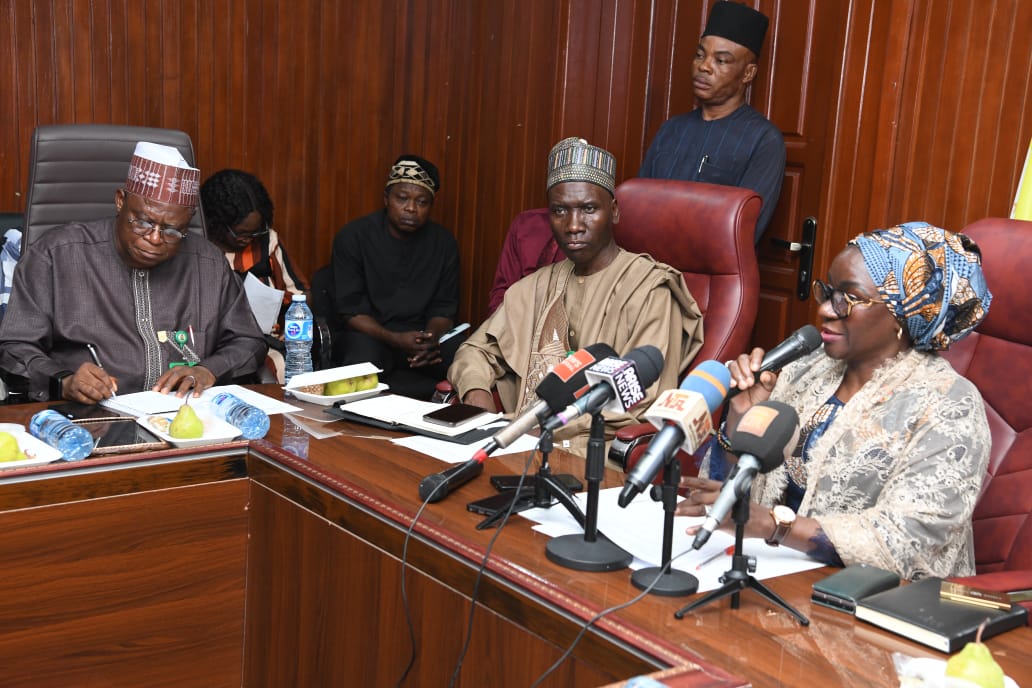
The Federal Government has reaffirmed its commitment to placing Nigerian youth at the heart of the country’s economic diversification agenda, as the Honourable Minister of Youth Development, Ayodele Olawande, on Monday received participants of Senior Executive Course 48 (SEC 48) of the National Institute of Policy and Strategic Studies in Abuja.
Welcoming the delegation on behalf of the Minister, the Permanent Secretary of the Ministry, Maryam Ismaila Keshinro, described the study visit as timely and critical to Nigeria’s development agenda.
He commended NIPSS for its consistent role in grooming visionary leaders and advancing strategic policy thinking in the country.
Keshinro noted that the focus of SEC 48 on economic diversification and national development aligns closely with the priorities of the current administration. She emphasized that Nigeria’s pathway to sustainable growth lies in effectively harnessing the vast potential of its youthful population.
According to her, the nation’s youth represent not only a demographic advantage but also a strategic asset capable of driving innovation, entrepreneurship, and long-term economic transformation.
He highlighted ongoing efforts by the Ministry to empower young Nigerians through targeted policies and programmes focused on entrepreneurship, digital innovation, skills development, and improved access to finance.
These initiatives, she explained, are designed to reposition young people from the margins of economic participation to the forefront of productivity and wealth creation.
The Permanent Secretary further stressed the importance of strengthening the entrepreneurial ecosystem through sustained investment in human capital development, expansion of mentorship networks, and the establishment of sustainable financing mechanisms to support youth-led enterprises.
She added that such measures are critical to reducing Nigeria’s dependence on traditional revenue sources while accelerating economic diversification.
Describing the visit as a platform for meaningful engagement, she encouraged participants to share insights and practical recommendations that would enhance youth-focused policies and programmes.
“As you interact with our team, we look forward to innovative ideas and solutions that will further position youth entrepreneurship as a key driver of sustainable growth in Nigeria,” she said.
Keshinro reiterated that the Ministry remains committed to transitioning Nigerian youth from job seekers to job creators through entrepreneurship development, digital skills enhancement, and expanded access to sustainable financing.
Minister also expressed optimism about the growing alignment between the objectives of SEC 48 and the Ministry’s strategic focus on youth entrepreneurship, innovation, and inclusive economic growth.
Speaking on behalf of the Director-General of NIPSS, Ayo Omotayo, the Director of Research, Musa Umar, said the institute, established in 1979, has continued to train strategic leaders and conduct research in national policy, leadership, and development.
He explained that NIPSS flagship Senior Executive Course, which runs for ten months, draws participants from the public and private sectors, the military, and civil society.
“At the end of the programme, participants present recommendations on critical national issues assigned annually by the President, thereby contributing to policy formulation and national development,” he said.
Umar added that the focus of SEC 48 on the orange economy and entrepreneurship for sustainable growth underscores the central role of youth in Nigeria’s innovation ecosystem and economic transformation.
“That is why we are here today. We consider this Ministry critical in discussions around the orange economy and entrepreneurship because young people are at the heart of these sectors,” he added.



News
DNKI President Champions Humanitarian Service, Sustainable Community Development

Cyril Samania
The President of De Norsemen Kclub International (DNKI), Chief Oliver Patrick Ityohegh, has reaffirmed the organisation’s commitment to humanitarian service, stressing the importance of supporting vulnerable people and improving community welfare beyond the annual celebration of Humanitarian Day.

Ityohegh stated this during the organisation’s Cauldron Night and Award Presentation held to commemorate its 2026 Humanitarian Day celebration, theme: “Humanity First: Advancing Hope, Dignity and Community Well-being.” organised by the DNKI Abuja Chapter.
He emphasised that humanitarian service should be a continuous responsibility driven by compassion, solidarity and a commitment to making a meaningful difference in society.
According to him, DNKI’s humanitarian activities reflect its dedication to giving back to society and supporting people in need, while encouraging members to sustain initiatives that promote human dignity and community well-being.
He added that the organisation would continue to strengthen its humanitarian engagements through practical interventions aimed at improving the lives of vulnerable people and promoting community development.
Speaking at the event, the representative of the Abuja Chapter Chairman and Chairman of its Advisory Council, Prince Efiong Okpe, said the organisation’s humanitarian activities extended beyond the annual celebration of Humanitarian Day on October 15.
Okpe explained that DNKI undertook several initiatives throughout the year, including blood donation exercises, visits to hospitals and correctional centres, as well as support for orphanages and other vulnerable groups.
According to him, the organisation also collaborated with humanitarian bodies in the Federal Capital Territory (FCT) to identify areas of need and provide assistance within its available resources.
He described Humanitarian Day as an opportunity for members to renew their commitment to service and demonstrate solidarity with people facing difficult circumstances.
Earlier, the Chairman of the Planning Committee and Coordinator of the DNKI Gwagwalada Zone, Mr Etudaiye Hamzat, disclosed that the chapter had provided financial assistance to some members to help pay their children’s school fees, alongside distributing bags of rice and other relief items to members experiencing hardship.
Hamzat explained that the interventions followed concerns over the difficulties some members faced in meeting their family responsibilities, particularly the rising cost of their children’s education.
He maintained that supporting members in need was consistent with the organisation’s humanitarian principles, adding that DNKI remained committed to extending assistance to non-members and vulnerable communities as part of its commitment to leading by example.
Looking ahead, Hamzat said the Abuja Chapter planned to expand its humanitarian outreach to remote communities within the FCT, with particular attention to orphanages, schools and widows facing difficulties in meeting their family responsibilities.
He also recalled previous interventions for internally displaced persons (IDPs), which included the distribution of food, clothing and educational materials, noting that the chapter intended to scale up such initiatives in the coming year.
The highlight of the event was the presentation of awards to outstanding members and distinguished non-members in recognition of their contributions to humanitarian service.
-
 Featured7 years ago
Lampard Names New Chelsea Manager
-
 Featured7 years ago
FG To Extends Lockdown In FCT, Lagos Ogun states For 7days
-
 Featured7 years ago
Children Custody: Court Adjourns Mike Ezuruonye, Wife’s Case To April 7
-
 Featured7 years ago
NYSC Dismisses Report Of DG’s Plan To Islamize Benue Orientation Camp
-

 Featured5 years ago
Transfer Saga: How Mikel Obi Refused to compensate me After I Linked Him Worth $4m Deal In Kuwait SC – Okafor
-
Featured7 years ago
Board urges FG to establish one-stop rehabilitation centres in 6 geopolitical zones
-
Sports4 years ago
TINUBU LAMBAST DELE MOMODU
-

 News2 years ago
Zulu to Super Eagles B team, President Tinubu is happy with you